Skip to content

Water heaters and MPOW

Our tankless water heater quietly gave up the ghost sometime between my shower yesterday afternoon and 7 a.m. today. While waiting for the plumber to call back (which happened only five minutes later, a very good sign; even better, he didn’t express surprise that our water heater was tankless, and simply asked “What model?”), I realized that I hadn’t updated folks on my job.

That’s because, like our water heater up to yesterday, my job has been functioning just fine (even though it has far more moving parts). I work for, and among, very nice people, and I don’t mean “there are a few decent people among the usual assortment of sharks, jackals, and dodos,” I mean that by and large My Place Of Work is populated by exceptionally smart, nice people who know their jobs and do them well.

People ask, what do I do? I do “research and development,” which conjures up chemists in white smocks bent over petri dishes, but in my case means I take Important Topics of the Day relevant to library automation and try to write reports that help MPOW become smarter about them. I start by doing traditional research — databases, web searches, Gartner reports, and the like — and then scrunch everything together, look it over, and figure out who I need to speak with to fill in the gaps and answer questions. (I’m really all R and little D. We have an r&d’er who’s quite the savvy developer and at least a foot taller than me, and just fyi, he’ll be at Code4Lib.)

Anyway, schmoozing is where my job gets really fun, because I like to schmooze. No, that’s an understatement: I adore schmoozing. Schmoozing is key to the “r” part of r&d. After I’ve run through the typically dull “how we done it good” articles (which in most cases make me begin asking how they really done it), I begin emailing/calling/messaging/Skyping/Facebooking and, when possible, tete-a-teteing. That’s when I get the real goods. There are times I get off the phone almost dizzy with revelations and “this is just for you” disclosures. The LibraryLand backchannel is alive and well (and I do my part to help my colleagues connect the dots).

The schmooze phase of r&d reminds me how many smart, passionate librarians we have in LibraryLand, and what good ideas they have, and how hard and creatively they work to solve the problems of the day. I think if there is one “inreach” I would like to make to MPOW it is to pump up the message that some of the most creative technology thinking of the day is coming from librarians themselves. I think it is easy to put the external world on a pedestal and assume that the slick commercial world is smarter than that loose collective of true library technologists. Mostly, the slicksters just have a lot more money.

Email problems fixed, it appears

I’ve been watching for about 18 hours, and I think my email is fixed. Who messed it up? I believe I did, in the middle of resolving another problem, by unwittingly pressing a button that deleted my MX settings in Dreamhost that tell Fastmail it’s my email provider. Dreamhost Support tried to suggest this was the problem, but (not too surprisingly) I didn’t receive the message. I found their support message in their reporting system when I logged in to report another small problem unrelated to email.

The interesting part about a problem like this is that the email just vanishes. It doesn’t bounce, it doesn’t arrive, it’s not sitting in a spam filter. Email becomes unmail.

All those correspondences, neither here nor there; trees falling in a forest, a trumpet player in the attic, the disappeared.

Why virtual participation in ALA must be legalized, not decriminalized

Four or five years back I attended a “meeting” at an ALA conference where by the time my friend and I showed up, five minutes after start time, the meeting had been adjourned. The members had met online and made decisions, and the face-to-face meeting was the nominal show-time to validate what they had done.

Naïve us!

I’m not going to argue that we force people to meet face-to-face to conduct business — which, incredibly, is what some old-tyme ALA Councilors suggest. The horse is out of the barn, and good for ol’ Mr. Ed, at that: as I keep saying, let’s get the busy-work out of the way between conferences so we can use our hard-won money and time to show up to network/learn/share/par-tay. Some meeting work still needs to be done face-to-face, but please — not the bulk of it.

What I am suggesting is that civil disobedience — which I promoted in an earlier post — is an interim step.

As Christopher Harris notes in his comment, functionally, it’s not as simple as saying “let’s just ‘do it’.” The biggest problem is that if we simply condone virtual participation, we don’t address the problem that crept in while ALA was pretending nobody worked this way, illustrated by the example that opens this post: we don’t have methods in place to ensure that ALA business is truly open.

We have a long, proud tradition of openness in ALA, and that’s a Good Thing. Some of that tradition is very hard-won. It was not always so: in the late ’60s there was a sort of revolution in ALA. It had been an insider’s organization with unfair rules privileging the insiders, and a lot of members worked hard to change that.

Some of those members are on Council today, and in their minds an “open” meeting takes place twice a year at a conference, where it is listed in a published paper bulletin and people gather in a room. (As I write that, it sounds almost quaint.)

Yet interestingly, the ALA Policy Manual doesn’t actually define what it means by open. From this rather dry extraction of ALA documents comes the sum total of Policy 7.4.4:

All meetings of the American Library Association and its units are open to all members and to members of the press. Registration requirements apply. Closed meetings may be held only for the discussion of matters affecting the privacy of individuals or institutions.

In my head, online committee work is potentially far more open than a meeting that requires all the hurdles of face-to-face participation. But it’s not open if you don’t know about it. Time, place, manner: these are the facts our members are entitled to.

In some ways I’m advocating a return to the Good Old Days, or at least to that twenty-year period when openness meant a meeting you knew about and could attend. That’s why it’s just not enough to break the law; we also have to remake it.

Caution: I smell the incipient lust of the ALA policy types: how they would love to spend years diddling with definitions, best practices, proposed policies, proposals to the proposals, nit-picking, quibbling, debating, postponing, referring to other committees, and every other tool used to throw roadblocks in front of change. Please let us not diddle this to death. It’s really simple! Give each committee a wiki page, tell them to advise members how to follow their discussions and to announce incipient actions, advise ALA members to subscribe to the feeds, and we’re done. Take note of the ten-day notice for final votes; it’s fair and reasonable.

We don’t even have to wait for a policy change; sunshine could precede legalization. That’s how I understand it went down for the ALA reformers of the early 1970s, whose practices set the standard for the organization.

The wisdom of each age

At 7 a.m. in a quiet hotel room — we were in Savannah over Thanksgiving weekend, and I was trying not to wake Sandy — I finished Leaving Atlanta, then rolled back and re-read the last section. I was struck again with the infusion of the child’s crystalline seeing with the (off-stage, narrative) adult’s wisdom.

Every book has its moment, but I had just been puzzling over a manuscript with a complicated point-of-view problem. Leaving Atlanta was exquisitely timely because this book is so skilfully told from the point of view of three children.

A child’s point of view is hard to do well. Too often, either the children come off sounding like little adults or they are far too much like children. The first is unconvincing and dull, and the second is not compelling; we don’t read literature for the wisdom of six-year-olds (nostrums about what we learned in kindergarten notwithstanding).

Young people have such an uncanny clarity about life; their experience isn’t tempered or filtered through the accretion of experience (which I have described in another essay as having the blinding power of a blizzard). But adulthood brings another kind of clarity — the way, when I’ve been driving through a snowstorm or torrential downpour, I realize I am so acutely aware of the situation. I cannot see, but I can know.

Then Dinty Moore of Creative Nonfiction pops up with a short, delightfully grumpy piece in Inside Higher Ed about the problem with teaching nineteen-year-olds how to “write.”

After sixteen years of pushing that old pedagogical stone up the hill, I sometimes question whether the conventional undergraduate—a nineteen- or twenty-year old American child of the middle class—really wants to see the world clearly. Or if he even has the ability.

This is what I think: it is like being Episcopalian. I have always felt that the virtue of my denomination lay in its ability to train my body to be receptive to the spirit. Sometimes years go by when I feel distant from God and faith, but in those years when I am a practicing Episcopalian (as opposed to now, when I am pretending to be a Congregationalist), I can force my body through the motions — stand, kneel, sit — knowing that when the spirit returns, the body will be there to catch it.

In the same way, it’s not a waste to teach the mechanics of writing to nineteen-year-olds (however exasperating it may be to instructors to read the same stuff year after year). First, some will be wise beyond their years. (I wasn’t, but we’ve all met the nineteen-going-on-forty-year-old.) But more crucially, when the coltish mind matures, the skills will be there, waiting and ready. Not only that, the young writer can bring to the craft a freshness and acuity we lose as in the process of aging we wander into that snowstorm of experience.

I had a similar discussion with a librarian friend yesterday; we sighed over how often we found ourselves uselessly advising younger librarians — useless, because some lessons can only be taught by age and experience. But I think we were also sighing over our former selves, which had their own wisdom. It’s an interesting business, this aging.

GLBT Lit Class, Chicago Area

Know anyone in the Chicago area looking for a lit class at a community college? I found this on the Newpages blog and just had to cross-post. The syllabus makes me want to take the class myself!

——————————————-

Dear folks–

I want to ask you to let friends know about the Gay & Lesbian Lit class I am teaching at Wilbur Wright College in Chicago. As you know, word of mouth about classes like these tend to fill their seats, so any publicity you can give the class would be really appreciated. You can forward this message to people who would be interested, post it on your MySpace page or blog, etc.

Let me know if there’s anything I can do that will help promote the course.

Cheers,
Dr. Aldo Alvarez
English Department
Wilbur Wright College

***

Dear Students:

This is just a short note to let you know that we are offering a new literature course for Spring 2008.

Literature 153: Gay & Lesbian Literature offers a survey of novels, plays and graphic novels by gay, lesbian, bisexual and transgendered authors. This course introduces students to a literature based on LGBT themes, to practical approaches to the determination of literary meaning, and to the concerns of literature in general.

This course will be taught by Dr. Aldo Alvarez, an expert in LGBT literature with a Ph. D. in English from SUNY-Binghamton and an MFA in Creative Writing from Columbia University of the City of New York. Dr. Alvarez is the author of INTERESTING MONSTERS (Graywolf Press), a collection of short stories, and the founder of *Blithe House Quarterly: queer fiction lives here*, which for ten years was the preeminent literary magazine for LGBT-themed short fiction by emerging and established authors.

Lit 153 is *fully transferable* as a humanities elective to any four year college. As you may know, humanities electives make you a more appealing candidate for a four year school so this is a great opportunity for you to diversify your student course portfolio. This course can also be taken by students currently attending other schools who want to take advantage of the reasonable tuition per credit hour available at Wilbur Wright College. The only prerequisite is eligibility or completion of English 101 or consent from the English Department chairperson.

This is the information you need to register for this course online at https://my.ccc.edu/.

56541 – Lit 153 – Section E – M/W 11 AM – 12:20 PM — A210 — Alvarez

If you require help, you may register in person on campus.

These are seven texts we will be reading in Lit 153: Gay & Lesbian Literature on Spring 2008:

— FUN HOME: a family tragicomic by Alison Bechdel (Graphic Novel) : http://en.wikipedia.org/wiki/Fun_Home

— A SINGLE MAN by Christopher Isherwood (novel) : http://www.glbtq.com/literature/isherwood_c,3.html

— ORANGES ARE NOT THE ONLY FRUIT by Jeanette Winterson (novel) : http://en.wikipedia.org/wiki/Oranges_are_not_the_only_fruit

— ANGELS IN AMERICA: A Gay fantasia on National Themes by Tony Kushner (two plays) : http://en.wikipedia.org/wiki/Angels_in_america

— CHINA MOUNTAIN ZHANG by Maureen McHugh (novel) : http://my.en.com/~mcq/cmz.html

— KISS OF THE SPIDER WOMAN by Manuel Puig (novel) : http://www.enotes.com/kiss-spider/

— BASTARD OUT OF CAROLINA by Dorothy Allison (novel) : http://www.enotes.com/bastard-out/

Lit 153: Gay and Lesbian Literature course will not be offered again for *another four years*. If this course appeals to you, NOW is the time to register for it.

Please contact me at aalvarez@ccc.edu if you have any questions.

Sincerely,
Dr. Aldo Alvarez
English Department
Wilbur Wright College

Virtual Participation: ALA Policy Manual Highlights

A collection of ALA policy applicable to issues related to virtual membership.

ALA Policy 6.3.2 Policy Functions

As noted in the ALA Constitution, Article VI, and the Bylaws, Article VII, three bodies — Council, the divisions, and the membership — have authority to determine and act for ALA in matters of policy.

ALA Policy 4.5 Requirements for Committee Service

With the exception of virtual members, members of all ALA and unit committees are expected to attend all meetings. Failure to attend two consecutive meetings or groups of meetings (defined as all meetings of a committee that take place at one Midwinter Meeting or Annual Conference) without an explanation acceptable to the committee chair constitutes grounds for removal upon request by the chair to and approval of the appropriate appointing official or governing
board.

6.16 Virtual Members

1) Definition of Virtual Members:

Virtual members of committees or task forces have the right to attend meetings, participate in debate, and make motions. Virtual members are not counted in determining the quorum nor do they have the right to vote. [An “average Joe” member can attend all open meetings, so being a “virtual member” is not a huge bump up from general rights and privileges.]

2) Appointment of Virtual Members to Standing Committees of the Association:

Virtual members of standing committees of the Association are appointed in accord with the provisions of the ALA Bylaws, Article VIII, sec. 2(a)(i). Inclusion of virtual members on a standing Committee of the Association requires the recommendation of the Committee on Organization and the approval of Council. No more than one third of the membership on a standing committee may be virtual members. [This reminds me of this tidbit from military history: prior to the 1980s, the U.S. armed forces capped female enlistments at 2%. Of course, an argument in favor of the one-third rule is that virtual members can’t establish quorums or vote — but that’s like the kid who kills his parents and then pleads for the court’s mercy because he’s an orphan.]

3) Appointment of Virtual Members to Standing Committees of Council:

Virtual members of Committees of the Council are appointed in accord with the provisions of the ALA Bylaws, Article VIII, sec.2(b). Inclusion of virtual members on a Committee of the Council requires the recommendation of the Committee on Organization and the approval of the Council. No more than one third of the membership of a Council committee may be virtual members.

4) Appointment of Virtual Members to Committees of Round Tables and Divisions:

Virtual members of division or roundtable committees are appointed in accord with each respective division’s or roundtable’s appointment procedures for committee members. No more than one third of the membership of a round table or division committee may be virtual members.

7.4.11 Purpose of Midwinter Meetings

[An important paragraph to study. I find the “assemblies of groups of individuals” an interesting clause. How could we use this?]

The ALA Midwinter Meeting is convened for the primary purpose of expediting the business of the Association through sessions of its governing and administrative delegates serving on boards,committees, and Council. Programs designed for the continuing education and development of the fields of library service shall be reserved for Annual Conference except by specific authorization of the Executive Board acting under the provisions of the ALA Constitution. Hearings seeking membership reactions and provisions for observers and petitioners at meetings of Council, committees, and boards are to be publicized; programs of orientation or leadership development to Association business are encouraged; assemblies of groups of individuals for information sharing vital to the development of Association business shall be accepted as appropriate to the purposes of the Midwinter Meeting. (See ‘‘Current Reference File’’: 1989–90CD #30.)

7.4.10 Membership Meetings

A membership meeting shall be held during the first two days of the Annual Conference, excluding days when pre-conferences are held, and at such times as may be set by the Executive Board, Council, or by membership petition, as provided for in Article II, Section 4 of the Bylaws. Agendas of membership meetings shall provide priority to discussion of membership resolutions. Memorials, tributes, and testimonials shall be introduced at the beginning of the last Membership Meeting. [These f2f membership meetings are typically grossly underattended–even though at present, as the policy stands, they have a very low bar for establishing a quorum; approximately 75 members “count.” More on these later if anyone’s interested.]

Bylaws, Article II

Sec. 2. Special Meetings.

Special meetings of the Association may be called by the Executive Board, and shall be called by the President on request of not less than five percent of the voting members of the Association as of the previous July 1, such request to be filed with the executive director at least ninety days before the proposed meeting. At least one month’s notice shall be given, and only the business specified in the call shall be transacted. [I assume this means of the entire association–like an additional conference.]

Sec. 4. Membership Meetings.

A membership meeting consists of the voting members of the Association with authority to act as set out in Article VI, Sections 4(a) and 4(c) of the Constitution. A membership meeting shall be held during the annual conference and at such other times as may be set by the Executive Board, Council or by membership petition as provided for in Article II, Section 2, of the Bylaws.

ALA Policy Manual

7.4.1 Meeting [defined]

A meeting is an official assembly, for any length of time following a designated starting time, of the members of any board, committee, task force, commission, etc., during which the members do not separate except for a recess and in which the assembly has the capacity to formalize decisions. Conference calls, Internet chat sessions (and their equivalents), and in-person meetings are recognized as meeting subject to the open meetings policy (ALA Policy 7.4.4). (Asynchronous electronic discussions by electronic mail or other asynchronous communication methods do not constitute meetings because they are not an official assembly with a designated starting time.) [It’s puzzling that ALA policy recognizes work can be conducted electronically, but finds so many means to limit it.]

7.4.2 Meetings Outside of Annual Conference and the Midwinter Meeting

Notice of meetings held outside of Annual Conference and Midwinter Meeting must be announced ten days prior to the meeting and the results of the meeting must be made public no fewer than 30 days after the meeting’s conclusion. Reports of meetings held outside of Annual Conference and Midwinter Meeting should convey a summary of the discussion of each item considered by the assembly and the decision made. [A single web page for announcements would satisfy this need.]

7.4.4 Open Meetings

All meetings of the American Library Association and its units are open to all members and to members of the press. Registration requirements apply. Closed meetings may be held only for the discussion of matters affecting the privacy of individuals or institutions. (See also ‘‘Current Reference File’’: Interpretive Statement on Open Meetings Policy.) [Note that the definition of “open” is left, well, open.]

Virtual Participation in ALA: A Civil Disobedience Approach

In terms of changing ALA, particularly in the area of virtual participation, I am personally committed to working along multiple tracks:

  • Supporting others who want to work inside the belly of the beast: that would include my strong, hearty endorsement of ALA Council candidates Aaron Dobbs and Chris Harris
  • Participating as a member of the ALA Task Force on Electronic Meeting Participation
  • Writing and speaking about the advantages to ALA to lead change in the area of virtual participation
  • Advocating civil disobedience, by encouraging ALA committees and other functional units to ignore ALA policy that prohibits units from voting between conferences, requires voting members to attend face-to-face meetings, and ignores virtual members in establishing quorums

I see these as complementary methods. It’s important that we get enough ALA reformers to understand the workings of Council. Personally, after three terms on Council I feel far too familiar with ALA’s plumbing and think I should run for Council only when we get a critical mass together to run as a slate, vote in our own Executive Board, and expeditiously change the organization.

As for the Task Force, this is the fourth time I’ve served on a unit dedicated to changing ALA in the area of electronic participation. My contribution so far has to been to draft a survey; the task force appears to be on hold for now. How ironic if we did the bulk of our work at conferences. I’m starting to worry this is a pyramid scheme: in the end, we’ll make recommendations that lead to the creation of another task force.

The writing and speaking is self-evident. It is the civil disobedience I have yet to posit as a parallel strategy.

In March, 2004, my partner and I were married at San Francisco City Hall. Several months later our marriage was invalidated, and it may be a long while before we see same-sex marriage legalized in California. But this civil disobedience changed many attitudes — not the least of which, our own. We went from seeing ourselves as outside the institution as people who could indeed marry. In that sense, civil disobedience appears to change the outer world but in truth, may be most useful for changing those who rebel.

My recommendation is that ALA units come out of the closet and into the streets. For committees, openly recruit “virtual” members and make it clear their participation counts; announce pending votes and conduct them electronically, by email, chat, Second Life, whatever works; make it a record of the minutes that quorums were established using virtual members; conduct ALA business as you do in real life. I would ask that electronic activities have plenty of strong sunshine — votes announced in public venues, archives and forums open to ALA members — to demonstrate that the most “open” meeting is the one that truly everyone can attend, whether or not they can spend thousands of dollars to fly cross-country.

This will probably ensure I never again chair a committee (particularly one superficially devoted to changing ALA on e-participation, though if I’m smart I’ll start to refuse those assignments), but if I were to be appointed chair of a unit, I would be ostentatious about conducting work online; I would insist on it. My goals would include getting most or all of the busy-work out of the way so the ALA conference could be about the things we can’t do electronically as well as we can face-to-face: network with colleagues, attend programs (and un-programs), explore vendor exhibits, see product demonstrations, attend great speaking programs, catch up with people we haven’t seen in a while, have some fine nibblies in an interesting location, and just enjoy being en masse in our librarian self-hood.

I’m hoping we get more, not less, of these opportunities, not just through massive f2f conferences but also through more online opportunities. As for our strictly-virtual colleagues, it would not surprise me if the loose ties created through their participation led them to find ways to attend face-to-face and virtual conferences.

ALA is afraid that if policy changes, and we loses the midwinter meeting as it now functions, it will lose revenue. But this syllogism is false, because it assumes that ALA policy is protecting us from change. My take on change is that it happens whether you wish it to or not, and the thin cardboard of an ALA “rule” isn’t going to protect ALA from the future. We can choose to shape change, or be driven by it. Whether ALA as an organization is around in thirty years depends on the road we take. A national association that meets two times a year, with one meeting dedicated to “conducting business” (you can’t even conduct a program at Midwinter), had best be reconsidering its route.

The weird part is ALA is convinced it can “save” its twice-year conference schema through policy enforcement, but in reality, the policy gets in the way of what we most need in our fractured society: a way to connect with one another. Eventually library directors will ask, “why do you need to attend a meeting twice a year? Why can’t you conduct work the way the rest of us do?” What will the answer be?

Of course, many ALA units un-ostentatiously conduct work online. They have to. ALA “rules” are designed to prop up the Midwinter conference because it’s a revenue source — there is no other rational reason — but it doesn’t mean those “rules” actually lead to best practices.

In fact, the weakness of ALA’s rules is most evident on Council itself, whose agenda is overwhelmed with hastily-written resolutions on whatever topics seemed urgent the month prior to ALA, while conversely, key issues happen in LibraryLand in between conferences and Council — the governing body of ALA — is unable to comment. Like having a one-year presidency (and yes, I understand the economic reasons for this), it enforces the ALA permanent bureaucracy as the real government of ALA. I don’t begrudge them all the work they do, but you should be aware how little say we the membership have in our organization, and how much that is a byproduct of our rules.

In any event, if you chair or sit on an ALA unit, I suggest you follow the slogan of a previous ALA president — “be the change you want to see in the world” — and engage in some ostentatious civil disobedience. Once the spluttering dies down, someone may someday thank you for saving ALA.

Another essay published! Plus niblets

Issue of Gastronomica with my essay in it

My essay “Chow” is in the fall issue of Gastronomica, pictured here.

Gastronomica‘s website doesn’t show it yet, but I’m bursting with pride so here you are. Yes, that is Freud holding a weenie. Sometimes a Hebrew National is just a Hebrew National.

That makes three essays this year: “David, Just as he was,” in White Crane, an elegant venue that deserves wider readership; “Range of Desire,” in Nerve; and now “Chow.” Sometime this week I am going to go to Fresh Market up on Timberlane Drive just to see if they have this issue, and if they do, I’m going to loudly announce to everyone within earshot (about 300 feet if I can manage) that my essay is in that magazine.

On other fronts:

I keep meaning to point you to Alison Head’s great essay In Appreciation of Measures that Tell Stories in Boxes and Arrows, a usability journal many of us should be reading anyway. Not only is her essay readable and fascinating and important, but in nearly five years of knowing Alison — at times talking to her every day, if not more often, during big projects — this is the first time I’ve seen what she looks like. It feels different in a good way to be able to visualize the person advising me, “No matter the size of your project, look for the emblematic measures. They will allow you to tell stories that hit clients right between the eyes and move them to action.”

Jodi Schneider (no relation) and Walt Underwood (we’re both into search, so we must share some DNA) both pointed me to Mark Pilgrim’s sine qua non of posts about the Kindle, The Future of Reading in Six Acts. Bravo!

I’m doing some market research on what we librarians call “virtual reference” — a baffling phrase that means answering questions through chat, like what I do on Land’s End when I can’t figure out why I can’t find clogs in size 5. (Because Satan told Land’s End to stop carrying shoes smaller than size 6, that’s why. That wasn’t the company answer, but I could read between the lines.) Anyhoo, if you have well-thunk observations about the future of virtual reference for consortial and statewide systems, do give a holler.

Arizona and Florida are doing something very cool with LOCKSS — more on that later.

Finally, for a couple of months I’ve been brooding over Stephen King’s essay about short stories. Everyone else wrote about it and moved on, but I’ll take a weak stab so I can get over it. King writes:

[W]riters write for whatever audience is left. In too many cases, that audience happens to consist of other writers and would-be writers who are reading the various literary magazines (and The New Yorker, of course, the holy grail of the young fiction writer) not to be entertained but to get an idea of what sells there. And this kind of reading isn’t real reading, the kind where you just can’t wait to find out what happens next (think “Youth,” by Joseph Conrad, or “Big Blonde,” by Dorothy Parker). It’s more like copping-a-feel reading. There’s something yucky about it.

You know, I write essays, not stories, but I read a lot of “lit mags” myself. King has taken something very pleasant and even necessary — finding out what gets published, learning from other writers, and reading with an eye cocked to the question, “What can I learn from this?” — and made it tawdry and sad.

I didn’t know it was a bad thing to turn green reading an Aimee Bender story and vow I would write something at least that good someday. Nor was I aware it was so awful to figure out where my work fits. Is it better to blindly send out essays without asking the question, what is the aboutness of this journal? What about pondering the aboutness of my work?

Sometimes other writers ask me about my “audience,” or suggest I could change an essay to suit a particular publication. For better or worse, I go by what I was once told by a wise writer: a good piece of nonfiction will always find a home. I have decided, if a piece can’t find a home, either I’m not looking hard enough, or it isn’t good enough. Meanwhile, I have yet to find a literary magazine that I don’t like on one level or another, whether or not it is a place for my work.

I’ll take Stephen King’s advice on stories — it’s been a long time since I looked at “Big Blonde,” and I bet I can learn something new — but with all due respect, I’m going to ignore his comments about why or how I read. If a little lust and envy are stirred in with my “entertainment,” I don’t think I’m the worse for it.

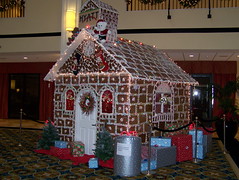
My new shed


My new shed

Originally uploaded by freerangelibrarian

I’ve found my shed! O.k…. perhaps not really… but this would make a great writer’s workshop. Makes me wonder what the Hyatt does with these between holidays. We had a great time in Savannah, including meals at Garibaldi’s and The Olde Pink House. The first time I’ve had clams with linguini for Thanksgiving, and it may not be the last.

Cleaning the Laptops


Cleaning the Laptops

Originally uploaded by freerangelibrarian

I’m always good for a meme, especially one this silly. and yet oddly easy to do. Happy Thanksgiving!