Skip to content

My good life


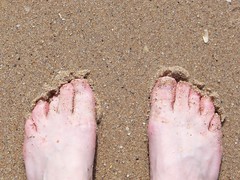
Toes in warm sand

Originally uploaded by freerangelibrarian.

More than one person has asked me what I’m doing these days. My days are pleasantly full without being crazy-making. I’m enjoying where I am right now–and appreciating that it won’t last forever.

My days include:

Following through with job leads, which includes the usual form-filling, trip-taking, interviewing-preparing activities;

Writing articles and giving presentations, which as more than one friend has pointed out could be my next job if all else fails;

Catching up on personal tasks that didn’t get done right (such as my taxes. I usually file an extension, as I did this year, but I’ve never been this far behind on my data-gathering);

Submitting essays for publication. I submitted about 25 in the last month… with a new rule, that for every rejection I have to send two more out. I just had a short-short essay rejected, so I need to send out two more before the end of this week;

Reading quite a bit. In theory I had some reading time before, but my concentration is back, and I’m able to read closely and thoroughly. The other night I woke up with a bit of midlife insomnia and read Alice Munro’s “The Bear Came Over the Mountain.” It’s gorgeous–a great example of the perfect use of flashback–and a three-hanky storie to boot. I found my brain slowing down and registering how her flashbacks work. So nice to have a brain again;

Personal writing (such as an essay about family life I started on last week’s trip to SEFLIN);

Digging rosebeds in the backyard, making sorbet, and playing with the cats; and

Properly mourning the losses in my life (California, and what we left behind), while celebrating the gains (such as walking on warm beach sand in West Palm Beach… instead of sitting in my hotel room checking work email).

This is the month where everything will fall in place. Either one of my job leads will take hold, or I will find myself self-employed and then hang out my shingle to aggressively market myself. I’ll know one way or the other fairly soon. Meanwhile, May, 2007 will always be the month when in the same day I earned my living, worked on my personal writing, and felt warm sand between my toes.

That’s o.k., lady, nobody thinks you’re interesting, either

Perhaps I’m feeling frisky because Jerry Falwell just died, or because I did my first Wikipedia edit, which was to the Wikinews article about him (I changed “reverend”–which is not a noun–to “minister”; it wasn’t the only style problem with this article, but it was the one that bugged me enough to take action).

But regardless, I have to respond to this slightly dated MSNBC article about Twitter, in which the reporter, Helen A.S. Popkin, concludes that “Twitter is stupid,” adding, “Twitter is just the latest development in the biggest generation gap since rock n’ roll invented teenagers.”

The first problem is the hugely sloppy demographic assumption. I would hazard the median age of my twit friends means many of us are in increasingly short supply of estrogen or head hair.

But the real problem is that the article is predictable and trite. A mainstream media reporter sneering at another new networked software? News at 11! A year from now, we’ll have the road-to-Damascus conversion, in which the reporter discovers, hey, there really is something to those doggone Internet tubes; then said reporter (after her gig is outsourced to India) will end up as the “content advisor” for some similar new service, cranking out press releases in which her company’s new product “moves the needle” (when it is not “opening the kimono” or creating “synergy”).

Popkin concludes that conversation on Twitter is banal. Lady, lady, lady: most conversation is banal. And ungrammatical. And mundane. And repetitive. And pointless, if you aren’t focusing on what Twitter is doing, which is providing a hangout for communing with your buddies, colleagues, and other interesting people. It’s a remarkably low-overhead hangout, as well, with no demands for special software, convoluted avatars, or special language.Of course, that may be the problem: for those of us who were around since the list of interesting places to go on the Internet took up two pages at best, Twitter is awfully easy. How can it be any good, if there’s no geek factor?

Popkin doesn’t even do the legwork to find out if what Twitter is really about–or if it has any interesting uses, failures, or successes. John Edwards’ campaign was using Twitter, at least briefly; what happened to that? I’d like to find out. I am now enjoying TwitterLit, which twice a day provides me with opening lines from novels–and I’m curious about the origins and motivations of this service. There’s enough real news about Twitter to do more than call me a teenager.

I don’t know if I’ll be on Twitter 4ever (Twitter’s 140-character text box puts a certain compression on one’s tping). I don’t know if I’ll be on it next week. But I do know that judging Twitter because it does what it is designed to do–transfer water-cooler chitchat to the Web–strikes me as the desperate cry of a reporter in need of a hot topic, stat.

Popkin’s takeoff on Twitter is funny (she imagines Jack Bauer keyboarding comments such as “thinkin i gotta torture this guy. oh well”), but the fundamental nature of Twitter comes from another well-known television event:

Angie: What do you wanna do tonight?
Marty Pilletti: I dunno, Angie. What do you wanna do?

That’s Twitter: what I ate, and what you ate, and the temperature outside (or inside), and whether you’re happy or sad, and how you feel on Mondays or the first day of your job or the last day or any other day, and on and on. The dumb, boring, wonderful stuff of life.

Oh, and I’m kgs on Twitter.

Reminder: FRL Feeds Relocated

 Free Range Librarian relocated its feeds when I migrated this blog to WordPress a couple of weeks ago. I recommend you resubscribe to the new feeds at these addresses:

https://freerangelibrarian.com/comments/feed [comments]

https://freerangelibrarian.com/feed/rss2/

You have other choices, as well:

https://freerangelibrarian.com/feed/rss/

https://freerangelibrarian.com/feed/rdf/

https://freerangelibrarian.com/feed/atom/

Atom feed readers… it’s possible you’re seeing this news for the first time. If so, welcome back, and happy catching up!

A good job for someone

My old job was posted to FPOW’s website. It’s a Word document, so I’ll just link to the page that lists it rather than cause any link weirdness for my readers.

This is a great job for the right person, the renaissance systems person who wants to work in academic libraries. The department has some stand-out excellent members; the library’s new director starts June 11; there are some great ongoing projects and room to build some of your own. Please share this job position with sharp techies who are smart, dedicated, good multi-taskers, and comfortable with working in academic environments. Tallahassee is a woodsy, attractive university town with more than enough to do and a refreshing cost of living for those of us who have lived in expensive coastal areas.

It wasn’t the right job for me, but that is immaterial. Three months ago, I wrote some friends to ask them, “So what color *is* my parachute?” They returned answers that reflected the silk bubbles of their own careers. The public librarians couldn’t imagine working anywhere else; the educators urged me to teach; the writers insisted I leave time for writing; the academic librarians insisted their jobs were ideal. I take all that to mean I know a lot of people who love what they do. If you love what you do, see yourself in this job description, and want a chance to make a significant difference, then apply for this job.

The divides within IT

Note: thanks to a worried comment from an FRL reader, I discovered several hundred FRL readers had been marooned when I migrated to WordPress a couple of weeks ago. I pointed the feed in question to the new WordPress rss2 feed. Tell me if you aren’t reading this 😉

I felt completely back in the game in yesterday’s SEFLIN talk. It was a fun, lively, engaging, challenging group, and I was doing what I usually do, which is try to plow through about 50 percent more information than can be humanly transmitted in a presentation timeframe while hopping around and waving my arms. Plus, I was wearing my favorite blue floral skirt that I had bought at an Ann Taylor outlet in Destin for an insanely low price, no less. Can life get better?

One brief aside has stayed with me. The SEFLIN board members were talking about how staff such as programmers are “up” on technology. When I’m in presentation overdrive I’m at my most unfiltered, so I quickly observed that quite often, systems people and programmers were behind–sometimes very far behind–on social software awareness and adoption. I added what I have thought for some time, which is that LITA, the “geek” division of ALA, has lagged behind divisions such as ACRL, PLA, and RUSA in moving to online learning, podcasting, and blogging. They nodded, and I went on, but that small exchange stayed with me and resonates today.

To non-tech-types, there is one flavor of techy, much as to non-librarians we’re all the same. (Wears an apple necklace: works with kids. Cat earrings: works with adults.) Yet within LibraryLand, there are as many flavors of technology as there are librarians. There are the librarians for whom work life revolves around the inner workings of the library catalog software; there are librarians who label themselves as “geeks” even though they may never script, see a shell prompt, or twiddle with code of any kind. There are deep-into-the-OS hardware people; there are hands-on hardware types, such as Jessamyn installing Ubuntu on donated computers; there are librarians who don’t know the difference between Java and Javascript, and librarians who dream in Java. There are librarians who know the inner workings of every single social software known to the free world, and librarians who have memorized the Windows registry but think instant messaging is for little kids.

Are we one group? Are we all from the same cloth? I’d like to think so. The walls of misunderstanding are strong, but not as strong as the ties that bind.

SEFLIN Board Talk


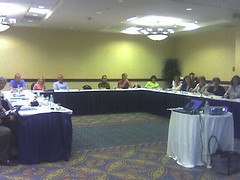
SEFLIN Board Talk

Originally uploaded by freerangelibrarian.

A happy and engaged crowd! I used this picture, taken with my Treo, to demonstrate uploading to Flickr from a cell phone, and then blogging from Flickr.

SEFLIN Presentation, Links and all that

On Thursday, May 10, in West Palm Beach, Florida, I have had a two-hour presentation with the SEFLIN board about social software. Here is the “virtual handout” of related links and bits of things useful after the talk. [updated 5-10, 5-11.]

This presentation, to start with. (It’s in PowerPoint. Updated 5-11.)

Blogs, IM and SMS, Flickr, YouTube, Second Life, Twitter, Librarything, de.licio.us , Facebook, Myspace

Some specific examples and sources (updated 5-11): lolcats, lolbrarians, the quiz by Pew Internet and American Life, David Lee King’s list of libraries on Twitter, Blogger, WordPress, Cingular IM commercial, Dance Dance Revolution, Jessamyn’s Ubuntu installation video on YouTube, IM jargon, Dr. Strangelove,  Cher, the Icarus blog, ALA’s gaming symposium, and Twitterlit.

Door prize: my list of Bloglines subscriptions (don’t take it too literally; remember what I said about cherry-picking)

If you have any follow-up questions, please do post them here or send them to me personally. Remember, yes you CAN has cheezburger!

Journalist hearts librarian; and, new feeds

Ron Miller, a freelance writer, posts about using libraries to do “old-fashioned research.”

It’s a flattering post, but several flags popped up for me: first, that a public library couldn’t meet his needs; second, the silos between academic and public libraries (as Frank Paynter notes, when you’re out of academia, you’re cut off from all the content within Higher Ed); third, that the academic librarian was initially intimidating.

Finally, my brow rumples every time I hear that libraries and librarians are still useful, which immediately raises the question of just how long that state of affairs will last (we are still selling horseshoes! you can still buy a typewriter!). The lady doth protest too much.
As a reminder, the RSS feeds for Free Range Librarian have moved. The preferred files are here:

https://freerangelibrarian.com/comments/feed [comments]
https://freerangelibrarian.com/feed/rss2/

You may see all kinds of legacy and new feeds… such as:

https://freerangelibrarian.com/feed/rss/
https://freerangelibrarian.com/feed/rdf/
https://freerangelibrarian.com/feed/atom/

I apologize that WordPress (or at least the theme I use) cranks out such a lame Atom feed and that this isn’t smoother for FRL’s readers.

Hope is a first-class stamp


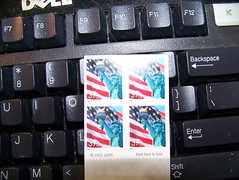
39-cent stamps

Originally uploaded by freerangelibrarian.
(a work in progress, as this post got posted live and now I’m writing it in pieces throughout this evening, saving as I go along.)

Today, while a breeze stirred the preternaturally dry spring air, I sent out six essays.

I don’t buy lottery tickets; I lose interest in slot machines after the first two-dollar loss; poker bores me, and sports bets confuse me. But submitting my work to literary quarterlies has taught me why people gamble.

The joy of the bet is that delicious, sub-erotic slice of time between commitment and resolution.
First is the dance of engagement where I compose a submission letter and hand-address a manila envelope. (By this time I know my quarry; I have spent evenings, even weeks, convincing myself that a certain journal is just the right match for a certain essay.) Then, while I print off the essay, I address a second envelope for the journal’s reply–the well-known, even mystical SASE (for Self-Addressed Stamped Envelope).

Increasingly I simply enclose a letter-sized SASE, rather than one large enough for the manuscript to be returned. It sounds eco-thrifty to have the manuscript returned, and I did that in my literary youth (that is, last year); but by the time the manuscript comes back I inevitably have found more revisions to make, more words to spin on a dime, more ways to make its luck happen.

The large manila envelope I use for sending the essay gets four first-class stamps. I don’t know if that’s extravagant; it’s not too little, because they always find their way to the journal, but that may be too much. But that’s not the betting part of this game.

It is the stamp I place on the reply envelope that clenches all of my hopes in its tiny paper heart.  This stamp will carry an answer to my mailbox and tell me if my luck holds. Maybe an essay will get accepted; maybe it will get rejected with a kind note; maybe I will get a form rejection (unfailingly accompanied by a letter urging me to subscribe to the journal in question, which really hurts when I have already subscribed, like the pang of meeting an old colleague who doesn’t recognize me).

I have had acceptance and rejection, and I know which feels better; but nothing feels quite so feather-light–not even the joy of acceptance–as that vast sky of possibility arching over the time between the moment when into the corner mailbox I slide my essay’s sealed manila envelope, knowing a small stamped envelope throbs within, and the moment when in thumbing through the mail I see an envelope whose hand I recognize, because it is mine.

Hope is a first-class stamp, over and over again. A small cost for what it gives me.

IM and 2.0 Culture

I move between many cultures, and as I ride that bus, I pick up habits from one and transfer them to another whether I mean to or not. So recently I was IM’ing with a friend, and after the second time I corrected a term I had misspelled, he pointed out that was unnecessary (he politely did not add how irritating it is, like most conversational disruptions). I hadn’t even been correcting my IM typos for years until my recent foray into AcLibLand, where the average techno-skill is lower than in my native habitat.

This all bubbled to the forefront this morning, while I was working on a presentation about social software and in one slide trying to explain 2.0 culture. There clearly is one, and there’s even a biblioculture within it, as the lolbrarian phenom makes clear. What I have come up with so far:

  1.  Humorous
  2. Non-hierarchical
  3. Time/space “shifted”
  4. Skeptical of authority
  5. Tepid about privacy and DRM
  6. Immediate, here-and-now, epistolary
  7. High tolerance for typos and errors

¡

I’m sure others have done better on this topic… it’s just one slide among many. I am drawn to this list, which means it means something to me.