Skip to content

Britannica Stirs the Pot

I love it when my predictions come true. Britannica is indeed using Gorman’s gorp to stir the pot (or hold a “forum,” as they think of it), as the following email that flew into my inbox this morning indicates.

So out of the tens, even hundreds of thousands of librarians Britannica could have selected, they pick the guy who is dedicated to bombasting us back to the Stone Age. His subjects are “many,” they warn us. I’d prefer “few but deep,” but perhaps that’s just me. Not only that, but there’s a part 3; he’s not even done yet.

Naturally, I am encouraged to give the B-dudes loads of link-love on their site. Free Range Librarian “could play a prominent part on this forum.” But do i wantz that cheezburger? (Hey, Pappas, thanks for letting me comment as much as I want… that’s so Web 2.0 of you!)

Do you all remember when I said, no, I am absolutely not supporting Michael Gorman for ALA President? More precisely, I said I was supporting Barb Stripling for ALA President. I had spent years on Council with Gorman and Stripling. My words seem prescient: she had a blog, she understands technology, she has the common touch… O.k., o.k., I’ll stop rubbing it in. Just remember this: Gorman was ALA President for a year, but he’s ex-president for life, and he’s riding that pony to town. For millions of people he now represents librarianship. We have a lot of work to do. (danah boyd, girl, we’re counting on you.)

Should we who get these messages post on that site… or count on the power of trackbacks to draw the conversation back onto the Web… or take some other approach? (I have considered translating Gorman into plain English… and possibly translating the English into lolspeak.)

I’ll ponder all this, and hope for your comments, as I spend this day rendering unto Caesar.

—————————–


Dear K.G. Schneider: Published at the Britannica Blog (http://blogs.britannica.com/blog/main/ ) is the first of three biting commentaries on learning and education in the era of “Web 2.0.” They’re written by Michael Gorman, past president of the American Library Association. His subjects are many, including blogging and the “citizen journalist,” intellectual laziness in the era of digitized sources, Wikipedia and anonymity on the Web, and the “cult of the amateur” and the “flight from expertise” that many see as characteristic of the Web today. Notable writers will be offering additional and alternative views. These writers include:

  • Sven Birkerts (Harvard University; author of The Gutenberg Elegies: The Fate of Reading in an Electronic Age)
  • Nicholas Carr (noted writer on information technologies and author of The Big Switch: Our New Digital Destiny)
  • Andrew Keen (author of The Cult of the Amateur: How the Democratization of the Digital World is Assaulting Our Economy…)
  • Thomas Mann (noted reference librarian)
  • Dan Gillmor (director of Center of Citizen Media and author of We the Media: Grassroots Journalism by the People, for the People)
  • Clay Shirky (consultant, writer on information technologies, and professor in New York University’s Interactive Telecommunications Program)
  • danah boyd (fellow at the University of Southern California Annenberg Center for Communications)
  • Matthew Battles (formerly of Harvard University’s Houghton Library and author of Library: An Unquiet History)
  • Scott McLemee (author of the “Intellectual Affairs” column for Inside Higher Ed)
  • Robert McHenry (former editor-in-chief, Encyclopaedia Britannica)
  • Gregory McNamee (veteran freelance writer, author of 25 books, and a weekly contributor to the Britannica Blog)

We encourage you to visit the forum, comment on the posts, and leave a link in your comments back to your own site. For the benefit of your readers, we’d appreciate a link to the forum from your site as well. We expect considerable traffic to the blog during these weeks, and you and your site could play a prominent part in this forum. You’re welcome to comment as often as you like, in response to as many posts as you’d like. Best wishes,

Theodore Pappas

The Gorman Shall Rise Again

This is brief, because I didn’t learn about this until I had written over 2,000 words on nonprofit IT management for an article that I need to wrap up. But how can I resist?

Having alienated most of his core audience, Michael Gorman has published a two part vent on Brittannica.com that demonstrates how ably he functions as a still point in a turning world. His hair is still blue (I didn’t know he actually liked that picture), he’s still using lots of long words to make small points, and he still hasn’t grokked the Web.

Jason Griffey, over on Pattern Recognition, does a nice job explaining the weaknesses in Gorman’s argument, and I expect more to come from various sections of the biblioblogosphere and beyond.

But I must point out that in the weird way that political extremes resemble one another, I agree with Gorman on some issues. I’m not convinced that the hive mind is always wise (the same mind that elected Bush at least once); I don’t fetishize Wikipedia, and am skeptical of the more woo-woo claims on its behalf; I appreciate the role of individual expertise. Nor do I think every text benefits from audience participation.

But as soon as I start to warm to Gorman’s argument, he turns his cannons toward “Web. 2.0” — and immediately demonstrates he is fighting the wrong battle.

To start with:

  • “Bloggers are called ‘citizen journalists'”: Some bloggers are citizen journalists — as Griffey points out, so was Thomas Paine — but that statement is a simple rhetorical error (or dodge)
  • “Alternatives to Western medicine are increasingly popular”: Many reputable doctors encourage the use of alternative medicine; if cranberry juice can fix a bladder infection, do we really need to ask Big Pharm to pollute a river to do the same thing?
  • “Millions of Americans are believers in Biblical inerrancy — the belief that every word in the Bible is both true and the literal word of God”: This is true, but irrelevant; Christian fundamentalism predates the Internet by, hmmm, close to 2,000 years
  • “[S]cientific truths on such matters as medical research, accepted by all mainstream scientists, are rejected by substantial numbers of citizens and many in politics”: This may be the most inscrutable statement he’s ever made. It conjured up the presidential administration’s resistance to scientific thinking about climate change. But did Bush and Cheney really pick up their ideologies from instant messaging, Facebook and Twitter? “Say, Dickie, what caused global warming?” “IDK… my BFF Jill?”

Gorman’s real motive becomes clear when he makes reference to a Goya etching, El Sueño de la Razon Produce Monstruos, which he — to cut to the chase — looked up in a book. (Books are always and forever accurate, right?)

I know about this etching partly because I read about it decades ago and partly because I recently went to authoritative printed sources for confirmation of what I had read and for additional information and insights. These reference works were not only created by scholars and published by reputable publishers but also contained the paratextual elements (subject headings, indexes, bibliographies, content lists, etc.) also created by professionals that enabled me to find the recorded knowledge and information I wanted in seconds.

O.k., so enlighten me. What harm would be caused if I read this information on the Web, and not in a book? For that matter, what if I didn’t have to worry about “paratextual elements” and just found what I needed through a search engine, with a few contextual clues to reassure me this was a reasonably sound reference and not the work of some 12-year-old (or an outdated art book with old references…)? And what does any of this have to do with Web 2.0 (which in Gorman’s head seems to be the name emblazoned on the side of the firetrucks in Fahrenheit 451, ready to come burn down his bookcases)?

What’s most disappointing is that these “blog” posts (to the extent anything published by Britannica can be said to be blogged) should have been written by Gorman, and not by Jaron Lanier, on whose ideas Gorman extensively, but ineffectively, piggybacks. Lanier is a worthy hawker in this marketplace of ideas. Was his hair not blue enough? His language not fusty enough? (I leave the third question unstated, but while we’re on that general subject, note that fewer than 10 of the Britannica’s “blog” authors are female.)

This contretemps would be funny if it weren’t so annoying. There are important things to be discussed about authority and order and metadata and quality and such, but elevating Gorman to the level of expert pundit on anything related to the Web suggests that Britannica isn’t seeking the intelligent exchange of ideas, but is looking to build its Technorati rankings through the now-tiresome back-and-forth of Gorman-says-X, now-we-disprove-it; I am sure Britannica is now busy finding people to “respond” to their manufactured controversy, like one of those episodes on afternoon TV shows I see at the gym where after the wife tells all, the dazed cuckold is brought onto stage to stammer his chagrine. Yes, I too have now contributed to that weary business, and I wish it were not so necessary to have done so.

The Boomer’s Texting Vocabulary

No sooner had I announced Twitterprose than LibraryThing went down — it’s still broken, poor Thing. My clever distinction from Twitterlit (which I enjoy tremendously) was that my entries would be strictly from creative nonfiction and that whenever possible the links would go to LibraryThing entries or online journals. Since Twitterlit does a few nonfiction entries, without LT, I find myself scrambling to pull recommendations from online journals… but then, maybe that’s not a bad thing. Still, come back, LT, you’re missed.

Since I’m on two writing deadlines (a state of affairs that makes me quite happy) and am also gathering ideas and a feathered cap for my YouTube presentation on digital preservation and social networks, I’m going to pull some stuff from my writing notebook that I thought up in an airport bar: the Boomer’s Texting Vocabulary… handy shortcuts for those of us of a certain age. Feel free to share with your BFF Jill.

BTV (Boomer’s Texting Vocabulary)

WMG: Where’s my glasses?

WMK: Where’s my keys?

WAIITR: Why am I in this room?

WDIPMC: Where did I park my car?

IDR: I don’t remember

IFYRN: I forgot your real name

FANOI: F***, another night of insomnia

IIHIH: Is it hot in here?

OTDW: Open the damn window

WYG: Who’s your gyno?

HMUP: Help me up, please

WK: Which knee?

WH: Which hip?

WE: Which eye?

BCD: Bad Cholesterol Day

AMFB: After my first bypass

WTFIMD: Where the f*** is my defibrillator?

BRBGTP: Be right back, gone to pee

GTRP: Gone to refill prescription

BPM: Blood pressure meds

FCP: F****ing co-pay

LTOT: Lost train of thought

AG/NAG: Aging gracefully, not aging gracefully

KIR: Kid in room

KTD: Kids these days

WTYMA: Wait til you’re my age

NDY: Not dead yet!

Open Source Radio: Help Keep It Going

Open Source Radio is a wide-ranging, engaging, and all-around terrific show (and not just because they’ve had me on a couple of times). They are in a major funding realignment (how well I know about those), and though they just got a donation that will keep them going through the summer, they aren’t out of the woods yet for funding into the fall or beyond.

If you like this show, please donate (and if you’ve never listened, give it a shot). I took $20 from my last consulting gig and gave it to Open Source Radio — I wish it could be more, and when I get more work, I will make that wish come true.

I typically give a fairly nice chunk of change to my local NPR affiliate every year, but henceforth I’m tithing some of that to programs they don’t carry that I enjoy. Shows such as Open Source make it possible to listen to quality radio wherever I am, even Tallahassee. All hail the Interwebs!

Announcing Twitterprose

Roses love prosesThis morning I created Twitterprose, a microblog for great lines from creative nonfiction, updated once every day.

Twitterprose owes its inspiration to Twitterlit, which has been seducing me for weeks with first lines to wonderful novels. I felt creative nonfiction needed some twitterlove and that I was the person meant to open her heart to this project.

Notice that to start with, at least, I’m using LibraryThing URLs. I considered Amazon, and may still use it for books not in LibraryThing, but when possible, I want to guide readers to a noncommercial site that is about the life of the work in question. (“Work” is not a vague term here. There may be times that I link to journals or individual essays on the Web.)

For similar reasons, WorldCat doesn’t cut it for Twitterprose: there’s just not enough social information, and its display is medicinally dull.
In any event, if you haven’t tried Twitter, or if you’ve heard it’s just a place where people hang out and chatter (heaven forbid!), consider signing up to get Twitterprose… and many other wonderful tidbits of joy.

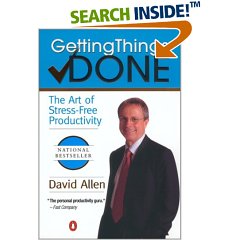
Getting Things Done

Getting Things DoneGetting Things Done has improved my management in one significant way, and for that I am truly grateful. For years I have been an email slob. Though I automatically file list discussions into sub-folders, my main folder for both personal and work mail has always been a tragedy of the email commons, with so many messages competing for attention that I wasted precious time every day sorting through messages to find the ones I need to take action on (whether action meant acting, delegating, or deferring).

From earlier management training, I had acquired some other skills that GTD simply endorsed, and it’s always nice to get a pat on the head. If a job can be handled right away, I do it; if it needs to be on a list, I write it down; if it needs a paper home, I file it (if I can’t get to it earlier, then once a week, on Friday afternoon). People marveled at that at my last several places of work, but from thirty years in the full-time workforce I’ve learned that task management is its own overhead, and the task you no longer have to manage reduces that overhead to an absolute minimum. I just hadn’t fully ported my analog practices to the actual environment where most of my stuff-to-be-done resided, though now that I’m weeding my inbox, I find that a lot of email is just pleasant chatter that can be deleted or filed, and just like weeding a library of stale and unused books, when I have finished tending the incidental messages, the important stuff stands out far more clearly.

From previous management training (in the military, of course; based on observation, I suspect most library “management” classes are thin on practice), I also knew to write stuff down. I use Outlook tasks, I use written lists, I use post-its for absolutely crucial stuff that may already be in a list but needs attention first thing. As a writer, I am never without a notebook anyway; even on the way to the gym I will return home for my notebook, because those minutes after I get off the treadmill are often flush with ideas, some great and some terrible, all worth noting. Yep, good idea: write stuff down.

I’ve seen several new managers get all shiny-eyed at the concepts in GTD, just as when I was first learning management, back in the 1980s, we all toted around The One-Minute Manager or any of the tomes on Total Quality Management. I don’t subscribe to the cultic following GTD has acquired (including a fawningly uncritical Wikipedia entry and an even sillier review by Ben Hammersley), but GTD is a nice, sensible book, with an accessible style. Also, management reading tends to be such a hard sell, and it’s easier to get people to read a book that is wildly popular; for that, all of us who have mentored new managers can be forever grateful.

My guess is that GTD is so very popular among the technically savvy because this is a group that is typically not offered management training or mentoring. Allen’s management tips are astonishingly basic: write stuff down! Stay organized! File stuff! Paper can be your friend! But if no one ever gave you that advice, and if your work culture has been “code til you bleed, then go play,” fundamental tips for managing the overhead of any job above the level of code monkey might seem revolutionary.

The limitation with GTD is that it works best if your time is yours to manage. GTD isn’t all that much help if your day is largely controlled by others, such as if your organization is built around the endless-meeting paradigm, where actual work production is coincidental to organizational processes, and your role requires that you swim glub-glub-glub in the river of endless discussion. Similarly, if you work in an organization driven at least in part by what I think of as “the novelty crisis” — where nearly every day features a newly-manufactured, ostensibly regime-toppling issue that realigns your priorities and blows your short- and long-range planning out of the water — GTD seems almost endearingly quaint, like a small child giving you a bandaid for a “booboo.” It won’t hurt; at least your life will be better-organized around the edges. But for many managers, its value is largely palliative.

Nevertheless, GTD convinced me to archive my embarrassingly huge email inbox and pledge to myself that before I turned off the computer each evening I would have fewer than ten unresolved email messages in my inbox. The vast majority of my tasks originate through email, so this is no small commitment. Most nights that has meant 9 messages left in my inbox, and it has never been empty (for one thing, I can’t decide whether to file or trash a 10%-off coupon for sugar-free margarita mix), but yes, I do feel as if I’m Getting Things Done. For a little over eight bucks on Amazon, GTD was a good buy. It just didn’t change my life.

Social Software Showcase at ALA Annual

I’m pasting in Karen Coombs’ announcement of a Social Software Showcase at ALA Annual (already linked here and there on the Web), which is the epitome of all that is epitomizable, and in which (as I have not yet resolved that unable-to-be-in-two-places-at-once issue) I will participate in via a YouTube video which I have yet to make because as Steve Lawson notes, I don’t know what my topic is yet.

Well, I have two topics but it all depends on whether one of the proposed participants can make it, in which case he has my first topic. Kapeesh? Then, since it was all a Surprise, planned by others, I was unaware of the social software angle, and I had vague plans to talk about LOCKSS, and find myself somewhat stumped on the issue of digital preservation and social software… though actually, it’s quite an interesting issue, if you think of it. Where do chats go to die? (Do they dry up like a raisin in the sun?)
I’m ashamed to say that I’m more worried about the wardrobe issues for my video; shall I be simple-yet-elegant, shall I wear one of my Halloween costumes… or what about a feathered cap?  What about backdrops — a fake city center, a plain wall, or (so you all know I’m very smart) my bookshelves? (Every time I do a bookcase backdrop for a photo I find myself wishing I were a foot taller, so my head could be poised against the really erudite stuff, and not a section that is half-travel, half-miscellany.)

Anyway, kudos to Karen, Michelle, Jason, and everyone else involved in the Showcase. Karen C.’s explanation follows.

This is the surprise that I’ve [as in Karen Coombs] been talking to people about for months now. A full description of the Showcase is available on LITABlog and there will be a lot more to come on the official Showcase wiki.

The Social Software Showcase, in some ways, has been a long time in the making. The PTBs at BIGWIG (myself, Michelle, and Jason) haven’t necessarily been happy with the conference format or planning process at ALA for some time (both as participants and organizers). The policies and procedures for the conference planning process don’t work well for creating innovative and responsive programming on technology. They also disenfranchise ALA members who can’t attend the conference in person or whose conference schedules are jam packed due to face-to-face meetings where the business of ALA is conducted or giving conference presentations.

Projects like HigherEdBlogCon and 5 Weeks to a Social Library have shown that virtual conferences can work and for some people can be a more rewarding experience than traditional conferences. So why not show the world of ALA that a virtual conference can be done and bring different people, ideas and conversations to the table? Beyond that the Showcase is a way for us to reach out to librarians (and maybe even library users) and get them involved in conversations about social software without making a massive personal financial investment.

The Showcase is above all an experiment and a demonstration of social software in action. It was planned and executed using chat, Google Docs, wikis, Twitter, and probably some other tech I’m forgetting to mention. That in itself is worth taking notice of. So is our list of presenters which include some creative, thought-provoking, and unique voices in the library world. The presenters, other organizers and myself are looking forward to your participation in this program.


Debi for Rent!

My pal Debi just posted her own “for rent” page on her site. She’s in the Chicago area, and is not only giftedDebi Lewis with all those skills she describes — planning your company website, writing, editing, research, porting databases to the Web, even fiddling — but is a genuinely nice, patient person you’d enjoy working with. Heck, she and I really need to come up with some joint project that will “force” me to use up some miles on a trip to her neck of the woods (though her cooking sounds so yummy-haimisch I might have to pack tent dresses and elastic-waist slacks).

I have to thank Walt Crawford for the “hire me” concept. Among other things, his example freed me up to state clearly what I’m available for, clarify some limitations, and remind people that I’ m available.

I suspect one reason I rushed into a job that wasn’t quite right for me, without asking the important is-this-me-and-do-I-really-want-this-job questions, was that I felt very uncomfortable with people asking, “But what are you going to do?” (Sometimes with the emphasis on “you,” sometimes with the emphasis on “do,” sometimes with the entire sentence in italics with square quotes.) I was eager to say to people, “But of course, I have work lined up!” I even passed up a job that might have been a very good fit because it meant waiting a couple more weeks and moving to Florida without A Job lined up.

But once I’m fifty, I will never make that kind of mistake again! (I can’t wait to see what kind of all-new and entirely unanticipated mistakes I’ll make when I pass that divide.)

Again, thanks, and I’m all ears. I’ve had some great opportunities come up that way, including some that I hadn’t anticipated, such as speaking gigs in faraway places, and I’ve also had tips such as “write so-and-so about adjunct work” — the kind of insider baseball tip I need. Thanks much for all the link love… it puts food on my table and a smile in my heart.

Back to an article (for pay) and then to redo my c.v. in a “teaching” version (which I have a model for because my MFA program has a session every year called “Life after MFA,” complete with fabu handouts).

ACRL response, ALA solicits website input, varied cheezburgers

Kudos to Mary Jane Petrowski, Associate Director of ACRL, who in response to my May 29 post wrote today, “I’m painfully aware that we are contacting new members long after they join. … I’m going pursue a solution to this problem with my colleagues here at ALA.” She playfully added, “How hard can it be, right?” Good luck, Mary Jane, and keep that sense of humor working for you.

Meanwhile, take some time while you’re at the annual conference to see proposed new designs for the ALA website. The announcement for this was in AL Direct, but I missed it; as much as I like the concept of AL Direct and enjoyed its early days, as of late I find myself skimming it more often than I read it, and I am not sure why.

You might think I’d be critical of ALA debuting these draft designs at a walk-in conference. Why not just put it all out there on the Web… radical trust, transparency, don’t limit input to walk-ins, etc. … right? … Hmmm, well, maybe it’s not such a bad thing to do it this way.

At FPOW Minus One, we launched design drafts quietly and conservatively to small groups. For one thing, sometimes we were wrong — even at times very, very wrong. (Ever since the last design I participated in, I have added the “Grrrr” factor to assessing written input for user frustration with a design, as in, “Grrrr, I couldn’t do X.”) That’s why it’s called iterative design: because you keep doing it until you get it right. But once a design is online, it’s too easy to take a proposal and flog it to death.

I hope these viewing opportunities are just part of a larger usability effort [update: good grief, I should  RTFB!] but I don’t fault their methods.

ALA is now cheerfully spamming me with vendor garbage love letters, and today I received this from Elsevier: “The folks at Scopus, Scirus and ScienceDirect are glad to hear you’re attending ALA.” Clearly they missed my NASIG presentation!

I appreciate the writing/consultation queries that have come my way, as well as suggestions for distance MLS programs to teach in… keep those cards and letters coming. I’m dedicating two hours today to writing MLS programs about adjunct work (I keep forgetting: I could teach a killer 2.0 class and work in a section on writing for the Web), in between working on an article about what makes nonprofit technology management so diffi– uh, different, I mean to say. Thanks to all of you who responded to my requests for input, and it’s not too late, as I’m finishing that piece up today and tomorrow. (Yes, you are allowed to vent, and I won’t tell.)

Finally, to repeat a point I make when I give presentations, there are all kinds of social software and some of it may fit you and some of it may not. I happen to like Twitter because it fits my work flow and my socialization behavior: work for a while, walk down the hall to make a cup of tea, chat with a person or two, sit down again, work some more. I tried Meebo chat rooms but have concluded they are just not my style: too much time commitment, too much of a “secret clubhouse” feeling, too many people at once. (I even like workshopping one-on-one, just as when I was a child I had playdates with one child at a time. Suits me.)

Aging is all about finding your style. I keep wanting to write a blog post, “50 is the new 50,” discussing some of the joys of midlife: how you’re freed from some obligations, have a better sense of self, have more acute awareness of time. But, having that acute awareness of time, I keep setting it aside for my paid work, and my workshopping, and the stuff for Steve the Accountant, and oh, you know…

ALA Annual 2007: My Schedule

Here’s the rough outline of my schedule at the American Library Association 2007 annual conference (DC)… Marilyn, Michelle, Lori, and anyone else trying to vector with me, take a look at see what fits! Note that the social events (PUBLIB, LITA Happy Hour, OCLC Blog Salon GLBTRT) are great places to meet up.

Friday 6/22/2007

Arrive mid-afternoon, drop bags at dad and stepmom’s place, hitch up my skirts and run to the…

PUBLIB Party (hostess)
Date: Friday, 6/22/2007
Time: 5:00 – 7:00 p.m.
Location: Poste (at Hotel Monaco)
http://www.postebrasserie.com/

Hollywood Librarian (Film Premiere)
Date: Friday, 6/22/2007
Time: 7:30 (red carpet walk, 8:00 showing)
Location: Washington Convention Center Ballroom B

Available for a quick nightcap after the movie…

Saturday 6/23/2007

Early breakfast with dad and stepmom
Date: Saturday, 6/23/2007
Time: 8-ish
Location: dad’s place

Exhibits, appointments (flex time)
Date: Saturday, 6/23/2007
Time: 9-ish to 11:30 p.m.
Location: Washington Convention Center

Lunch w/JL
Date: Saturday, 6/23/2007
Time: 12:00 p.m.
Location: Cafe Promenade, Renaissance Mayflower

The Ultimate Debate: Do Libraries Innovate? (panelist)
Date: Saturday, 6/23/2007
Time: 1:30 PM-3:30 PM
Location: Renaissance Mayflower room: Grand Ballroom

3:30 – 4:00: Meet w/Marilyn

The Open ILS: PINES, the Evergreen Open-ILS Program & The University of Rochester Extensible Catalog Project (blogging for LITA)
Date: Saturday, 6/23/2007
Time: 4:00 – 5:30 PM
Location: REN Room 12-14 WCC 103A

LITA Happy Hour
Date: Saturday, 6/23/2007
Time: 5:30 – 8:00 (that’s one long happy hour! Chalk me down for 6-7)
Location: Capitol City Brewing Company (Downtown DC, 1100 New York Ave NW, (202) 628-2222)

(Dinner with friends, Location/time TBD, 7-ish)


Sunday 6/24/2007

Breakfast with friend
Date: Sunday, 6/24/2007
Time: 9-ish
Location: TBD

Appointment
Date: Sunday, 6/24/2007
Time: 11-12
Location: TBD

Lunch with SK
Date: Sunday, 6/24/2007
Time: 12-1
Location: TBD

Exhibits, appointments (flex time)
Date: Sunday, 6/24/2007
Time: 10:30-ish to 12:30-ish
Location: Washington Convention Center

Technology for Trustees (panelist)
Date: Sunday, 6/24/2007
Time: 1:30 – 3:00
Location: ?

LITA Awards Reception (possibly… could skip for another event or meeting)
Date: Sunday, 6/24/2007
Time: 3:00 pm – 4:00 pm
Location: MAY Grand Ballroom

Cocktail with friend
Date: Sunday, 6/24/2007
Time: 4:30 pm – 5:30 pm (ca.)
Location: MAY Grand Ballroom

OCLC Blog Salon
Date: Sunday, 6/24/2007
Time: 5:45 – 8:00 p.m. (At least til about 7) (I’m targeting 5:45 – 6:30… may skip it depending on when the GLBTRT awards ceremony is planned… [uh, that would be Monday morning])
Location: Congressional Suite at the Grand Hyatt

(Killing this event completely) GLBTRT Social
Date: Sunday, 6/24/2007
Time: 6:00-8:00 PM
Location: Remington’s Country-Western Bar, 639 Pennsylvania Avenue SE
http://www.remingtonswdc.com/ , http://tinyurl.com/37psro

Dinner with Friends
Time: 7:30-ish-on

Dinner plans still open… usually go out with some GLBTRT friends, but I’m open to suggestions.

Monday, 6/25/2007

ALA Member Participation Task Force (member)
Date: Sunday, 6/25/2007
Time: 8:00 – 10:00
Location: ?

GLBTRT Awards Brunch (still need to get ticket!)
Date: Monday, 6/25/2007
Time: 10:30 – 1:00
Location: Renaissance Mayflower, Grand Ballroom

Depart for home… see you in Chilly Philly next January!

Not attending, would if I could:

Super-top-secret Saturday event, 1:30 – 3:30 (more later) Social Software Showcase

LITA Open House
Date: Saturday, 6/23/2007
Time: 4:00 – 5:30 PM
Location: Renaissance Washington hotel
(I hear they’re serving ham)

LITA Top Tech Trends
Date: Sunday, 6/24/2007
Time: 1:30 pm -3:00 pm
Location: MAY East/State Rooms

UIUC GSLIS Alumni Reception
Date: Sunday, June 24th
Time: 5:30-7:30 p.m.
Location: Doubletree Hotel, Terrace West Ballroom