Skip to content

Top Technology Trends, ALA Midwinter 2008

Mild post updates:

First, if you are attending Midwinter and want to see the LITA Trendsters in action, it’s Sunday, January 13, 2008, 8-10 a.m., LOEWS Congress B. The session will be recorded, but we’re so much more fun f2f.

Second, under interoperability/open data I’d add NISO’s ballot item to establish a working group on serial knowledge bases. Kudos also to NISO for being so open about its documents and processes.

————————————————————

I had to miss LITA’s Top Tech Trends panel at Annual 2007, so it has been a full year since I have really engaged those rusty parts in my brain. And what a year it has been!

Hardware is becoming smaller, larger, and wider. TVs, laptops, and iPhones are now designed around 16 x 9 — a display shift gently pushing its way through our culture. Meanwhile, the cell phone is that “ubicomp” (ubiquitous computing) device talked about twenty years ago, while HDTVs keep getting bigger and cheaper; the 32″ we bought last year looks positively petite. (Thanks to Richard Madaus, the Boss of Bosses at My PLace Of Work, for pointing out the 16×9 phenom.)

The path to interoperability

For the I-Heart-Standards crowd, we had several interesting pops that point to a possible trend. It only took two years for SUSHI to debut, which is like a nanosecond in the standards community. Also, the NCIP discussions may or may not lead to fruition, but I like how they are trying to build in flexibility.

A very smart co-worker has been observing for a while that LibraryLand needs an “ISWN” — an ISBN that colocates items at the work level. Apparently great minds think in parallel: by mid-2008 several large publishers are planning to implement ISTC — the International Standard Text Code — which is an ISBN-like number that collocates items at the expression level.

This NISO-approved standard does what xISBN attempts to do but much more cleanly: as it says on Laura Dawson’s wiki, ISTC “identifies the intellectual property that could be manifested in any number of ISBNs. For example, the book ‘Moby Dick, Or the Whale’ would be identified with an ISTC; the Bantam edition, the Barnes & Noble edition, the Signet edition, the Norton Critical edition would each be assigned a different ISBN.”

Not only that, but as Dawson explains, the ISTC goes even farther: “ISTCs are not limited to books. They can be assigned to poems, articles, essays, short stories – any written work. So an ISTC can identify the poem ‘Lady Lazarus’ by Sylvia Plath, and another ISTC can identify the collection ‘Ariel’ in which it appears. A third ISTC can identify the unedited ‘Ariel’ collection that includes poems the original publication did not.”

This has so many possibly wonderful implications my head is exploding — the smallest of which is that finally, I could add single essays and short stories to LibraryThing. In any event, it’s interesting that such a key standard has bubbled up so quietly and yet in parallel with the ideas brewing in the brains of other smart people.

Open the door, see all the data

Design concepts such as open source and service-oriented architecture continue to mature, and these ideas percolate in new and interesting ways, such as:

  • Evergreen‘s success in Georgia and continued growth
  • Continued success for Koha
  • WoGroFuBiCo‘s recommendation to put authorities on the Web

In winning its first public-access mandate, SPARC made AAP throw a clot, and I admit enjoying the spectacle. Who will win in the short run may not matter as much as who wins in the long run — and the the open-access crowd (largely) seems to grasp that right now it’s about hearts and minds. I warn the open access crowd to walk lightly in this area and be respectful of disciplines where mandating open access would be counterproductive. “‘Shoot if you must this old gray head, but I get paid for my work,’ she said.”

To open source and access you can add, “open data.” Profession-wide, we’re asking the right questions — are we best served by a model where our de facto network catalog data is proprietary? — and the conversations about open data knowledge bases are also heartening. Even more interesting is that discussions that would have been pooh-poohed a decade ago now have serious traction.

Some LibraryLand types actually understand the phrase “service oriented architecture.” For those who don’t, Eric Schnell spelled it out for us in a fabulous five-part series. Go Er-ic! Go Er-ic!

One interesting phenom, first observed with Endeca’s penetration of the library market, is that librarians appear more open to non-library software. Two non-library software products, Jive and LivePerson, have passed the selection process for large virtual reference networks, and AskOntario will debut its LivePerson-based VR service on January 15. Jive is based on Jabber, an open source product, demonstrating that all roads lead to London.

Overall librarians appear somewhat savvier about software selection. Maybe it’s just who I speak with, but increasingly I engage with colleagues who are familiar with terms such as as “deliverable,” “critical path,” “stage-gate,” and “project management.” Awareness of user needs is also on the rise.

Blogging is mainstream. People understand the implications of maintaining a blog, and the field is shifting to a focus on either the well-written niche blog with something new to say and specific audiences to serve, or the group blog. On LITAblog, Eric Lease Morgan talked about the “abandoned” blogs, but I’d focus on the blogs that have become very big.

The LibraryThing for Libraries service points to a growing awareness that population density is key for social networking, that simply adding a tagging function to OPACs is not adequate, and that libraries are small and the Web is large, which is a strategically healthy point of view. This ties into experiments such as WorldCat Local, which is designed around luring library users from the wild and placing library services squarely in the user’s web workflow.

Ships That Sailed By

I noted in July that not one but two libraries in Arizona had implemented BISAC identifiers (the subjects established by the Book Industry Standards Group), one for their physical organization and the other for their OPAC’s facets. Some folks really got their shorts in a bunch over this, and the PUBLIB discussion list appears to harbor quite a few Dewey fundamentalists (leading to my other conclusion, which is that the old-style massive discussion list may be on the way out).

One boat we have pretty much missed as a profession is mobile device compatibility. By the time most of us catch up with it, it won’t be needed any more. Can’t win ’em all.

The Absolute Guide to ALA Midwinter

Mary Ghikas, ALA wonk, once again put out an amazzzzzzzzzzzzing guide to ALA Midwinter. Must reading! I found it thanks to Aaron Dobbs’ post to several ALA lists, and may I remind you he’s running for ALA Council and I’m supporting him.

On the ALA wiki page linking to Mary’s report I also saw the following good advice from the Task Force on the Environment — I’m going to follow suit.

The Task Force on the Environment of the Social Responsibilities Round Table (TFOE-SRRT) wants conference goers to bring their favorite traveling mugs and water bottles in support of efforts encouraging the American Library Association (ALA) to reduce its carbon footprint. TFOE will launch this event at the upcoming ALA 2008 Midwinter Meeting in Philadelphia from January 11-14, 2008. The title of this campaign is “Cup by Cup for a Greener ALA.”

The campaign will show that ALA members are ready to make lifestyle changes for sustainable conferences and to protect the health of the Earth.

The math is simple. A typical ALA Midwinter draws over 10,000 librarians to its 2000+ business meetings, discussion groups, programs, and events. If every librarian attending Midwinter brought their own coffee cup more than 10,000 paper or Styrofoam cups would not enter already over-flowing landfills.

How to be “famous” (wink wink, nudge nudge)

I was an unrepentant smoker for many years. I considered it my business and nobody else’s until the day in 1988 when I walked outside a building at Hahn Airbase to light up, and an airman who had wandered outside for the same reason said, “Oh, cool. An officer who smokes!” Then lit up a cig himself.

In 17 years of smoking I had never seriously tried to quit, but sudden self-awareness, followed by guilt, were great motivators. Two months, untold quantities of Nicorette gum, and one cracked tooth later, I was a successful, if cranky, ex-smoker.

Which leads me to today’s post, which is a bit of beginning-of-year, pre-ALA-conference thought-gathering. Without ever intending to, I have become well-known in my profession, and at some cycles in my librarian career have been quite visible. (Outside of librarianship, I’m anonymous, and that’s fine. I use quotation marks in my title because industry-specific fame is highly relative; I am sure there are star-quality ichthyologists, not that I can name one.)

Along the way to “fame” (wink wink, nudge nudge) and (mis)fortune, I’ve learned a few things, sometimes the hard way; some of them are strategic tips; some are observations; and some have to do with responsibility.

Like it or not, you are a role model. I list this first because if you don’t hear anything else, hear me when I say that old coots like me may take you with a grain of salt, but if you are an It Girl or Boy, everything you say or do has a good chance of being absorbed by newer librarians. Women in particular often have difficulty with the idea that they have power and influence. Get over yourselves: what you say matters.

Pace yourself. I’ve watched more than one flavor-of-the-month librarian take it all on and then flame out in a year or two. It’s easy to agree to do it all; actually executing all those tasks is another issue. Your family and friends may not appreciate how when you return from your big speaking gigs you need to hole up to finish some shiny project before you leave for the next gig.

One reason I backpedaled on filtering gigs was after giving dozens of talks in one year (on top of a day job) I was travel-fried, to the point where the slightest hitch or problem (a delayed flight, something I forgot) could cause me to burst in tears in the middle of an airport — as I did when I expensively cabbed to the wrong SoCal airport too late to get to the right one. (I have a friend who travels a lot who once was so burned-out she arrived at a conference with an empty suitcase; she had forgotten to pack her clothes.)

Slow down, cowboys and cowgirls. You don’t have to take on every single speaking gig, every book or article, or every extra-cool project. Pick strategically and pick well.

Pull your weight in your non-famous life. Probably the highest compliment I ever receive is to hear that at work I’m “just Karen.” I work hard to be “just Karen,” and that includes being careful to do my part of the effort. I don’t rationalize that the special opportunities I get, such as speaking engagements, are a fair exchange for whatever work they actually hired me to do. Likewise, I always said I was elected to ALA Council three times simply based on name recognition (as were some people who clearly don’t belong on any governing body), but I worked hard to pull my weight on Council as a peer.

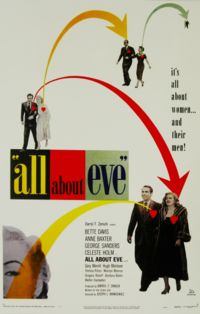
All About EveDon’t let ambition turn you into Eve Harrington. Remember All About Eve, where an ingenue claimed to be Margo Channing’s biggest, bestest fan, then walked all over her? Let your friendships be sincere, and don’t use people or filch their ideas and then “forget” to acknowledge them.

On the flip side, some people will latch on to you for no other reason than you’re well-known and you’re useful to them. Don’t worry, they’ll disappear when your star fades.

Help up-and-comers, especially people who may have a hard time getting selected for particular roles. I’ve served in at least one professional capacity where it was obvious that female predecessors had slammed the door behind them. Keep that door open and pull people through it. For example, Code4Lib is offering minority and female scholarships this spring to their 2008 conference. Can you recommend someone? Can you give someone the inspiration to go? This is a great conference, and could even be a career-maker for the right person.

Also, share your favorite dark horses with the people recruiting speakers and writers. They will appreciate hearing about fresh voices, and the new people will appreciate the leg up.

Tap the peer network for advice and insights. Do you suspect an honorarium is too small? Are you being asked to ride in a truck with chickens and goats in order to get to a speaking gig? (Actually, that sounds rather fun, but maybe not more than once.) Does that great publishing opportunity benefit everyone involved — except you? Does something not smell right, feel right about an “opportunity”? You’re probably right. Email other people who have boldly gone before you. It could be you just need to negotiate a little harder or be warned about a handler’s goofiness, but forewarned is forearmed.

What goes up must come down. In the Internet filtering wars of the late 1990s I was a flavor of the month. I gave over 40 talks about filtering, published an influential book, wrote articles, and had a website on the topic. At some point LibraryLand’s focus shifted to other issues; additionally, other people became well-known on this topic, too. Yielding the stage is an act of graciousness.

Don’t be shocked, shocked when people approach you for your influence. You clearly don’t mind being visible, so why would it bother you when you’re approached to comment on a book or report, or provide a recommendation for someone? Where you don’t want to take action, a simple “No thanks” will suffice. That doesn’t mean you have to spend every minute responding to requests; if the request is truly absurd, you may ignore it without comment.

Some stuff needs to stay unsaid. When you’re highly visible, a little self-awareness and discretion go a long way. So-and-so at Your Place Of Work may be a creep or a jerk, or your boss may have done you seriously wrong, but ask yourself if you’d want to read tell-all blog posts where these people listed their takes on your shortcomings. (This reminds me of a time when my sister and I fumed to an older friend how our mother was making us nutty, and she replied with a grin, “You’re probably doing the same to her.” Oh.)

Similarly, you may be in the throes of a personal or professional meltdown and feel the need to share the details with several million of your closest colleagues, but consider carefully how much of your life you want to share in perpetuity — as in, like, forever.

Be gracious about proffered advice. Even if you don’t agree with the advice, unless it’s entirely outlandish (drink Drambuie for breakfast! go braless to job interviews!), thank the person who took a risk sharing it with you, tuck it away, and revisit it later. I remember some years back when my friend Nann advised me of mannerisms that flawed my speaking style, and I’m still glad — not just that she gave me that advice but that I had the good sense to think about her comments with an open mind.

Be gracious about solicited advice. In a similar vein, a lot of people may come to you for advice, some of which you may be able to provide. Even when I can’t help someone, I try to give them a reasonable referral.

Some people will resent you no matter what. I’ve had to get comfortable with the fact that some people really do not wish others well. Some will badmouth you publicly, and even worse, some will badmouth you sotto voce. I hesitated about even writing this post, which I’ve been thinking about for close to a year, because in my head I hear a voice making snide remarks about so-and-so thinking she’s hot stuff (hence also the cautiously qualified title). But hence the next piece of advice:

Own up to your own feelings. I spent years whining that “so-and-so doesn’t like me” before I got honest with myself and acknowledged that the feeling was mutual. Likewise, boycotting an activity because another famous so-and-so was invited is also not cricket (yup, seen it happen, thought about doing it myself). Be an adult, please. You may not think highly of this person, but someone does, so put on your best public face and do what needs to be done.

Keep a sense of proportion. Don’t assume that because you’re well-known, your poop don’t smell. We’re all a bit broken, just like we’re all a bit wonderful. There are many amazing librarians who don’t happen to be well-known, and will do many amazing things and yet never be “famous” (wink wink, nudge nudge). Being well-known (even on the miniscule professional level) is kind of a fluke, like being able to sing or having a photographic memory, and the skill sets that led to your wink-nudge-famousness don’t have a heck of a lot to do with how well you do in the rest of your life — the full span of which will turn out to be much, much larger than all of your “famous” moments set end to end.

Council Resolution on Electronic List Participation

Dear ALA Council,

As a former ALA Councilor I’d be very appreciative if someone forwarded my comments to the list.

I know through various sources, including talk on the Council list, that  Council is considering a resolution to require that ALA’s discussion lists be open.

Personally, I see no harm and only good from this resolution. Some of it ties into a post I wrote last year about why electronic participation needs to be legalized, not decriminalized.

I realize there is a de facto practice to keep open lists open (as in read-only), much as any member can sit in on a face-to-face meeting. I also know that in keeping with practices for face-to-face meetings, closed discussions are kept private (e.g. book awards). However, I agree this should be codified. ALA is light-years behind the rest of the world in “virtual sunshine” and we are long overdue for a change. This resolution would signal to our membership that we do have a commitment to electronic participation.

It certainly won’t hurt to make it clear (perhaps in an accompanying document) what “open” means: ALA members can browse, search, and read list traffic for all open discussion lists; lists are findable and announced by ALA. Lists should only be closed for reasons that ALA discussions are closed (state reasons, etc.). though really this can be elucidated in accompanying guidance.

Language for this resolution can be tightened as follows: make reference to ALA-managed discussion lists (which would exclude casual personal lists, such as Gina mentioned); exclude lists used for closed discussions (this has already been covered in discussion); and here’s a big hidden biggy: *ensure list archives are fully searchable.*

The last time I searched the Council list I ran into a retrieval limit; I was trying to retrieve posts I had written and I wasn’t coming up at all (I’ve served three terms on Council). I wrote ALA and was told that the search function was limited to how far back it can retrieve items; there also seems to be some configuration issues. This is just absurd—and of course such limitations interfere with how “open” a list really is. If you want to see this in action, try searching the Council archives for “schneider.” A basic search retrieves nothing, despite my, what, 8 years on Council?  Only by doing an advanced search month-by-month can you retrieve (some) results. Well, if you knew what month and year someone had said something you wouldn’t need to search the list.

I disagree that this resolution would affect small convenience lists set up by individuals for casual off-committee discussion, any more than two or three people talking in a hallway at a conference constitute an “open meeting”  that triggers all the rules that apply to such. In any event, you can’t ever really prevent “meetings outside meetings” — I’ve participated in one division where it was obvious all the real decisions took place earlier, in personal discussions — though ideally these casual discussions would find their way back onto the lists.

I know ALA is planning an upgrade to Sympa 5.3 in February. ALA ITTS should be able to advise whether that will address this problem.

It would be a nice goal to make ALA discussion lists OAI-harvestable, and I’d also like to see ALA’s new usability person, when hired, address the confusing Sympa interface, but let’s not go hog-wild.

Council may have a number of people available to help craft this resolution (and thanks to Mary Ghikas for her helpful input), but I volunteer myself, should assistance be required.

I am a member of the Task Force on Electronic Meeting Participation but am not speaking as such. (The chair and one other member have posted their own thoughts to Council list.) As I said on the task force list, it’s my opinion that the work in this area must take place on several fronts, and will happen piecemeal, incrementally,  and sometimes extralegally, and that a task force can ever only be part of that effort, and in some cases must follow the membership in the direction it is headed. I applaud Melora Ranney for taking this to Council, and encourage Council to support an amended version of this resolution.

My ALA Midwinter 2008 Schedule

Friday, January 11, 2008

Arrive 11:30 a.m.

1:30 – 4:30 pm, Philadelphia Marriott Downtown, Grand Ballroom, Salon E-F – OCLC Symposium: New Leadership for New Challenges

5-8 p.m. LITA Happy Hour Cebu,123 Chestnut Street [depart 5:45]

6-8 PUBLIB Happy Hour

8 – Dinner with friends

Saturday, January 12, 2008

(At some point on Saturday or Sunday I’m hoping to spend an hour at the resume review center, reviewing resumes)

8:00 am Vendor breakfast

10:30 am – 12:00 Applying Social Networking to Your Library through WorldCat.org Pennsylvania Convention Center, Room 103C – or —

10:30 – 12:00 Primo in Action Marriott Salon F

12:15-1:15 Task Force on Electronic Meeting Participation PCC, 301

1:30 – 4 Exhibits (walking with friend)

4:00 – 6:00 LITA Standards IG MAR Salon A

5:30 – 7:30 Cocktails with ECITL, location TBA

5:30 – 7:00 p.m. Camila Alire Campaign Kickoff Marriott Hotel, Room 501 [6:00 – 6:45]

7:00- whenever Dinner with friends

11:00 p.m. ALA Midwinter After Hours, Moriarty’s Irish Pub, 1116 Walnut Street (tentative-that’s awfully late)

Sunday, January 13, 2008

8 – 10 a.m. LITA Top Tech Trends

10:30 – 12 LITA BIGWIG (stopping in as BIGWIG co-chair emeritus)

10:30 – 12 LITA Forum 2008 Planning Committee (stopping in as Forum 2009 committee member)

1:00 pm – 2:30 Meet QuestionPoint rep, lunch w/rep and Diane

4:30 – 6:00 Task Force on Electronic Meeting Participation

6:00 – 8:00 Jim Rettig Presidential Planning Task Force

8:00 – 10:00 Nightcap with friend

Monday, January 14, 2007
8:00 am – 10:00 am LITA Town Meeting Philadelphia Convention Center – or —

8:00 – 10:00 am OCLC’s Newest Membership Report: Sharing, Privacy and Trust in Our Networked World, Philadelphia Marriott Downtown, Grand Ballroom, Salon A-B

1:15 flight back to TLH

American Family Association Provides Handy How-To Guide

Some blog posts just write themselves.


New DVD shows how homosexual activists took control of the city government in a small Christian resort community

And how they plan to do the same in other small towns

Dear ,

AFA has just released a new DVD, “They’re Coming To Your Town.” The DVD shows how a small group of homosexual activists took over the city council in Eureka Springs, Arkansas, and began imposing their homosexual agenda on that community.
For 40 years Eureka Springs has been known as a resort town for Christians. Their Passion Play has been attended by hundreds of thousands of Christians. But the activists are now in the process of turning Eureka Springs into a haven for homosexuals.

“They’re Coming To Your Town” shows how, using deceitfulness and lies, homosexuals maneuvered themselves into positions of power and then used those positions to promote their agenda.

“They’re Coming To Your Town” is an eye-opener to those who are not familiar with how homosexuals use the system to attain their goals. It is a 28-minute DVD, making it perfect for viewing during Sunday School.

I urge you to order the DVD, watch it, then share it with members of your church. Give a copy to your pastor. Click here to view the trailer.

Click here to order “They’re Coming To Your Town.”

Thank you for caring enough to get involved. If you feel our efforts are worthy of support, would you consider making a small tax-deductible contribution? Click here to make a donation.

Sincerely,
Donald E. Wildmon, Founder and Chairman American Family Association
Donate with confidence to AFA

Be it resolved…

I understand Kate’s resistance to New Year resolutions. We start every year on a diet very strict about processed and sugary foods, and somehow by late January I find myself with a Marshmallow Peep in my mouth. I’ve also never been much for “resolutions” that didn’t do much for anyone; nothing is particularly affected if I don’t learn to yodel or forget to teach our cats to swim.

But I have been thinking how I want 2008 to end — for me, but also for this planet — and what my role in that should be, so I do have several resolutions.

Help elect a president who can lead this country. I don’t know how I will do my part here (or even who this candidate will be), but it’s by leaps and bounds my most important goal for 2008. If I don’t do my part here, then nothing else matters.

Create a smaller carbon footprint for myself and for others. After I saw An Inconvenient Truth, I went on a website that assesses carbon footprints, smug that mine would be even smaller than my size-5 feet. I live sensibly, drive an efficient car, and have a short commute (at the time, I commuted to my office on the patio). To my shock, I’m a bit of a pig, and my excess is all due to air travel. I think I can do my best work here by helping ALA become an association that doesn’t require people to fly cross-country to “attend a meeting.”

Keep improving my writing. My friend Marie once commented that writing every day works a special writing muscle. I am now writing several days per week, but I want to pick up the tempo — even if it means writing for fifteen minutes. To that goal I add taking at least one class, attending at least one conference, and focusing on placing four pieces.  I also will continue reading good writing and participating in my beloved workshops, and will teach at least two workshops.

Make people at work smile every day. Whether it’s because I’ve done a good job on a critical task, or because I remembered to thank someone, or simply because I’m being friendly, I want to make at least one person smile every day.

Improve my fitness. By next September I want to be able to run the entire way from my house to Lafayette Street.  I’ll do some of this running during nasty hot humid weather, but that’s life. I’ll run very early or very late if I have to.

Pray a little more. If I can add one more prayer to my life every week, that will be over 50 prayers I’ve added to my life by 2009. Praying has never harmed me, and often it’s helped me — particularly when I am praying for others, which reminds me that every life is important and that we are all in this together.

Happy New Year, one and all!

Breaking news: the Internet is useful, people still use libraries

[update: in a comment, cj, below, provides a link to the original survey instrument which also provides answers to some of my questions.]

Pew just issued a report, Information Searches That Solve Problems,” that even on its debut over a holiday weekend has already been quoted left and right as proof that the Internet is a popular information source, Gen Y uses libraries, and people want printed government documents.

I’m still trying to sort out what the report really means, and that’s hard to do in part because some of the language in the report feels very fuzzy, if not at times a wee bit misleading. Yes, yes, go Illini, but I do have to ask if the UIUC GSLIS partnership with Pew on this grant isn’t a bit like Big Pharma underwriting studies of restless leg syndrome, which until we had a drug to cure it was merely ants in one’s pants.

I’ll bet the people responding to the gov-docs question (whatever it was) had no idea that gun was loaded. “A plurality of respondents said they prefer access to government documents on the internet, but significant numbers said they still would prefer to get printed government publications by mail or from government offices and libraries.” That’s a conclusion that can be twisted in many ways and might be deployed by the old-school gov-docs-library crowd to justify maintaining the vast tombs of print publications moldering in depository libraries at the expense of ensuring prompt access to online government information, in or out of libraries, when for all I know the balloons over the respondents’ heads were, “Yes, I do sometimes prefer a paper W-4.”

This also feels contradictory to the finding that “The vast majority of Americans want and expect information about government programs to be available on the internet.” (Note how a “plurality” in the press release jumped to “a vast majority” in the actual report — if in fact we are talking about the same question.)

Again, I get the feeling we’re supposed to do a happy-dance about Gen Y using libraries, but the data right there in the blurb for the report could also be phrased as “libraries are least preferred methods for getting information”:

  • 58% of those who had recently experienced one of those problems said they used the internet (at home, work, a public library or some other place) to get help.
  • 53% said they turned to professionals such as doctors, lawyers or financial experts.
  • 45% said they sought out friends and family members for advice and help.
  • 36% said they consulted newspapers and magazines.
  • 34% said they directly contacted a government office or agency.
  • 16% said they consulted television and radio.
  • 13% said they went to the public library.

In other words, the radio was a more popular resource than libraries for “getting information.” Not that I don’t enjoy sitting around waiting for NPR to answer my questions, but these findings seem to be more congruent with OCLC’s findings that libraries are the least-likely methods for information-seeking, which would suggest that in the perception of most users, libraries are about books, not information — though less so for Gen Y.

Then in the report we read:

65% of adults who went to a library for problem-solving help said that access to
computers, particularly the internet, was key reason they go to the library for help.
And 62% of adults who went to the library for help actually used the computers at
the library.
• 58% of those with problems said they used library reference books.
• 42% of those with problems said they perused library newspapers and magazines.

So computers in libraries are important — a good finding — and nearly everyone who went to the library to use a computer did in fact use a computer. It’s interesting and I think useful to know that when people do go to the library they use a variety of sources.

I am curious to know what “reference books” and “library newspapers and magazines” were most valuable (Consumer Reports is one good bet). All in all, remember we’re talking about the 13 percent who use libraries, not the 87 percent who do not, and I would bet that the users’ mental models of “reference books” was far different than that intended by the question.

I have some concerns about the verbs used with respect to libraries. Why and how did these users “use” libraries? Did users visit libraries? Call them? (I’m willing to bet that “virtual reference” in any of its manifestations — chat or email — had an undetectable viral load.)

I like that we know that “The problem that was most likely to be cited by those who went to libraries related to education – either making a decision about a school, getting more training, or finding financial resources. That reason was cited by 20% of the adults who went to libraries for help.” I wonder if this is due to the impact of public libraries — or have academic libraries (both two and four year) played a role in pushing the needle on public perceptions about library services?

I don’t know what to make of the statement, “Asked whether they would go to a library in the future to help them solve problems, 40% of Gen Y said it was likely they would go, compared with 20% of those over age 30.” Again, why is it that 60 percent of the library users wouldn’t use a library in the future — and what about that 80 percent rate for those over 30?

Despite these grumbles and a raised eyebrow or two, as always I admire the work of the Pew folks, and I agree with something not emphasized in the report: a lot of people don’t use the Web so much and don’t use libraries at all. That doesn’t make the Web or libraries less important, and in fact it raises the question of the perceptions and experiences of the 87 percent not turning to libraries — or the 60 to 80 percent who having used libraries once for their information needs do not plan to use them again.

We will never turn our country into a nation of library users; that has never been true. But is it reasonable — or perhaps even important — to try to reach higher than where we are?

I *do,* I *do,* I *do* believe in Santa!

So we had a deliriously wonderful week in Manhattan, staying at our friends’ elegant Chelsea condo (which we had all to ourselves for all but one day), and when I got home I saw an Amazon box with my name on it.

By this time I had forgotten about SantaThing — the LibraryThing “Secret Santa” project. I had long ago purchased books for my SantaThingy, and since Sandy and I didn’t exchange gifts this year (what, New York City isn’t gift enough?) I had pushed the gifty side of Christmas far from my mind — except to sign myself up for an online class in food writing, to begin in mid-January. So I’d have something under the tree Christmas morning, I bought two of the four books on the reading list.

Any doubts I had about taking a class (“Oh so frivolous,” whispered the voices in my head) were pushed aside by the overwhelmingly wonderful food writing which I read in airports, taxis, subways, and stolen hours in the wee morning light and late every evening. I gobbled down Garlic and Sapphires, then lustily chomped my way through The Man Who Ate Everything. I already owned and was halfway through Best Food Writing 2006, which I had left at home, not suspecting that two days into our trip I would be in the Biography Bookstore, begging for more food writing (the post-holiday help were clueless, but I spied Comfort Me With Apples and demanded I be allowed to buy it).

Both Garlic and Sapphires and The Man Who Ate Everything are set in New York City, so my memory of this past week will always be of reading about great food and then (on a more modest scale, to be sure) consuming it. From the squid in hot pepper at the local Thai joint to crispy red snapper at a tony Vietnamese place to everything-bagels-mit-schmears at Murray’s to  quick bowls of pho we gobbled one famished afternoon near City Hall to the macaroni-and-cheese-with-truffles at La Vie, another local place in Chelsea, it was all deeply satisfying.

The class reading list had one more book: MFK Fisher, The Gastronomical Me. I didn’t buy it when I bought the other books, reasoning that with Amazon Prime I could order it anytime after I got home. I don’t know why I didn’t demand that the nice young men at the Biography Bookstore look up this title, but I didn’t.

You are thinking you know the end of this story: The Gastronomical Me is the book that was in that Amazon box.

But it wasn’t.

Instead, my SantaThing had sent me The Art of Eating — a compendium of five of Fisher’s works: Serve it Forth, Consider the Oyster, How to Cook a Wolf, An Alphabet for Gourmets, and yes, The Gastronomical Me. 

So I came home a little blue over the end of a wonderful trip to a magical city, and there waiting for me was this gift, this perfectly marvelous, amazingly spot-on, more-than-I-would-have-ever-thought-to-ask-for, yes-Virginia-there-is-a-Santa mind-boggling doorstop of a book that immediately lifted my spirits and gave me a path back to the joy I had experienced this week.  And if that’s not what Christmas is about, I don’t know what is.

A few days off, Open Source Radio, and a note on comments

Free Range Librarian is celebrating the season with a few days off the blogging grid to take a deep breath and bid a proper adieu to 2007.

When I return, it will be in just enough time to ask for ideas about trends, in preparation for my stint on the Top Technology Trends panel at ALA. I’d start soliciting now but I’m going to stay offline as much as possible this week and won’t be able to publish or reply to your comments.

Meanwhile, I keep forgetting to share the good news that after a rocky funding period last summer, Open Source Radio has returned to the air. Christopher Lydon recently sent email that said, “Call this the Open Source version of a Christmas card — a quartet of recent conversations touching on poetry (Helen Vendler on Yeats), wisdom (Transcendentalism), music (Alex Ross on the 20th Century, Osvaldo Golijov on the 21st) and war politics (Juan Cole on Napoleon and Bush-Cheney).” May your ears be merry and bright!

I have moderation set up on this blog so that if you’ve previously published a comment here you should be able to post comments without my intervention, provided your comments have fewer than three links. The Akismet spam filter is configured to stop messages with lots of links regardless of who posts them, which I don’t quite understand; if I trust you, I trust you. Then again, maybe that’s in case someone’s using your email address to post spam.

Akismet spam filter does a good job  — it caught over 12,000 spam comments in the last 15 days alone — but it’s not perfect. Sometimes good messages go into the spam bucket, and with 800 junk comments every day, there’s no way I can catch those unless you, dear reader, alert me. Meanwhile approximately ten to twenty bad messages go into my moderation queue every day, and trust me, you don’t want to see these; most are truly disgusting.

This week I’ll also be thinking about personal goals  — which include doing my part to replace that bozo in the White House with a competent leader. See all-y’all round the digital campfire!