Skip to content

Basic Training

“Go down the road that jogs off the main road, then turn right at the stump of the cypress tree that ain’t there no more, then pass by where the Monky Ward’s used to be, then go about half a mile to the place, I think it used to be an Esso, not sure any more, then go see Bill (I hear he finally stopped drinking) and tell him Jimbob’s daughter Suzy sent you.”

We’ve been in Tallahassee for close to a year now, and I’m still trying to build my basic life skills. The above dialog is a composite of directions from several previous lives, such as the reference to the Montgomery Ward’s in Albany, New York that had closed long before our arrival, but taken together, it is the gist of most referrals I’ve had for auto mechanics in Florida.

Other places, I’ve always had great luck with car mechanics. For fifteen years, we found mechanics who were sincere, hardworking, fair-priced, efficient, and highly-skilled. Some of them were funny (such as Dan in Albany, who after Sandy knocked off a side-view mirror for the third time asked her if she wanted him to buy them in bulk) and some were intense (the shop in Palo Alto always scrunched their faces as if they were about to transplant a liver, even though they never replaced anything more serious than the stereo some thug tore out of my car on Middlefield Road) and some were philosophical, such as Steve in El Cerrito, who opined often about the quality of Hondas and got moist-eyed on our wedding day (which was also the day my Honda got its newest set of brakes). Don in Wayne, New Jersey was the boyfriend of a dear friend who died, and we miss him and hope he is doing well.

Every car mechanic came with an excellent, and very specific referral… the best, because it was the strangest, was for Steve. On the afternoon of September 11 (yes, that September 11), when I was living in a dingy apartment on Cottage Street in Point Richmond, California, I was watching my neighbor May fill water bottles and tote them to her apartment, which was the sort of thing we were doing because September 11 seemed like an earthquake, only much worse, when another neighbor — an ex-cop who sat alone in his apartment with his fat calico cat, drinking wine and toying with his extensive gun collection — walked past me and told me to go to Steve’s. “He’s a good guy,” he said out of the side of his mouth, then clammed up and kept moving. So I took his advice, and he was right.

We’ve met a lot of people here, but I think I am experiencing cultural confusion. I keep waiting for someone to tell me to go to a specific auto shop and see a mechanic by the name of [Steve/Dan/Don/etc.]. Instead, I either get vague answers (“Oh I go… anywhere”) or cryptic, almost scary directions (“You turn right three miles past the place where the bridge used to be”) or faint praise that makes me hesitate (like being told that the mechanic in question was probably off the sauce right now).

So I took my car to a place in the paper, a place Sandy had used once (also out of desperation, though they worked out fine), and I want to believe them, and have no idea if I should. I split the difference on the recommended repairs: let’s do X today; let’s save Y for later. If these guys wanted to rip me off, they would not have called me up to say that despite my vague answers, my car did not need a new timing belt or other items associated with scheduled maintenance.

It’s not so much that I don’t trust them as I feel at odds with how I found them, and with the whole blasted process of making sense in this new world. I want things to work they way they worked elsewhere, where I could get Pellegrino water instead of the ubiquitous “sweet tea,” where on time meant on time, and where directions were precise in what I am now guessing was a Yankee sort of way. None of that will happen, so I guess I better grin and bear it.

So clean, so linear… so YA


Mine. No share. Go way!

Originally uploaded by freerangelibrarian

My Librarything “Early Reviewers” copy of Nikita Lalwani’s “Gifted” showed up yesterday, and when the afternoon storm knocked out the electricity, I used this as my excuse to sit near a window (not TOO near a window) and begin reading by ambient light.

I greatly enjoyed the first thirty or so pages (always a good sign) and marveled at the neat, linear progression… the adroit but clear change in voice… the clarity of the characters. Then the power came back on and before I set the book aside I flipped the book over to read the blurb.

“Included in High School e-newsletter… mailing to YA librarians…. presented at National Council of Teachers of English conference…” Oh, and a Myspace page. Egads, it’s a YA novel!

That’s perfectly fine (I still reread Pooh, and why not?), but at least as I remember them, this ain’t nothing like the YA novels I read by the bucketful fifteen-odd years ago during my brief career as a children’s/YA librarian (which lasted all of six months before I was slurped up into technology… no regrets: loved the kids, wasn’t keen on the organizational culture). This book is longer (pushing 300 pages), the language more complex, the details richer.

In any event, I am not sure what makes this a YA novel — unless it’s the 14-year-old girl-math-whiz protagonist — but I mean that as praise, and I am only comparing it to my dim memory of a certain type of book from a certain era in a certain place.

I take it with me to the car mechanic’s today, so I should have my first read-through done by tomorrow.

Survey on Blogging

By way of the Disruptive Library Technology Jester, I found this announcement of a survey of bibliobloggers (which I am using to play with Blockquotes inside Blockquotes, and also because I’m in a rush due to various deadlines):

Meredith Farkas is conducting a survey of those in the library and information science profession who blog:

After two years [since completing the first Survey of the Biblioblogosphere], it doesn’t take a survey to see that the library blogosphere has changed a great deal. So many people now are blogging who would never have considered it two years ago. While I felt like I knew of most of the library blogs out there in 2005, I know that I probably barely know 1/10 of them today. Something that was once seen as incredibly risky to do (and still is depending on how you approach it) is now thought of as a way to make a name for yourself in the profession. The number of libraries that are blogging has exploded as well. All of these changes have made me very curious about what we’d find today if we did the Survey of the Biblioblogosphere.

By the way, I’m glad to see the Jester posting more frequently. For a while there it seemed to be the same ten posts, which would periodically refresh in my aggregator while he played with his food, but as of late, there’s good solid stuff there, Jester.

The Ithaka Report

Dorothea offers her own take on the Ithaka Report, which to borrow her excellent summary, is primarily about “the state of university presses and libraries vis-a-vis scholarly publishing.” Coincidentally, between power outages yesterday I read the Ithaka Report line-by-line and privately offered my own thoughts to several people, as a kind of throat-clearing for some other thinking and writing I am doing about the fate of small literary journals and our roles (note plural) as librarians in helping this art form (particularly note the word “form,” as in “not information pills but intentional artistic objects”) survive.

Dorothea briefly comments on the Ithaka Report’s assessment of institutional repositories as “dusty attics,” though I prefer to think of them as “Potemkin villages”; after all, my own attic is full of things I actually need to use now and then, or at least enjoy revisiting. Dorothea asks, “But siloing and Not Invented Here is the heart of the difficulty, isn’t it?”

Honestly, before I worked in an academic library, I didn’t know or care what an IR was. After I was led into the inner sanctum and shown the Great Truth, I thought, “You have got to be kidding.” My observation about IRs is that we have established these grey-lit databases (for that is all they are) roughly along the same lines we “invented” library catalogs. They are often barely visible, usually hard to use, marketed in advanced Biblish (“institutional repository” — there’s a phrase that rolls off the tongue), and most of all, built and managed along traditional library-feudal lines, that is, they are established institution-by-institution, so that Great Big ARL Number One can pull out its IR around the campfire and compare it to that of Great Big ARL Number Two. Of course, the metrics for comparison tend to be as illusory as those of most Giant Thingy Contests.

Not long ago I observed — as did another wise librarian colleague in a previous life — that for all the work some libraries were doing with IRs, the faculty seemed aware of, and preferred to use…. well, Blackboard. I participated in a Blackboard focus group a few months back and was astonished to hear faculty talk about the joys of using it for sharing preprints and other documents with their colleagues. It was easy to use. It was “in the flow” of their other activities. At least on that campus, they could share across and within disciplines.

My thought at the time was if Blackboard is so natural to faculty, why not encourage them to use it with abandon and then harvest the content into a space where we could do our amazing dog tricks with the data so that it could be stored, shared, and preserved?

My other thought at the time was barring the local example of Blackboard, if it were proved that overall subject repositories were more natural spaces for faculty to contribute data, would we be willing to accept this and work within this framework? Or as librarians are we only willing to board a train when we’ve built its tracks and set its maps and its timetable? (Part of that business of “we have no self-esteem unless we’re in charge on our own terms.”)

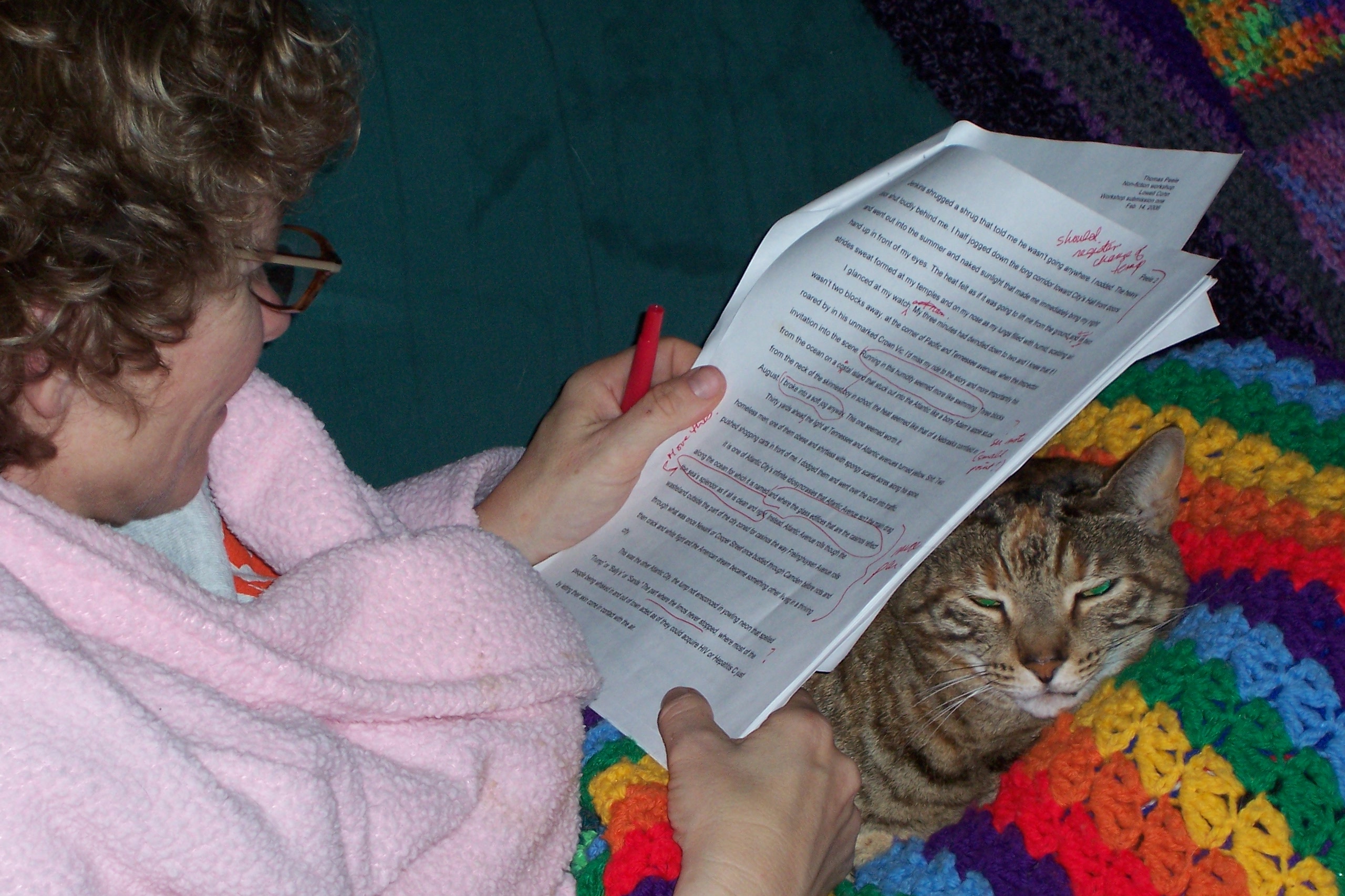
My passing comment about SRW the other day was due to my disbelief that we had again built another cargo-cult standard on whose behalf we will stand forever on the beach, gazing into the sky for those followers we are so sure will eventually arrive — a standard, no less, that requires the rest of the world to conform to us, much as our small tabby cat imagines the house and its occupants are entirely at her disposal and await her every beck and calling (though in her case, she may be right). Sometimes I wonder if we can ever do anything else.

Harry Potter and the Frog Strangler


Frog Strangler

Originally uploaded by freerangelibrarian

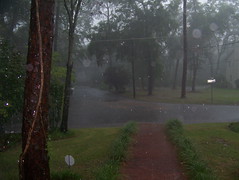
About two o’clock today, the house began to twitch… well, not really, but we had a thunderstorm so loud I levitated the first time it cracked the sky. The power went out several times. The cats flattened themselves in the back of the bedroom closet. I gave up on trying to read with the lights going off and on, and sat in the dark a while before a friend called at 2:30 to “talk turkey” about one of those management issues that friends call to talk about.

A dark afternoon suited my frame of reference, as I finished Harry Potter this morning around 3 a.m. (after waking up at 1 a.m. wondering where I was and realizing I had fallen asleep on the couch). I spent this day trying to write an article as I dealt with the cold reality: I would never again crack open a Harry Potter book for the very first time!

But I have so much to look forward to… a wonderful new job… a drive along the Georgia coastline… turning 50… learning more Floridian vernacular. Life is good!

NASIG revisited — a series of posts — introduction

To fulfill a contractual obligation to submit a “small paper” in addition to delivering a plenary session at NASIG’s 2007 conference, from now through August 24 (or earlier, if I feel I’m done — “small paper” is a nice loophole) I will be writing a series of posts based on my presentation, State of Emergency. These posts, together, will be protected under a Creative Commons 3.0 Attribution License.

I haz a job! (is neet! do like!)

R&D is very hard workYes, the long national nightmare is over! I have real employment, with great people in a wonderful organization!

As a: RESEARCH & DEVELOPMENT CONSULTANT

(It was capitalized in the job announcement, so I assume that’s how it is usually spelled, OH, AND WHY NOT!)

And it is at:

College Center for Library Automation (CCLA)

Which despite not being in all caps is nonetheless:

a collaborative state-funded organization established in 1989, to provide and maintain the Library Information Network for Community Colleges (LINCC) to Florida’s 70+ community college libraries

And incredibly enough,the job actually entrusts me with MAJOR FUNCTIONS (also in caps), q.v.:

Monitors, assesses, and reports on library, information industry, and other standards for implications regarding CCLA/LINCC services and products. Coordinates CCLA consideration of emerging standards and technologies. Provides expertise on the integration of library and information industry standards (metadata controls, data structures, linking mechanisms, etc.) and related technologies into digital products and services provided by CCLA. Defines and recommends LINCC quality standards in cooperation with staff using established advisory processes. Monitors, assesses, and reports on technological trends for implications regarding CCLA/LINCC services and products. Monitors, investigates, tests and evaluates potential new or enhanced LINCC-related services and products as needed. Determines and documents feasibility, functional requirements, and product features. Proposes potential new applications for LINCC users and/or CCLA staff. Recommends appropriate implementation strategies for user needs and CCLA resources. Provides leadership for CCLA services and LINCC-related maintenance and development projects as designated. Coordinates all aspects of service/product design, development, delivery and resource utilization within CCLA’s team processes to ensure timely and effective implementation. Consults with CCLA staff, vendors, and other organizations as needed to deliver appropriate and timely services to LINCC users. Participates in CCLA planning, decision-making, and operations as member of teams and work groups. Maintains effective communications that keep CCLA staff informed of the status of all areas of responsibility and contribute to coordinated implementation of services. Provides input and advocacy regarding user needs, trends, and issues that can have an impact on CCLA/LINCC services. Serves as staff resource person in areas of responsibility. Represents CCLA at meetings and other professional events as required and makes presentations regarding CCLA/LINCC services as needed. Performs other duties as assigned.

Great job, huh? Thirty years in the full-time workforce, and this feels like one of those once-in-a-while jobs that offers everything — great people and organization, perfect responsibilities, a nice short commute, and a great location (who doesn’t want to say they work in Innovation Park?).

I took my time and so did they; I wanted this to be right (and I was willing to keep freelancing if it wasn’t, and passed up some other, not-quite-rights along the way). I’m happy, and so is Sandy (and I’m guessing the church will be, too). I start August 10. I’m going to take some personal writing time next week, after I wrap up a couple of deadlines, and we’re talking about going to Savannah the following week for a couple of days, returning just in time for me to dust off my workin’-lady clothes and find matching trouser socks.

Thanks to all of you who cheered me along and gave me advice… good to be back in the saddle again. I am sure my blogging will decrease quite a bit while I settle in to my new position (once I knew Real Employment was very likely in my near future, I stepped up blogging… revised some old essays… finally alphabetized my books… organized my office closet… and sent out a few more pieces… and slept in til 9:30 today, just because I could). But don’t worry, once in a while you’ll still see me out on the Free Range, postin’ away.

It was a dark and stormy neocortex…

Tonight the Tallahassee Writers Association featured a talk about description by Janet Burroway, FSU writing prof and author of the classic textbook, Writing Fiction. I was cranky and had a pounding headache when I arrived, but Burroway engaged so wonderfully with her audience that I forgot all about the challenges of the day as she explained how using good descriptive language engages the reader’s neocortex, zapping the ol’ limbic system with words that evoke the chemical reaction between physical reaction and emotion.

It’s one of those theories I don’t ever want to learn has any flaws to it. Even if we find out some day that the neocortex simply exists to allow us to make right turns on red without killing ourselves, I’m going to keep believing in Burroway’s argument, if for no other reason than it sounds a lot cooler than spouting “show, don’t tell.” (That gets flogged to death, does it not. The great part about creative nonfiction is that there are no penalty points for ‘telling,’ assuming it’s done the right way and in the right place. If an essayist didn’t get up on her stump and start thinking on the page now and then, people would think she was simple.)

I have decided to give the Tallahassee Writers’ Association another try (even though we spent fifteen minutes on a writing exercise about whales in which we were really discussing orcas — fortunately, I contained myself from pointing that out, and I guess “Shamu, the easily-socialized dolphin” does sound a bit lame). TWA feels peppier than it did last fall, the topics are interesting, more young people show up… I still have an issue with a workshop session where we don’t share our work in advance (at that point, I just went home, as do most members), and I note that again, the annual 7 Hills Writing Contest puts a 1,000-word limit on essay submissions, but at least TWA pulls together struggling writers. Not that it could ever compare with the elite SWAT team, The Greater Tallahassee Literary Writers’ Guild and Reader’s Advisory Service, but I do think I shall show up to TWA next month, too.

We had a discussion about point of view, which in retrospect was the first time Ive been to a TWA meeting where we’ve really dug into Craft — I mean got its sticky stuff all over our hands. At one point someone asked Burroway what was the meanest trick an author could play on the reader, and she fired back, ending a book “And then I woke up.” Amen to that. Amen also to having only one question about playwriting all evening. Amen to returning to a discussion about point of view.

Several titles Burroway or her introducer mentioned that will have to go on my “git list”: two of her own books (Raw Silk, Embalming Mom); Douglas Hofstadter’s I am a Strange Loop; David Mitchell’s Cloud Atlas.

I’m now ready to collapse with Harry Potter, using the copy loaned to me by Lisa, my writing buddy; I want to read it straight through, but I don’t want it to end. That, to me, is great fiction.

Eight Tips for Healthy Meetings

Do you stagger out of meetings moaning how you hate, hate, hate meetings? Do you yearn for anything — earthquake, hurricane, building collapse — to get out of the meeting you’re in? Do meetings have to be so awful?

The bad meetings always stand out in my memory, but actually, I’ve attended many good meetings, as well. They had a few things in common.

1. Agendas. A good meeting has an agenda. It might be a very informal agenda, such as “Today we are all going to share for two minutes each on everything we’ve done this past week.” Or it might be an elaborate, three-level-outline agenda. But a meeting without an agenda is not a meeting, it’s an encounter group.

2. Openness. Unless the meeting needs to be closed (personnel issues, for example), the meeting is not only open to those who are required to be there, but to people who have an interest in the topic and want to sit in. That also means that meetings are held at times that facilitate this openness (for a major violator of this principle, see ALA Council, which does the bulk of its work a day after the conference has ended). This openness not only contributes to cross-pollination; it also makes meetings more broadly accountable.

3. The meeting is the meeting. That sounds either Zen-like or Seuss-like (or a little of each), but let me clarify. I have worked in a number of settings where the announced meeting was really just a showcase, and key decisions took place before or after the meeting among the informal leaders in the organization. A variation on this is the person who hangs around after the meeting and has a special one-on-one meeting with a key decision-maker which alters decisions made at the meeting or makes new decisions on topics that weren’t addressed. Obviously, the cure for this is fairly complex — these problems are symptomatic of a toxic organizational culture — but if you can affect real change at that level, then meetings have a chance of becoming meetings again, and not charades resented for the time they suck from activities that people have some control over.

4. Time management. The push is to get the meeting done so people can leave the meeting and Do Something. Meetings not only have start times, but end times. Meetings do not wander on and on; agenda items have time limits. It is true that good meetings contribute to outcomes, but meetings rarely are the bulk of the outcome, and a meeting should leave people jazzed about the issue at hand, not exhausted and burned-out. (Oh, and don’t you love the admin-type whose power trip includes breathlessly showing up late for every single meeting — often with a dramatic explanation of the Very Important Thing that made her late? Yeah, me neither: if you can, start the meeting on time and don’t let this person get it off course when she arrives. Otherwise, practice your patient half-smile.)

5. Democratic but not anarchic. On the one hand, the meeting is not a lecture; you do not sit there, wishing you were dead, while for an hour someone on high reads notes that should have been sent out by email, or asks “questions” that have predetermined “answers.” People have discussions, and discussions resolve problems or lead to problem resolution strategies. the convener makes a special effort to acknowledge all meeting participants and draw the best out of them. On the other hand, the meeting is not dominated by trolls who filibuster on every topic (often with extreme negativism and pronounced opinions) and drown out meeker voices as they hammer home Their Way of Doing Things. To keep a meeting democratic without becoming anarchic requires some adroit, situation-specific meeting management — some of it thought through in advance, with a strategic awareness of the participants’ behavior styles — but it’s key.

6. Not every issue needs a meeting. (Tangentially, see also my observation earlier that for every action there is an equal and opposite committee.) Sometimes a problem can be at least partially resolved by two folks standing around a cubicle tossing a nerf ball; sometimes it’s too early to meet because you don’t know what the issue is. Sometimes the issue needs slow, protracted online conversation (easier among people who work this way naturally) rather than the artifice of ten people, a room, and an agenda.

7. Not every issue can be resolved in a meeting. I’ve seen meetings where the participants were determined to come to a conclusion right then and there. But a meeting is not always the right venue. Sometimes you need more information. Sometimes it’s too early to make a decision. (Yes, this does have to be balanced with not having a separate meeting-outside-of-the-meeting structure.) Sometimes you need to send out the email that you think you need to read aloud at the meeting because no one’s reading it, and if people aren’t reading it, find out why. Sometimes the issue requires an innovator, or serial conversations — someone interviewing people sequentially. Sometimes the issue is too volatile to discuss in the meeting format; you don’t want people being agreeniks because they feel put on the spot.

8. Food, fun, and familiarity. I tend to like work for work’s sake, so it took me a while to learn that offering a nibbly or two can greatly improve someone’s opinion of a meeting, as can a little fun (sharing something humorous) and recognizing human, non-work-related events, such as birthdays, new babies, household moves, and other events that make us who we are.

But the yummiest nibbly in the world can’t compare to a meeting that engages the right people for the right reasons, starts and ends on time, and leaves you better-equipped to handle the issue the meeting addressed.

Institute for the Future of the Book Releases CommentPress 1.0

The if:book folks have released CommentPress, a fascinating WordPress theme that allows paragraph-by-paragraph commentary. CommentPress has great potential… at some point I  suggested it could be used for public discussion of license agreements, such as those from Google Book Project.

I was privileged to test CommentPress before release — you can visit my test site here — and as I went through the version changes, exploring all the features, my mind churned with other applications, such as distance education, analyzing federal budgets, and so forth.

If it had one more level of division to it, CommentPress would be superb  for producing online journals — that is, if instead of essay/paragraph, the content could be grouped along issue/essay/paragraph lines. (Yes, I’m just an old-fashioned gal.)

But that is neither here nor there. Download it, or play with my installation, but whatever… have fun! Nice job, if:book!