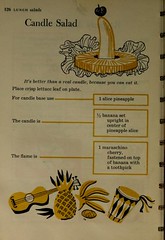
Originally uploaded by Ellbeecee
And I have absolutely nothing to say about it. It’s just a salad. In a cookbook for kids. So stop laughing! (Thanks to Twitter friend ellbeecee for the tipoff.)
Bookmark to:



(N.b. I have a Flickr set tagged CNF2008, and I also set up a mailing list for anyone interested who attended.)
I’m doing a turn-and-burn — touch down, refuel, take off with afterburners blazing to teach “Writing for the Web” for NEFLIN on Wednesday — but I wanted to share my top ten favorite things about My First Writing Conference, the Mid-South Creative Nonfiction Conference held in Oxford, Mississippi this last weekend by the Creative Nonfiction Foundation.
1. Fab-u-travelous location! For a town of about 11,000, Oxford sure does have groovy culture and some mighty fine cooking. The “Square” is dominated by Square Books, a venerable independent bookstore — really, three bookstores — that also hosts weekly recordings for Thacker Mountain Radio. (I heard Dinty Moore read from his memoir, Between Panic and Desire; there is absolutely nothing like the full-bodied acoustics of a large public reading.) I’ll talk about the food in a separate post, but Oxford’s comestibles were indeed toothsome. Then there are boutiques, jewelry stores, other looky-loo stuff, and nice-for-walking side streets.
2. Swank conference facilities! The rooms were handsome in an unscuffed, looky-here-we-just-renovated manner, and I was comfortable the entire time (except for swimming around in huge boardroom chairs on Friday). Our workshop room on Thursday had a late-model Smart Board.
3. Decent lodging! The Inn at Ole Miss is plain but decent, and very affordable. My room was missile-silo quiet. The conference facility was only about two city blocks away. (Be warned that the parking is dreadful, due to construction.)
4. Cozy size! With fewer than 100 attendees, I was able to make friends, talk with agents, hobnob with the creativenonfictionerati, etc.
5. Knowledge-imparting preconferences! Small classes, good instructors. I don’t know about the other classes, but I soaked up a lot in the structure and characterization classes.
6. Illuminating talks! The conference theme was travel writing, yet science writing came up a lot as well. I’ve never heard agents or publishers talk about their business, so that was helpful.
7. Schmooze-friendly schedule! The conference was carefully structured to allow us long lunches and to provide us with a minglish event every evening.
8. Pitch practice! I understand this happens at most writing conferences, but I was able to talk to flesh-and-blood publishing types about some magazine article ideas — a first for me.
9. Faulkner’s home! Which I didn’t visit! That’s right! Buh-bye Willy! I don’t give a rat’s fanny about Faulkner, and it’s possible to feel that way and enjoy Oxford. Instead, I sat in L&M’s with three new writing pals, stuffing my face on righteous sustainably-grown local happy-pig andouille and making happy googly eyes at the chef. Oh wait, I wasn’t going to write about the food just yet…
10. Aforesaid pals, far more than three, who provided catharsis, giggling, intrigue, rapid information exchange, note-swapping, walk-taking, plate-sharing, commiserating, scheming, planning, comparing, and meal-refrigerating (I had a fridge in my room, which meant that somehow, on Friday I became the curator of Elena’s leftover shrimp, which she ate for breakfast Sunday morning). I like them all (the people, not the two-day-old shrimp). I hope it’s not the last time I see any of them.

Originally uploaded by freerangelibrarian
Last week I paid four dollars for a dozen eggs, and that was an insanely good bargain. They weren’t just any old eggs; they were fresh eggs from a local farm, and aside from being almost too unbearably pretty to crack open — they were pastel blue and green and yellow, some with tiny tan speckles — they had an egginess that was other-worldly, a full, buxom flavor that makes supermarket eggs taste like paper towels by comparison. We had eggs for dinner, scrambled with minced Vidalia onion greens and a little turkey sausage, and those golden fluffy eggs were better than many a pricey restaurant meal I’ve had in my life.
So Thursday I cracked a few eggs in that writing class. I got my money’s worth and then some. It was hard, necessary work.
I woke up Friday morning and almost wished I didn’t have a class that day, I was so eager to sharpen my knives and take them to essays that have the germs of ideas I’d like to forward but just aren’t working yet. At least two of these essays are going to be teardowns; they don’t work in their current form. Now I can see why.
(But Friday’s class was wonderful, a class by Dinty Moore — not the stew, but the famous writer/teacher– on characterization, filled not only with fabulously practical advice, but with laughter, encouragement, and much chocolate. Thursday was the day I worked on a weakness; yesterday I worked on a strength. I’m glad I did that in that order.)
(Oh, and if you want to know how Dinty got his name, read his book!)
Then last night I went out with other conference goers and had a long, wonderful evening — passable food, delightful company — and that helped too. We’re all struggling, word by sentence by paragraph, and they (and a couple of friends back at the ranch) reminded me that placing four (maybe five) essays in a year is really not bad at all.
The eternal message I have for myself is “I suck as a writer,” but — in addition to instruction that may help dial down the suckmeter — it helps to be reminded that this opinion is endemic to the profession and in its own loopy way, crucial to my success.
The first rule of workshop is, do not cry at workshop.
I ran that tape in my mind over and over again this afternoon while the instructor for my writing workshop carefully, politely explained why my essay didn’t work.
I knew it didn’t work; that’s why I brought it to workshop. It has beautiful language and interesting ideas and absolutely no forward motion of its own; it was a leaf shuddering in the vortex of a stream. This essay and others with its problems explain why I was so eager to spend the first day of my vacation with a dunce cap perched on my head.
I got what I came for — I got exactly what I wanted: a clear map of where I went wrong. It was useful. It was good. It was probably the best explanation of structure I have ever heard. It was also the best feedback I’ve had on my writing since I left the dear Jesuits at University of San Francisco back in Ought-Six.
So you’ll have to forgive me for being a bit numb. I was a brave little writer, but I sleptwalked out of class and to another event and then to another event, dimly aware of speakers and music and wine and conversation, my skin on fire with the humiliating knowledge that I can profoundly suck in ways I hadn’t even realized.
Someone in class rolled out that over-plucked canard, “You must kill your darlings.” I kept my mouth shut (because the second rule of workshop is, one stays silent while being workshopped), but those who know me are familiar with how ruthless I am in my writing mantra, “Reduce, reuse, recycle.” I don’t have sentimental attachment to the word ingredients in my writing; if it’s good stuff, it will resurface in some other piece, and if it doesn’t, then let it stay moldering in the literary compost pile.
I just wish I could always see where I screw up.
Mississippi, that is, for the Mid-South Creative Nonfiction Conference. By all reports a charming town, with a great bookstore and several good restaurants.
This is my first vacation by myself in over fifteen years — since I met Sandy –and it seemed like a good idea at the time, but I now feel a little stressed. I’ve done plenty of business travel on my own, and even a bit of obligatory family travel, just not personal time that was all about me.
Plus what if I show up and all the Writing People laugh at me?
On Thursday I have a workshop to keep me busy, and on Friday the events start at 3 p.m. It’s not as if I don’t have things to do to fill in those spare moments. At some point this week it burbled into my brain that I’m teaching a Writing for the Web workshop next week at NEFLIN, and I began pulling together the bare details — I can work on the wiki. I’m also taking a (ab-fab!) class on food writing through Stanford Continuing Ed, and I’m sure I’ll have homework.
Though lying in a bed reading til noon also sounds grand…
I try not to think about this too often, but at times it’s depressing to contemplate that a capital city with two universities can be home to a “Gourmet Guide” — really, next to what you can find on Chowhound, the only local guide to dining in Tallahassee — with a rating system that makes absolutely no sense.
Last week’s review of Liam’s should have afforded me some comfort. It’s a relief to see coverage of a restaurant that is not a chain (why does Outback even need a review — do Blooming Onions change that much city to city?), did not last update its interior in the Eisenhower administration, and hasn’t forged new records for critical health inspection violations.
Stiff’s language was even, for once, restrained — which is, believe you-me, a Good Thing. I have written on Chowhound how painful Stiff’s writing can be when the Dem’s editors (clearly distracted by the far more important business of reporting ad infinitum on FSU’s football team) let Stiff stain their newsprint with far too many of his sappy puns, down-home yucks, and windy references to The Good Old Days of forty and fifty years ago (you remember those days, when Jim Crow reigned and women couldn’t get credit cards on their own recognizance).
I won’t even quibble that his review of the actual food at Liam’s is scant on description, as is true with most of his reviews. His background in the industrial-strength hospitality business is evident in his focus on the setting and service (not bad things to address) and his brief, sensory-limited comments that a dish is “nirvana” or that the duck is “rose-pink rare.” (With duck, the first question is always is it rubbery.)
Nor will I dink Stiff, who comments on Liam’s commitment to healthy food, for failing to observe that one current discussion in the foodie world focuses on the environmental tradeoffs to shipping organic goods long distances — as in, flying in organic duck from upstate New York. Liam’s does feature many local foods; the pea shoots that graced my (local, sustainably-caught, sweet as sugar, fresh as a splash of ocean foam) sea bass grew somewhere between here and Thomasville.
Furthermore, with respect to environmentalism, Tallahassee is so far behind on its developmental milestones — the topic is still a big yawn to many in this area, where the unapologetic guzzling of energy resources can border on the grotesque — that Liam’s may have to simply serve a high-demand food such as duck if it’s going to compete with other top-drawer restaurants. I have had duck at a number of local restaurants (Urbane’s so far was the best), and it’s only my gradual interest in ethical, environmentally responsible dining that even has me raise this question.
I will even forgive Stiff for attempting to go foodie on us in his wine discussion while not realizing that despite their small but nice wine list — a fairly new turn at Liam’s — they welcome “BYOB.” They have no corkage fee, and will store and open your wine for you.
But then — for no reason stated — Stiff gives Liam’s four and a half “hats.”
Four and a half effing hats.
Liam’s is a restaurant that is in a completely different stratosphere from most of the — I must say it — crap in this area. Liam’s is often referred to as “big-city-good,” as in, if it were suddenly transported to Manhattan, it could stand proud next to many a restaurant of its ilk. (The lone pho house in Tallahassee is only Tallahassee-good — respectable for this area, just not in a league with big-city pho houses.)
You speak of Liam’s in the same breath as Avenue Sea (in Apalachicola) and Urbane, Sage, and Cypress in Tallahassee (Kool Beanz, Clusters and Hops, and Fusion often enter this debate as well, as do some very good ethnic restaurants, rib shacks, and breakfast or oyster joints).
But based on that ludicrous Gourmet Guide — a guide based on the singularly incomprehensible food rating efforts of Stiff himself — Liam’s is half a hat above Outback and The Melting Pot — two chain restaurants!
But then again, the Tallahassee Democrat’s Gourmet Guide is top to bottom a ridiculous mess.
Sahara — with its hand-rolled dolmas, meat or vegetarian — has three hats– just like Macaroni Grill. Meanwhile, my beloved Shell Oyster Bar has three and a half hats — right up there with Stiff’s rating for The Olive Garden.
In the “light meals” category, Jenny’s Lunchbox — a cute and tasty breakfast and lunch joint — has only three hats, while Crisper’s, a forgettable chain, has three and a half.
On and on it goes, no rhyme or reason.
I have tried in this discussion to steer clear of drubbing truly local restaurants. In food reviewing, one visit should never torpedo a local business. My sense is that local reviewing can focus on what’s great and good, and leave the rest to inference or at least, where a place must get reviewed, to unavoidable conclusions backed with extensive evidence. But let’s just say that I’ve dined at enough places on the list — some of which serve what I think of as The Food You Eat When You Go To Hell– to say without any equivocation that the “Gourmet Guide” is neither gourmet nor a guide.
Read Chowhound, ask around, learn about the area. We don’t have enough great places to eat, but we do have some, and they deserve your business. Just steer clear of the Democrat’s restaurant advice, or as happened to me far too often when I was very new here, you’ll get Stiffed.
Berry at Library Journal loves to stir the pot, but I don’t get the fuss over his latest about the Vanishing Librarians. Still, heck, I’ll give it a go.
It looks like the “transformation” we seek for libraries and librarianship may turn out to be more of a “deskilling” of library jobs than an enhancement of the profession. More and more working librarians are “managed” by a new breed of library leader. Their model for the new public library is that dehumanized supermarket or the chaotic disorganization of the largest Barnes & Noble.
Is this the lede for this article, or a Zagat review?
As this process unfolds, the once professional responsibilities of librarians are being dumbed down into the duties of retail clerks or the robotic responses of machines. Our circulation desks are disappearing. The humans who once greeted and discussed with patrons our wares and services as they dispensed them are being replaced by self-service. Those circulation clerks are either being terminated or sent to work elsewhere in the library.
O.k., let’s parse this paragraph. Librarians are clerks. No, they are robots. No wait, they are neither. OMG, furniture is vanishing, employees are being made to work Elsewhere in the Library, and Angry People-Eating Self-Check Machines are taking over!
Our reference services and the desk from which they were delivered are gone, too, replaced by wandering “librarians,” with or without an MLS. They are supposed to be proactive in searching out patrons in need but are too often summoned on walkie-talkies or terminals to come to the aid of only those who ask or to respond to the few inquiries that arrive online. Of course, we need fewer and fewer of these librarians, because patrons are urged to do it all for themselves, via Google, PACs, or whatever they discover through our terminals or their own laptops and PCs.
Damn straight, John. We sit at those desks for a reason: because it makes us look important. If patrons need assistance, they can come beg for it, and we can continue asserting our professionalism by pointing patrons to an appropriate section of the stacks — preferably up several flights of stairs and down some sepulchral hallway. If they don’t find what they’re looking for, tough nuts. What do they think this is, a service industry?
Our catalogers began to disappear with the takeover of that function by OCLC, the nonprofit that aspires to be a corporation in this brave new retail library world. The standardized result of the effort is bypassed by patron and librarian alike, as they turn to the more friendly Amazons, Googles, et al., for the less precise, more watered-down “metadata” that has replaced what used to be cataloging. Apparently, users don’t miss the old catalog, except as a familiar artifact, which is testimony to how low this dumbing down has taken us.
Exactly right here as well. We need a lot more expensively-produced, randomly dissimilar MARC records floating around privatized ILS silos. Makes us look sharp as a profession.
In the new model, that most sacred of our professional duties, the selection of materials to build services and collections, is turned over to either small centralized teams of two or three librarians and clerks, or in extreme cases to an external vendor, usually a library book distributor.
Once again Berry is on the bus. If only we could go back to the good old days, before organization, teamwork, and the “because I like this author, that’s why” school of collection development!
The resulting “destination” libraries resemble the cookie-cutter design of the grocery store, aimed at making sure everyone who comes in goes out with “product” (books, CDs, DVDs, or downloads). What the patron takes is of as little concern to the storekeeper librarian as it is to the supermarket manager. The success of the enterprise is measured in the number of products collected by patrons, now called “customers.” It is no longer measured in the usefulness or impact of the service on the quality of life in the community served.
Wow, I wish I had worked in Olden Tymes, when libraries knew how to measure the “impact” of reading on their users instead of asking stupid questions like how many “products” the “patrons” were actually able to get their hands on. Sounds like a real lost art.
Many of the American Library Association-accredited LIS programs that once claimed to “educate” the professional librarians who run these libraries have been invaded by faculty from other disciplines, a great many of whom are far more adept at the politics and pedagogy of academic survival than they are at the principled professional practice of librarianship.
Are you sure it wasn’t a hostile take-over by the Employees Who Don’t Want To Work In Other Parts Of The Library?
Now the progress of this deskilling has come full circle. Having discovered that the manager librarians of these supermarket libraries need fewer and fewer professional librarians to staff their simplified operations, the governing authorities are beginning to decide they don’t need a professional librarian to manage them. Some have been turned over to successful business types from industry, some to lawyers, some to academic administrators or fundraisers, and some to professional financial managers.
Methinks Berry either has some examples in mind he forgot to use, or he copied this paragraph from “Michael Gorman: Hits From the Golden Years.”
The most surprising part is that so few library leaders have raised their voices in alarm or outrage at this erosion of the standards to which libraries once aspired. It is frightening to think that we will stand quietly by and watch as professional librarians disappear from libraries and with them the quality of the services and collections in which we once took such professional pride.
Berry states the solution in the second paragraph. We must rise up in arms against the Angry People-Eating Self-Check Machines… because when self-check is outlawed, only outlaws will have self-check.
 I wasn’t in the mood for Thistle and Shamrock on my drive home from a Sunday afternoon writing siege at Panera’s (a little Celtic music goes an extremely long way for me), and I really wanted to finish listening to the latest On the Media show I had downloaded to my iPod, so I rummaged in the scary bottom floor of my purse for my Kensington digital iPod FM transmitter — but came up with a handful of parts.
Somehow the transmitter had separated. The tip, which constrains all the innards of the transmitter, screws off, which is a good thing if I ever need to change the fuse (I didn’t even know it had a fuse until the transmitter deconstructed), and a bad thing for someone with a purse so messy for all I know the WMD are in there.
I found four parts. The only problem is that there are actually five, and the missing part is a bespoke little spring that makes the doomaflatchy stay firm against the whatsis so the whole thing works.
So I wrote Kensington and asked them if they sold a spring or could provide one.
No, they said, they couldn’t. (This unit is being discontinued, Amazon advises.) But they could send me an entire replacement unit, assuming I could provide them with my address (easily acquired; I ran outside my house to make sure I remembered it correctly) and the serial number on the unit, which gave me a day’s pause as I rummaged through my office (strangely evocative of my purse) for the handy Brookstone magnifying glass a friend had given me two years ago. (I think the magnifying glass was a regifting thrice removed from friends who are pretending they aren’t growing old, and who will later complain that they can’t read the serial number on the back of their iPod/transmitter/Treo/computer, etc.)
Now, I’m sure Kensington doesn’t replace entire units for every customer query or problem. I’m guessing “you need an X fuse” is their most common response, and if I could fix this with a fuse, I would. I also suspect that tepid reaction to their new unit might make it good policy to send out freebies for customers with problems with the old ones.
But I already adored Kensington for the value this product had added to my life — and if you think that’s an overstatement, try driving from Tallahassee to Atlanta with only the radio as your companion (which is why it usually stays in my purse: so I have it when I rent cars).
For that matter, try driving to Publix from your home when the local public radio talk show is all a-chatter about poor picked-upon Mr. Vicks who ain’t done nuthin wrong. In exasperation against local radio programming I have used my iPod and my FM transmitter to create Radio Free Tallahassee, and I now donate directly to the public radio shows I regularly download. My iPod transmitter isn’t some miscellaneous bit of technology; it’s part of my local survival strategy (and I went through several other brands before finding one that worked).
So while I wait for the new transmitter, I shall hum to myself quite a bit — and the song shall be “If only we could all be like Kensington.” When my transmitter finally meets its maker, the chances are extremely good I’ll buy another Kensington. If the new unit is a dud, I’m going to be a lot more forgiving, and still willing to give Kensington a chance, and if I like it, I’ll coo all over Amazon. Overall, they’ve set the temperature of my warmth for their company far higher than it had been before I reached into my purse and came up with a handful of metal and plastic.
Meanwhile, in preparation for some Very Serious Work (research about research — the thought makes me dizzy), I ordered The Black Swan from the Leon County library. It arrived, but in the wrong format (CD instead of print). So I wrote the library, and guess what? I got the same service.
The library didn’t say “You ordered the wrong format!” There weren’t demands to come in to get this right or even call them (this was all by email). They immediately reassured me that the right format was on order — and guess what, they even told me when it might arrive. I know they have funky old catalog software that makes it difficult if not impossible to put this last bit of information into messages, but how wonderful that they took the time to share it with me so that I didn’t have to give up and buy the book from Amazon.
I’m always happy at that library — if they don’t have a book, they get it for me fast, and everyone is so friendly. I feel welcome there. But I felt welcome by this email exchange, as well.
The key here is understanding that it’s not the freebie or the close attention to an interlibrary loan. It’s not about the policy or the workflow. It’s about the focus on making — and keeping — happy, even passionate, customers.
At first, when I couldn’t find a post I had made on Chowhound yesterday morning before I left for work, I chalked it up to my own sloppy surfing. I have been acutely focused on Friday’s talk, as many people from MPOW are coming, which I am finding very stressful to the point of frazzlement and hair-pulling (if I flub a talk 300 hundred miles from home, I can fly home and be done with it; but I see these folks every day).
But then I looked in the cache for Bloglines and found my own Chowhound post and the one that prompted it, in reference to this discussion of Urbane, a new restaurant in Tallahassee.
It’s not even the first Chowhound post of mine that has evaporated into the net-ether. Last week I linked to my review of the Shell Oyster Bar, and that vanished. I thought, well enough: they don’t want bloggers using Chowhound as a honeypot.
But what was wrong with the following posts? (Posting dates refer to Bloglines’ feeds, not to Chowhound’s timeline.) I thought we were having a smart exchange about the nature of expression with respect to food.
And how comfortable are we about living in a world where commercial enterprises calling the shots on intellectual freedom — with nary a word to the authors? Yes, I know they say they can do that — but is that the world we want to live in?
The other poster’s comment (sorry, I don’t remember who it was!), Tue, Feb 12 2008 4:35 PM:
“Coffee & Doughnuts” sounds lifted directly from The French Laundry Cookbook. “Coffee & Doughnuts” is one Thomas Keller’s signature dishes. It is one of my most revered and treasured cookbooks. IMHO it is one thing for a recreational chef to prepare something right from a cookbook, but for a “Chef” who is paid for his creativity, technique, and talent to plaguarize…I would expect more than that. I have followed previous threads on different sites and this topic of chefs plaguarizing has been thoroughly dissected. Bascially, is it right for a chef to put a dish on his menu, take credit for it, when it has been directly lifted from another chef. Take classic dishes for example; Nicoise Salad, Beef Bourgogne, Tarte Tatin, the list is endless. These dishes are constantly replicated, however a good chef will reinterpret. In this case the classic dish is actually a cup of joe with fresh doughnuts. Thomas Keller is world renowned for his whimsical approach to classic dishes. So is it fair for another “chef” to steal his dish, even though it was published in his cookbook (meant for the home cook)?
My response (Wed, Feb 13 2008 9:54 AM):
Well — this was not a cup of joe with doughnuts (which I would not have bothered with); it was a silky mocha semifreddo topped with cream — a fake frozen latte — served with doughnut holes, really very moist, hot quasi-beignets. So if the name is borrowed but the dish is reinterpreted, is that not acceptable? In the literary world, titles of books are not copyrighted; unless someone outright trademarks them in advance, they are not protected. I can’t present the text of Pride and Prejudice as my own, but I can certainly use that title and then whimsically write my own take on this classic. To me this is not “lifting” (let alone plagiarizing) but responding. Food is a conversation. Urbane’s chef replied to Keller, “This is how *I* see this dish.” That to me is not only legitimate but delightful. Riffing on other chef’s interpretations is a way of saying we are all participating in an ongoing discussion about cuisine. Urbane’s interpretation may well be conditioned by the idea that in Tallahassee, palates are far less jaded than in the Bay Area, and a local diner might be acutely disappointed by a dish that would seem cute or whimsical for the culinary Brahmins of the world. I appreciate your erudition here, by the way — I will probably never dine at the French Laundry, but it’s nice to find out that a local dish has more classic roots than I realized. I just hope we never find ourselves dining on “Lamb Shanks French Laundry — All Rights Reserved.”
 It is very early Wednesday morning, and I’m feeling some small beads of sweat on my neck. I’m looking for inspiration any way I can get it — from my brain, from divine sources, and of course, from you, gentle reader.
This Friday morning I’m giving at talk to SOLINET about how to market, get buy-in, and otherwise feed and water your library’s blog. I think I agreed to this last summer, when many very nice people were finding me gigs to keep food on the table.
In any event, when I was reminded in November of this commitment, I said to myself, self, I said, that’s February — no problem!
Then in January, I said, pish tosh — that’s over a month away!
Then last week I said, I have the whole weekend! But then I had that icky muscle-thingy happen, and I was so heavily medicated my doctor warned me against not just driving, but using kitchen appliances with moving parts. So I decided PowerPoint was a kitchen appliance (it chops text, right?), and lay on the couch, reading.
Cut to Wednesday morning. I’m still dorking around with my slides, and though I had brilliant thoughts in the shower, they got toweled away. I have a few ideas, but am struggling.
(I’m talking about blogs affiliated with libraries and library organizations and oriented toward library users… not the free range type, like this one, and not otherwise excellent “industry” blogs, such as Library Garden and It’s All Good.)
My go-to blog of choice is Icarus — a lovely blog where many posts have a voice and a focus on “you, library user” — and the AADL’s blog, but surely the well can’t run dry there.
I’m not limiting myself to library blogs — because the point is not “how can I have a blog as good as the best in LibraryLand,” but how can I have the very best blog possible — unfortunately, not quite the same question. But I want to give honor where honor is due.