Skip to content

Summary of my defrag talk

Pete Warden of PeteSearch provided a great summary of my defrag talk. (I love his one small error: don’t you think we work with “marked data”? There’s a posse lookin’ for yew, and yew is marked.)

I’m tagging this with the naive tag provided at the conference (defragcon) and two variants: defragcon07 and defragcon2007 (Y2K-compliant ;> )… Uh, I say that, but I don’t see the tags showing up on the post. I see them here, in the tag section. Perhaps a theme issue.  Something else to debug…

Workshop: Writing for the Web

This is a syllabus-in-progress for a workshop I’m teaching this Friday, “Writing for the Web.”

I know a lot of instructors consider their syllabus to be closely-guarded goods, but my take is that this syllabus is not much more than “CliffsNotes” for what (I hope) will happen in the classroom — and I’d rather put it out there and get feedback.

Plus, if you’re taking this workshop, you aren’t required to read anything in advance; we will go over short sections in class. But in the immortal words of my paternal ancestors, “It couldn’t hoit.”


1. Preliminaries (15 minutes) 9 – 9:15

  1. Administrivia
  2. Introductions
  3. What this class is about (and why most examples are not from LibraryLand)
  1. Welcoming exercise: co-authored story (15 minutes; group exercise, smartboard) 9:15 – 9:30
  1. Writing for the Web: what are the genres, and how are they different? (30 minutes; discussion, smartboarding) 9:30 – 10
  1. Blogs: Icarus, Hot Coffee Girl , Andrew Sullivan , Broadsheet (group blog)
  2. Magazines and Journals: Salon, Slate, Huffington Post, Brevity
  3. Cartoons and other mixed media: XKCD , Unshelved
  4. Podcasting and video: QandANJ, 23/6
  5. Microblogging: Twitterlit; Twitter haiku
  6. Simple old press releases, user forms, etc.
  1. Tips for writing for the Web (1 hour; lecture, discussion, smartboarding) 10 – 11:00
  1. Beginnings and endings: Joel Peckham, “Scream,” from Brevity; Heather Armstrong, “Reading the Fine Print” from Dooce
  2. Scaling your work for the web reader: Short posts, Ron Hogan, Galleycat; Short sentences, Chris Rose, Nola.com; short paragraphs, Alexis Wright, “The Disney Look,” Switchback; honing in on the main thing, Tayari Jones, “This is NOT my lucky sweater,” Tayari’s Blog
  3. Using an active, first-person voice: “Zen Interlude: Spring Awakening,” from Panopticon
  4. Scene, setting: Gail Siegel, “The Telemarketer’s Point of View”, Salt River Review
  5. Description: Anne Panning, “Candy Cigarettes,” Brevity
  6. Dialog: C.D. Mitchell, “This, Too, is Vanity,” storySouth; Lowell Cohn, “My introduction to Linguistics,” Switchback
  7. Voice and humor: littera abactor, I Has a Sweet Potato
  8. Integrating other media: photo, Zacharek’s review of “Bad Santa,” Salon; food photography, Clotilde Dusolier, Chocolate and Zucchini
  1. Break! 15″, 11:00 – 11:15
  1. Writing time (30 minutes) 11:15 – 11:45
  1. Getting started: write, just write! (3″)
  2. Blogging a life experience (27″)
  1. Reading from our lives (15 minutes) 11:15 – 12:00
  1. Lunch! (1 hour) 12:00 – 1:00
  1. Group exercise: a sensory image exercise to “regather” our inner artists (15 minutes) 1:00 – 1:15
  1. Feedback, editing, and the art of revision (30 minutes; handout: tips for revision) 1:15 – 1:45
  1. “But it’s just a blog”: why editing matters; Brevity craft piece on copyediting
  2. Feedback: how to ask for it, how to receive it, how to give it, when to ignore it (handout)
  3. Shampoo, rinse, repeat: why revision is your friend — and how to revise blog content (otherwise known as, how great blog posts really get written) (handout)
  1. Exercise: revising today’s exercise (15 minutes) 1:45 – 2:00
  1. Reviewing our revisions (30 minutes; smartboarding, discussion) 2:00 – 2:30
  1. Break! 2:30 – 2:45
  1. Revisiting the elements of writing (expanding topics from section 4, exploring open questions; topics may change from those listed below) 2:45 – 3:15 (handout)
  1. Form and structure: Sheila Squillante, “Four Menus,” Brevity
  2. Character: Rebecca McClanahan, “Orbit,” Brevity
  3. Telling (summary, exposition, commentary, interpretation): Lisa Harper, “Remnants,” Lost Magazine
  4. Conflict
  5. Point of view (who is “I” or “we” in a library blog?)
  6. Audience (who are “they”?)
  7. Research: Marie Fiala, “Inter-Views,” Switchback
  8. Full-tilt writing: Melissa Lafsky, “Double Take,” Opinionistas [post no longer online?]
  9. Full engagement: David Pogue, “Readers Answer some of Pogue’s Imponderables,” New York Times
  1. A final grab bag of advice (30 minutes) 3:15 – 3:45
  1. Reading your work — out loud
  2. Leveraging found content — library-focused
  3. Evergreens are ever-useful: A.O. Scott on Mailer
  4. How to subdue the Bad Voices telling you not to write
  5. Writers are readers
  6. Building and maintaining the writing habit
  7. Finding a writing buddy
  8. Books about writing (and when to close the book and get going)
  9. Classes, reading, personal instruction, workshops: Brevity’s essays on creative nonfiction
  10. Writers’ associations, lists, and blogs: TWA, AWP, Galleycat
  11. Getting published in the library press
  12. Getting published in the non-library press
  13. When to blog it, when to submit it, when to sit on it for a while
  14. Ethics and blogging
  15. Kibbles and bits
  1. Wrap-up (15 minutes) 3:45 – 4:00
  1. Review of the day’s topics
  2. Revisiting today’s co-authored story
  3. Sharing our writing goals

Acknowledgments and so forth

  • Several writing examples are courtesy of Doug Martin of the Department of English at Indiana State University, who with Kim Chinquee is publishing what promises to be an invaluable book, Online Writing: The Best of the First Ten Years (Snow*Vigate Press). Another source was The Best Creative Nonfiction, Volume 1, edited by Lee Gutkind, including a blog post no longer in… um… print?: Melissa Lafsky’s “Double Take.”
  • Other examples were suggested by readers on my blog, emailed by shy librarians, or hoovered up by me in the course of my efforts to read as much as possible for my whole entire live-long life.
  • Also see my del.icio.us collection about writing for the web and my haphazard blogroll of blogs about writing and writers.
    Two books on writing I enthusiastically recommend are Anne Lamott, Bird by Bird, and Stephen King, On Writing. There are many, many more… whatever gets you writing and revising and carries you through the dark nights of the soul when you know your writing blows chunks and you feel guilty for deserting your family for another damn story/essay/poem you know, just know that no one in their right mind will publish, is a “good” writing book.
  • Find more books at Tom Christensen’s post and ensuing commentary at rightreading.com about best books for writing and publishing.
  • If you’re wondering what a “smartboard” is, it’s not scary and like waterboarding, and it’s not as hard to learn as surfboarding; it’s an electronic whiteboard, and a pretty nifty tool for teaching.
  • Call me a funky old fundamentalist, but I will be strictly enforcing a no-email/surfing rule during class. There will be breaks where you can touch base with the mothership, and it’s actually fine with me if your cell phone is on and you dash out to take an urgent call (if I’m distracted by an occasional ringing phone, what would I be like in a traffic jam?), but writing is in part about learning to focus.
  • N.b.: This list is bulleted because WordPress 2.3.1 is driving me insane with editing problems.

Jim Rettig’s Implementation Task Force

I wanted to do a lavish long post on this, but I’m whaling away at my workshop material for this coming Friday, as I really need to finish getting it together today and tomorrow, so that on Monday another person from MPOW and I can drive to Atlanta for a NISO meeting on NCIP, which I now refer to as a “standard,” quotation marks intentional.

Where was I? Oh right! Every ALA president establishes a task force to help him or her “implement” his one-year reign (we’ll just call him Jim of 365 Days — though actually he gets a 53rd week, due to some scheduling magic… I love ALA math).

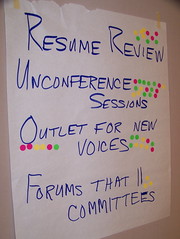
Unconferencing was very popular

As you can see from this Flickr picture, we had all the ingredients found in modern-day meetings:

  • Large pieces of paper
  • Adhesive dots in random colors
  • Markers

Ah, ALA… going from the Defrag conference to 50 East Huron was like stepping back fifteen years.

Jim’s task force is very good group: active and vocal, funny and forward-thinking, not afraid to rant at the Man, and by this I do not mean Jim (who I variously call El Jefe, El Presidente, Boss, or Chief, just to annoy him), but ALA itself. I posted some bon mots on my Twitter feed… not all of which I’ll repeat here…but perhaps my favorite was everyone snickering at the title of one ACRL report: a “White Paper on Diversity.”

The top stuff to take away is that Jim cannot change a lot of things, and wisely pushed some things off his agenda — he’s not going to change the architecture of ALA in one year — but he can move the needle, even if slightly, toward a more inclusive, user-centered ALA that has much broader appeal to newer librarians: more unconference opportunities, more “author of your experience,” more collective voice, less of the sage-on-the-stage model. Or to quote Genevieve Owens: “The member is not broken.” (Has a nice beat. You can dance to it!)

I have a much, much longer post percolating about ALA’s policy on virtual membership, and how that won’t change until ALA sees that this works to its benefit as an organization (which may take a few retirements).  I’m starting to think that instead of trying to change ALA policy, members should simply consider it censorship and route around it. Many do that already.

Anyway, ALA having one-year presidents means that fundamentally, the organization is run by its full-time bureaucracy. (Social studies majors will observe that the Executive Board technically has political control, but…) Changing ALA is a slow, iterative process. If Jim can change even one thing for the better, that will be pretty damn good stuff.

Don’t stand so close to me

Note: as a reminder, my email to bluehighways.com and freerangelibrarian.com is still very screwed up. I have had any number of people tell me they sent me email; I’ve participated in small threads where other people see responses that never arrive. I’ve sent myself email from other accounts that get there. And of course, I keep having conversations with people (through means other than email) that invariably begin, “I sent you a message…” (No, it’s not in junk mail, and it doesn’t bounce.)

The ongoing problems I’m having with with my email — I’ve now begged Fastmail to undo subdomain mapping and as soon as I’m not on the road I’m going to find a new email provider — remind me of one of the silliest arguments for open source: that people want to be close to their software.

Understand, there are many good arguments for open source, and there is obvious value to the “many eyes” approach to software development.  (No, Fastmail is not open source. That’s not the point.) But as an end-user, if I have to get close to my software to make it work well, something’s very wrong. Yes, there are forums for Fastmail and I could “engage.”  But I don’t want to “engage” in this issue any more than I want to figure out why the handle fell off our six-year-old refrigerator.  I’m busy; I’ve got other things to do. I’ve “engaged” for a month and that has been more than anyone should have to get involved with making a tool work. I just want functioning email.

Email lists: are they last-century?

Through various means — social software, personal email, conversations — I’m getting the distinct impression that many newer  librarians don’t care for email discussion lists (listservs, MailMan lists, etc.).

I’m not fighting this; in part, as a social software kind of gal, I understand it, in a blurry personal sort of way. My own take on lists is that a few voices dominate, whereas on my favorite networks, the distribution is more ecumenical.

But I’d like to know: if you don’t like email lists — why? Do you have other, better tools? Are there characteristics of lists that are offputting or alien to your behavior?  Do you communicate differently?

Defrag 2007: Exploring the Implicit

The Defrag conference, which took place over two days in December (!) November, featured speakers and panelists such as David Weinberger, Doc Searls, Esther Dyson, Marti Hearst, and a constellation of other digirati and hopefuls. There were a few interesting exhibits — Yahoo, AOL, and Siderean were there, among others.

I have the usual core dump available, but here are my highlights.

Bibliocommons

Beth Jefferson of Bibliocommons was at defrag, and last night she spent a luxurious amount of time walking me through her rather amazing product: the first truly social online catalog. After you see Bibliocommons, you realize that products such as WorldCat Local and Primo are at essence 1.0 technologies, and no, tacking the ability to tag onto an OPAC doesn’t fix that problem.

I won’t issue any spoilers, but think about this: we keep trying to connect libraries with users. But why don’t we get out of the way and connect users with users? Is the goal of Facebook to get us better connected with its founders — or with one another? Does the president of AOL appear every time we IM someone?

(Also, why does so much library software have to be so damn ugly? Well — part of the answer is that we let librarians “design” it, reconfiguring what was right to begin with into some librarian’s fantasy of how people think and search. Ironically, library staff have the least control over the side of the software where it matters most to them: the backend, where local workflow matters.)

David Weinberger

But anyhoo. David Weinberger set the stage with a numinous, searching, petal-unfurling keynote, the notes for which make for excellent reading but do not do justice to how well he gave it. It isn’t often that we spend the beginning of a conference exploring the implications of technology through a poem by Rilke. His speech resonated through the remainder of the conference (even as he high-tailed it for Italy to give another talk) and hence forward I will be seeking evidence of the implicit in all I examine.

Esther Dyson

The core of Dyson’s speech (which she shared the previous day with the FTC) was this question:

Over the years, marketers have become better and better at collecting data on individuals, recognizing them, classifying them and sending them personalized (you’re a segment) and even personal messages (you are member 582930, with 56,784 miles). So why can’t they use those same talents and show them personal disclosure statements?

Looking for a good LibraryLand speaker? I’d think she’d trump Colin Powell any day, but then so would David Weinberger.

On how the Grownups really do it

Of late in LibraryLand I’ve heard complaints that librarians give boring presentations in PowerPoint, and why don’t we use amazing networked applications, etcetera, like They do.

Actually, most talks at defrag were done with PowerPoint (or like Esther Dyson, they used no slides at all). The difference was how it was used. Dick Hardt of blame.ca gave his “defragging identity” talk with over 400 PowerPoint slides — and it was absolutely astonishing, funny, and memorable (many slides had one word or one small image). David Weinberger’s slides had a minimalist loveliness to them and a unique font; he would tease out a phrase and put it in the upper left corner of an otherwise blank slide. Only a small handful of vendor talks followed the model of a slide with a canned template replicating the words coming out of a speaker’s mouth.

I emulated the big boys and used no background; I also switched to a font (Georgia) that felt a bit elegant and bookish; and as I have increasingly done in my slides, I spoke mostly to images. I had a few live links in my talk, and they were my only logistical hiccups, because the wifi network was crowded and there were times when I held my breath while a page sllllloooowwwwwly displayed. (Very presenters tried to go online. Their audience was online, so it wasn’t really necessary.) If I had to do it over, I’d use recordings or find some other way around not having to wait on crucial information painting a slow screen or (in the case of LibraryFind) learn minutes before my talk that the site was down.

Lesson? Wheel: invented. Just make sure yours isn’t square.

Doc Searls

Doc Searls pointed out that the business model for Facebook is no different than NBC, and he emphasized that we are not the customers; we are the consumers. He railed against the machine quite well and amusingly, and at a conference where everyone bemoaned “silos,” he puckishly observed that the free market is silo-based (a thought that kept crossing my mind as I heard competing companies complain about other products not opening their data).

Conference Logistics

This was a small, single-hotel conference. We had a good negotiated room-rate, free room broadband, free conference room wifi, delicious breakfasts and lunches, and painless guidance through our activities.

The hotel is exquisite, and everyone, including Doc Searls, commented on the video art installations in the elevators. I had several good sessions in the hotel fitness center, where I watched TV or read while pounding a treadmill facing a gorgeous cityscape view. My room even had a clock-radio with an iPod dock, and for once, more than enough electrical outlets. The hotel food was good enough that Beth and I just hung here and had good noshes for dinner.

The conference was excruciatingly well-organized and yet relaxed and fun; when the first morning slipped its schedule, everyone adjusted a little. Meals were buffet-style with a little something for everyone (I am still hallucinating about the tiramisu I walked past fifteen times, but I was brave) . We wore business casual. Everyone had laptops, and each room was set up with tables and powerstrips.

(So, how does your last library conference compare with this?)

Cautionary comments

At some point on Day 1 I realized most people at this conference assumed I had put down my rubber stamp, snapped off my shirt garters, and turned the big key in the lock of some imaginary small-town library before coming to the Big City. I knew I needed to rev up my talk with library data (and indeed, during the talk I said I wished my presentation had simply been “45 minutes of random things you didn’t know about libraries”). I didn’t say anything particularly new about taxonomies and folksonomies (although I got a few laughs here and there, plus a good poke at the way we do business), but I did get some people to rethink libraries.

To boost my talk, I went to ALA’s “I Love Libraries” website, but it crapped out on me with PHP errors. I’m glad that happened, actually, because I would have been depressed by what I find there. Looking at it today, I go to “take action” and read some confusing information about school libraries. Huh? I look at the “news”: mostly negative. The section “about” libraries has turgid long paragraphs without any punch, narrative, or take-aways. It looks written by committee. I don’t really know who this site is for, or why it’s there.

I then went to ALA’s slow, disorganized website, and though for once it wasn’t down when I needed it, after digging and digging I only found some press releases with some dated library statistics wedged in among a lot of stuff about librarian salaries. I then went to MPOW’s website hoping for something like a ten-point FAQ (perhaps pointing out that 49% of all undergraduates attend community college, that eBooks and other digital resources have been a resounding success, and that we have more searches in LINCCWeb than… well, I don’t know, many places), and instead struggled to glean a little information from a hefty PDF. My best data was stuff I had previously spent a week scrounging from various sources.

No wonder sharp, interested people asked in my talk asked if libraries were thinking about becoming community centers, etc. — in other words, what our existence will be like post-book. (Note: of the audience, exactly one regularly used libraries.) It’s a valid question (sorry: it IS a valid question, get over it) and we have valid answers… just not anywhere people like these will encounter them, or people like me can get at them easily.

My defrag talk

My voice-over for this talk included a few facts about community colleges and libraries, plus a mention of Six Degrees of Francis Bacon, a game I learned from Andy Havens of OCLC. Using WorldCat Identities, I can get from David Weinberger to Francis Bacon in four steps!

(Also, the Flickr tag data is courtesy of Tom Reamy’s talk at Internet Librarian last week… and I have used the data about Library of Congress so much it almost feels like mine, though I did hear LoC present this info at a talk this summer.)

A nice group, though I’m very, very happy to be through with my presentation! I think it’s so important for us to talk outside our traditional domains — invigorates our points of view, and gives us the “embed experience.”

WordPress 2.3.1 editing problems

I upgraded to WordPress 2.3.1 because it was a “security” upgrade, meaning that after the One True Upgrade was released, people found holes in it. But I’m now experiencing very peculiar editing problems (that naturally mess with my ability to do my presentation through WordPress… Satan is in my software this week).

The big problem is “mushing.” If I try a series of paragraphs:

Now is the time for all good men

Bananas are fun to throw at monkeys

I like cheese, toasted mostly

Sometimes the list “sticks,” and sometimes it doesn’t; sometimes the words scrunch together into one paragraph. And sometimes the space between a period and the first letter of the next word gets mushed together as well.

I haven’t seen this reported anywhere… I don’t have any administrative plugins… grrrrr.

Whoops!

Something is amiss with CommentPress; the blog I set up for my presentation won’t display the posts. I’ve installed CommentPress before on other sites, so I’m assuming the latest version of CommentPress isn’t playing with the latest version of WordPress.

Ohhhhkayyyy. I’ll make sure I have the boring, predictable, but safe PowerPoint, but I’ll also do a blog post with all the links and plan on going live, with voice-over and live links.

Between the time change and the two-hour time zone difference (not to mention less than 72 hours on the ground between trips), I’m very confused… it’s a good night to cocoon with a salad, junk TV, and my talk. But the view from my room is wonderful — I’m on a high floor at the Hyatt in Denver, and it’s all very urban, glittery, and glamorous.

Del.icio.us link of the day for November 4th

Here’s my favorite del.icio.us link for November 4th: