Skip to content

Me, Inc.

Me

Emily at My Place Of Work took this great picture of me, and I thought since some of you haven’t met me in person (or know me from several hair colors ago) you might want to see what I look like, particularly in the hands of a good photographer.

This week, in between conferences, I also updated a lot of Me stuff scattered on the Web, including the pages on this blog that describe me and my writing.

I was very proud to add a link to The Best Creative Nonfiction Volume 2, due out in July 2008, in which you will find my essay, “Range of Desire.” But I was equally pleased — even relieved — to add a post-MFA essay, “Still Life on the Half-Shell,” to my list of publications. I’ve been worried I would become one of those MFAs Who Don’t Write.

I also propagated this picture as my standard photo for social software, bios, and so forth. I have several other backgrounds from this photo shoot that also work well — greenery and flowers — but as a Facebook friend noted, this picture captures a certain mischievousness that is very “me.”

Then I rummaged around for my c.v. and said, “If someone at MPOW needed this at the last minute for a grant application — or for that matter, a promotion — would I be happy with it?” The answer was “no,” so I updated that too.

I am not preoccupied with what one journalist I know once referred to as “the Karen Schneider brand.” If anything, I’m a bit too relaxed. But just as I sat back and admired myself two weeks ago after thoroughly updating my financial recordkeeping — that scrubbed-clean sensation of accounting for every nickel I spent or earned last year — I feel good for giving “Me, Inc.” a little spring cleaning.

One other thought spooling out of this activity is the need to mentor myself. I’m fortunate to have some great mentors out there — people who advise and guide and encourage me in my journey. But in the end, I’m responsible for maintaining and growing “the Karen Schneider brand.”

Twitterprose Lives Again

Creativity is thinking up new things. Innovation is doing new things. — Theodore Levitt (quoted in Helene Blowers, “Innovation Starts with ‘I’“)

I revived Twitterprose yesterday, and will try to keep it going for a while.

Twitterprose publishes a line a day (6 a.m. Eastern Time) from the best creative nonfiction. You can follow Twitterprose (at least) three ways:

It’s a blog! Subscribe to the Twitterprose feed, and you’re done.

It’s a Twitter feed! If you’re a Twitter user, just follow Twitterprose.

It’s right here on this dad-blame blog! If you read Free Range Librarian from the blog itself (versus through a reader such as Bloglines), today’s Twitterprose is on the left, below the search box.

I started Twitterprose last June, when I was in between my first and second jobs in Tallahassee. I stopped updating in August, when I was getting busy with my new job, starting a community writing critique group, continuing to write and revise personal writing, and otherwise dog-paddling through life.

But last night I grumpily decided to upgrade this blog to WordPress 2.5 — not because I was bursting to see the new WordPress administrative interface with its adorably unreadable eensy-teensy fonts (think “serial number on the back of an iPod”), but because there’s reportedly some bug that afflicts earlier versions of WordPress.

I say “reportedly” because though I read a panicky tweet on Twitter and saw some blog posts, I don’t see this bug reported on the WordPress blog. I hope I baven’t been FUDded into this upgrade (FUD = Fear, Uncertainty, Doubt), but I don’t need to get on the road and find my blog has been misbehaving.

So I upgraded poor neglected Twitterprose, on the assumption that if it died, that would be a clear warning (poor little Twitterprose, serving as the queen’s taster). The first question is always “can I post to my blog,” and so I rummaged through my bookshelves for a sacrificial first line.

(The upgrade went well. But I resignedly gird my loins for the next “OMG you must upgrade WordPress NOW” post.)

When I flipped through Jeffrey Steingarten’s The Man Who Ate Everything, I remembered why I like doing Twitterprose.

I’m a reader, a writer, and a librarian. Why wouldn’t I want to select great first lines from creative nonfiction and share them with the hungry world? I’m also a bit of a geek. Why wouldn’t I want to use social software to do this? I’m also plowing through acres of books and essays right now as I work on an review essay about food writing, so it’s not as if I’m short of good things to share.

I’m also feeling the afterglow of Helene Blowers’ talk at Computers in Libraries this week about the “I in Innovation” (see her slides).

As Helene drummed into us this Tuesday, creativity is well and good, but innovation is defined by action. When Twitterprose stopped, no one rushed in to fill its gap. Debra Hamel does a marvelous job with Twitterlit, but Twitterprose focuses exclusively on creative nonfiction. I also try to link to online journals, LibraryThing, WorldCat, and the occasional obscure bookseller, leaving Amazon as a source of last resort. Nothing wrong with Amazon — I shop there regularly — but the librarian in me wants to do more than offer up first lines; I want to share new and interesting places to find them.

(The social networker in me also hopes you’ll share your own ideas for great reading I can highlight in Twitterprose.)

So let me try once more. I’ve salted Twitterprose with great lines for the next several days which will automagically appear whilst I romp in Miami at IA Summit 2008, courtesy of a tool called Twitterfeed and the WordPress scheduled posting function.

Let’s see if I can make time in my life to cup my hands around the small flame of this idea.

Why Mentoring Rocks

This is about two women, a blog, and a statewide mentoring program.

I recently had to write a midway review for my participation in the 2007-2008 Sunshine State Library Leadership Institute — also known as the “mentoring program.”

Mentors are like favorite aunts. We can hone in on helping our mentees with a focus that isn’t always possible from the most caring supervisor. Cheryl has a bucket of great ideas, a passion for librarianship, and a genuine heart. As we worked our way through the goals process and listed all the things she could do, it became clear that she had an idea pulling at her sleeve: a poetry blog that would serve poets, readers, and librarians in this part of the country.

So The Poetry Scene lives — and it’s marvelous. Talk about a focused site for under-served populations!

For all the other activities she’s done in the program, Cheryl’s ability to start with two things she cared about — poetry and librarianship — and turn them into a living, breathing service is the standout example of what a joy it has been to be part of her world.

As I summarized the value this program has had for me, I realized that my relationship with Cheryl, my mentee, has also reinforced lessons learned over the past decade.

As a junior manager, I thought the “people” side of work was a chore to be dealt with as hastily as possible, and that my own skills were my central contribution. But in several successive jobs I learned that it’s not about me, it’s about the people I work with. I needed to back off, be less invested in “my way,” listen more carefully, go fight for the tools and training and time they need to do their job, know when to hold my breath and be patient while they figured things out for themselves, and help tip back the bushel so their lights would shine.

In many cases people have terrific skills and potential, and they don’t need “larnin'” as much as they need a cheerleader — someone to coach them to their natural excellence and ensure them that their ideas can really take root. They also need someone who just plain cares about them and is in their corner for their success. There is no shiny new tool, no public accolade, no triumphant “win” that can hold even the feeblest dimestore birthday-candle glimmer to the warmth you can experience by helping someone else fill the world with their brilliant light.

Supervision is tough work, and mentoring (by definition a highly self-selected relationship) only exposes us to the fun, cool side of it. I can’t imagine a mentoring relationship where I’d have to tell someone that her job was eliminated or that she smelled. (It’s actually harder to tell someone they smell — and I mean pee-yew, “patrons are talking” odiferous. A decade later, and I can still feel my blood pressure rise just thinking about that conversation.) Mentoring relationships also sidestep the boring, routine paperwork, the picayune tasks, and the quotidian slog.

But participating in the mentoring program has been a deeply satisfying reminder of my own progress as a professional — and what it means to be a part of someone’s success. I can have a strong, happy career without ever supervising again (much as I’m a Real Woman without having had a child), but if that’s my career trajectory, I’m going to make a point of being a “favorite aunt” as often as possible.

April Showers Bring Link Flowers

The Library of Congress posted a Webcast about their marvelous Flickr project. Also see their FAQ, which lists the technical details.

Peter Murray (aka “Disruptive Technology Library Jester”) has a good roundup of OPAC replacements and wrappers from his excellent presentation at the NISO “Next Generation Discovery: New Tools, Aging Standards” conference last week.

In LibraryThing you can now browse the complete libraries of the likes of Ernest Hemingway, Sylvia Plath, and Susan B. Anthony, thanks to the “Legacy Library” project. After browsing Hemingway’s library, I’m already planning to ILL a copy of Paris Was Our Mistress.

Dewey or Do We Not? A funny YouTube video about… yes! Dumping Dewey. It’s ten minutes long, but worth playing while you clean your desk or whatnot.

I’m not the only person to offer up the idea (as I shared in my Code4Lib 2007 keynote) that a critical mass of library software developers could rule the world.

The less commodity meat and dairy I consume, the more pleased I am to read about fast-food companies taking notice of changing consumer preferences. Organizations such as the Humane Society and PETA have been influential, but key food authors such as Eric Schlosser (Fast Food Nation) and Michael Pollan (The Omnivore’s Dilemma) have also been instrumental in changing public opinion. Writers rock!

WordPress issued a new version, 2.5, and I’m running out to install it… NOT. My experience with WordPress releases is that I’m perfectly happy to let the second mouse take the cheese; you come here to read this blog, not the code that drives it. I will wait for 2.5.1, and even then will check all the plug-ins and themes I use before scheduling the upgrade over a couple of days when if I need to I can devote some time to repairing broken stuff. (A Google search for “wordpress fixed in 2.5.1” only confirms my decision.)

Bravo Gloria and LibraryLand!

News sources report that Gloria Won, a health librarian at UC San Francisco, played a key role in alerting LibraryLand that POPLINE, a federally-funded health database, was blocking the word “abortion.” Won, noticing that her search results weren’t retrieving anything for “abortion” (an odd result in a database for “reproductive health”) had written POPLINE.

The word “Orwellian” gets flogged to death, so (in honor of Fahrenheit 451) let’s call the following squib from the New York Times Bradburyan:

“We recently made all abortion terms stop words,” Debra L. Dickson, a Popline manager, wrote [in her reply to Won]. “As a federally funded project, we decided this was best for now.”

Ms. Dickson suggested that instead of using “abortion,” librarians could use other terms like “fertility control, postconception” or “pregnancy, unwanted.”

Oddly enough, this answer didn’t appease Won or her colleagues. (Perhaps for “manager” Dickson could substitute “shill” or “apologist.”)

Won’s boss told NPR, “It just spiraled after that.” NPR writes that “medical librarians wrote to the media, contacted women’s groups and went online.” POPLINE has since unblocked the word.

I know a lot of people think “reference is dead.” Walk-up desk reference is definitely in steep decline, and no wonder — it’s a pre-computer model. But look at the professionalism of Won and her colleagues as they lived out the values of information advocacy and intellectual freedom.

Reference isn’t a set of tasks; it’s a state of engagement. Reference is dead. Long live reference!

FRL to Magee: Get Off My Lawn

(Happen to notice a title change and some editing? I love it when I get something completely wrong, which I did initially in this post, where I confused Peter Suber’s words with those of C. Max Magee, Thorny Technology: Open Access Causes Problems at the Iowa Writers Workshop, The Millions, March 13, 2008. All I can plead is a failure to follow the indents in Suber’s post. Thanks to alert reader Rick Mason for quickly commenting. Let me start over, and-a one, and-a two…)


I was wandering in the wilderness in mid-March, so I missed the scuffle over electronic theses at the University of Iowa, home of the Iowa Writers Workshop. Students and faculty had been arguing that the University of Iowa’s open-access policy greatly diminishes their theses’ marketability.

Over at the Open Access News blog, Peter Suber groused quoted Magee grousing that MFA writing programs “do their students a disservice by deciding to call their students’ culminating works, ‘graduate theses.'” Suber Magee then kicked sand in my eyes:

In the academic world, terms like this [i.e., thesis] have concrete meanings, and there are – sometimes unwritten – rules that govern their usage. Perhaps it would be too much too suggest that calling the final projects of MFAs “theses” is overcompensation by programs that have an inferiority complex when compared to the more grounded academic disciplines, but Iowa and other programs should be aware of these rules in the first place …

I know a little about the standards of the “academic world.” I don’t wear my c.v. on my sleeve, but it’s worth pointing out that my MFA from a small Jesuit university was in many ways more rigorous than my previous two degrees from the University of Illinois and Barnard College — put together. My MFA thesis was hard-fought-for and hard-won, and I’m proud of it.

Is my MFA thesis ready to publish? Of course not. The definition of thesis is “a proposition to be maintained or proved.” The writing-program thesis is a mid-effort work product that “proves” the student has mastered the ability to leap from a hopeful first draft into the grim, sweaty slog toward a product that has some of the shapeliness of what we recognize as literature.

Of the thirteen essays in my master’s thesis, four are either published or in press; one is slightly MIA; two are making the rounds; others are in revision; some may stay silent, bound in buckram. None of my published or in-press essays went to press exactly as they were presented in my thesis. I revised the essays — some a lot, some a little — and then the light hands of editors (no, I’m not being facetious) groomed them a little more. (If your essay needs more than a “light hand,” ‘it’s not going to get accepted anyway.)

This is not a broken model, nor does it mean that there was anything wrong or substandard with my thesis. It’s how writing works. For every MFA student who makes a splash with a publisher-ready thesis, there are thousands more who produce works that fully realize what a writing program is intended to do, even though their manuscript stops short of anything people outside the jurisdiction of creative writing (to Andrew-Abbotize this discussion) would realize as a final product. This fine-grained attention to literary excellence — Slow Writing, we could call it — is what makes the MFA in Writing the de facto “English” degree of this century.

When will the essays in my thesis be ready to publish? My first answer: the gold standard for an MFA thesis is not whether it is a publishable work — a benchmark too fluid and market-driven to be an academic standard — but whether it represents my understanding and execution of the steps in the journey from idea to manuscript. My second answer: my essays will be ready when I say they are ready, not according to some arbitrary hourglass. Yes, I am saying I am not appeased by short-term “embargoes.”

I believe in many of the tenets of open access. But I’m left cold by Suber Magee’s sour-grapesical dismissal of another discipline’s rigor and shapeliness. If that’s the winning strategy for open access, I’ll stay in the traditional-publishing camp.

Try a little tenderness

Next Monday, off to Computers in Libraries I go, hey-ho. It’s a turn-and-burn; I leave that Friday for IA Summit, so I’m arriving at CiL Monday afternoon and departing 24 hours later, after honchoing the way-cool session, Woepac to Wowpac.

Some of us presenting at CiL have expressed dismay, if not disbelief, that CiL would sink money into some funky enterprise-2.0-platform we didn’t need, or even have time for — particularly considering the source. But let me make this very clear: that’s a peripheral issue relative to the larger worth of this conference.

Many ITI conferences manage to pull together interesting people and topics in a tight, action-packed venue. I have seen many great programs at ITI conferences — most recently, I’m remembering Darlene Fichter talking about mashups, and Liz Lawley, for her keynote, dressed as her World of Warcraft avatar.

But I also remember the many breakfasts, lunches, dinners, coffees, cocktails, and even hallway hugs I’ve had with people I care about. My first CiL? I don’t recall the programs, though I know they were good. I remember running into Steve Kerchoff outside the hotel and grabbing lunch with him, and if the meals in my life were a pile of chits to trade away for a little more time, that one would be a keeper I’d squeeze tight in my writing hand.

You really don’t get enough time with the people in your life. It is really all so fleeting. And if the other stuff around those moments is good, all the better. When I asked a colleague at MPOW what he liked about Internet Librarian (traditionally held in Monterey), he brought up not just the programs, but the barking of sea lions on the night air. I remember having a damn fine time in Monterey last fall (except for the morning when I went to move my rental car in between sessions, and slammed it into a pole — hardly ITI’s fault!), and it was difficult to say goodbye to the Left Coast.

I wish ITI had made a couple of decisions differently. For that matter, I can trace my fingers across my life’s inventory and come to the same conclusion — and some of my decisions have hurt others, sometimes significantly, whereas none of us have had so much as a fast pulse due to limited wifi or the essential brokenness of some company’s “platform.”

ITI hasn’t kept us in Iraq for five years, or subsidized inhumane factory farming, or closed down libraries. They’ve just kept on with these conferences — right now, in an economy that is bucking and heaving — and, like so many of us, tried to adapt to the times.

Hope to see you in D.C. — if not this year, perhaps another.

Dixievore Pescetarians Unite


Tallahassee Farmer’s Market

Originally uploaded by freerangelibrarian
The market up at Timberlane doesn’t look like much, if you’re accustomed to “farmer’s markets” with masseurs and string quartets — folding tables and veggies, no oompah bands — but at least a handful of farmers are there year-round.

It takes some dedication to go to the farmer’s market in the blustery months, when you’re lucky to score garlic greens and maybe some resilient spinach, but as the photo shows, we’re getting into the easy season, when it’s a joy to fill shopping bags with sun-drenched ‘maters, fancy lettuces, eggplant, peppers, green beans, Manatee Farm’s wonderful oyster mushrooms, and wickedly sweet strawberries.

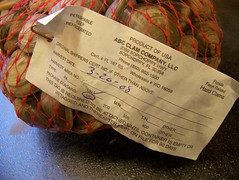
Sopchoppy OystersI’m not all about the veggies, however, and two weekends running I’ve scored fabulous local fish. Last weekend it was clams from ABC Clam Company in Sopchoppy. I rested the clams in cold water for four hours so the clams would spit out whatever it was they had brought from the sea, then steamed them with a little white wine and butter and whisked them to the table with crusty brown bread.

I also bought some tupelo honey from the fisherman, and asked him if he had produced it. “No, I used to, but it’s too hard,” he replied. “Now I let the bees make it.” It was Easter weekend and I was splurging, so I made tupelo ice cream–just vanilla custard ice cream with tupelo honey instead of sugar. It was satin-smooth, and tasted of sunlight and spring afternoons.

At the urging of a work colleague this Sunday I went to Mike’s, an Asian food and fish store. In the past I have been underwhelmed — it seemed weary, and smelled of old fish — but something has indeed happened at Mike’s: it was bright and tidy, with only a faint, clean aquatic fragrance to tip me off that the fish counter was still there in the back of the store.

A knowledgeable young fishmonger pointed Yessum toward the grouper cheeks. (“Yessum” is who I am in many Southern establishments, as in, “Yessum, those grouper cheeks are right fresh.”) Grouper is a moderately-flavored local fish, and its cheeks are sweet delectables that bake up moist and firm; at $6.99 a pound, grouper cheeks are an insanely good deal.

Mr. Fish apologized for the shortage of other fish — apparently there was a run in the store the previous day, and their fish is the real McCoy, pulled in from our Gulf waters — but there was no need; I was a happy cook. I baked the grouper in a drizzle of olive oil, sea salt, and fresh-ground pepper, and served it over a mound of eggplant sauteed with Vidalia greens, garlic, peppers, and oyster mushrooms, accompanied with whole-wheat couscous perked up with organic parsley for color and bite.

I still eat meat now and then, but the more I learn about factory farming, the less interested I am in commodity meat — and the more I paddle toward local, sustainably-caught fish. With Southern Seafood anchoring the northern end of town and Mike’s for those of us in these parts, and rumor having it that New Leaf, when it finishes expansion, will have a fish counter, plus fine establishments such as the Shell Oyster Bar to keep us in mollusks, there’s no shortage of oceanic protein to keep us Dixievore pescetarians happy and well-fed.

Stuff Costs Money

Over the holiday weekend, Dick Kaser, ITI’s VP for Content, posted a comment to my post about SWIFT, the not-so-swift “2.0 platform” ITI had invested in for its conference attendees.

In 418 words, Dick explained that stuff costs money. Thing is, we know stuff costs money. Everything costs money — even “free” stuff, like kittens or software. (Not that “turnkey” software is a walk in the park, either.)

To be fair, not everyone realizes that stuff costs money. My five years managing a web portal in California that many people thought could be run for “free” (I guess because it was mostly run by women) taught me that a lot of people don’t think stuff costs money. But even Wikipedia costs money.

The conference economy

The idea that stuff-costs-money also fuels the conference economic model. It costs money to hold a conference, it costs money to attend a conference, and it costs money to present at a conference.

ITI covers the registration fee for speakers, and that’s a nice offset. But Dick might check into how many speakers fly in just long enough to give their talks, and he has to be aware that registration fees are just a fraction of the total cost of attending any conference you can’t drive to on the same day.

This means (as is obvious to anyone already participating in the conference economy) that speakers at an ITI conference pay for the opportunity for face time. They might pay directly or through their institutions, but somebody pays, because to flog this poor dead horse, as Dick said in the DLib article he references — a point I had made several years earlier in an article published in The Bottom Line, “The Tao of Internet Costs” — stuff costs money. (In 2006, DLib even found out that DLib costs money.)

Paying for face time is an accepted part of the conference cost model. Of course, there’s more to it than that — informal networking and opportunities to meet vendors and the occasional fluffy white bathrobe. But fundamentally, we are investing in face time, either for ourselves or our institutions or in most cases, for both stakeholders. For many conferences, the payoff works out well for everyone involved.

As David Lee King pointed out, SWIFT breaks the conference economic model. It’s not that speakers and other heavy-duty conference types “don’t want special tools.” We already have “special tools.” They’re called blogs and websites. These tools costs money — to own, to build, to maintain — but they have a pay-off. Even with a modified term of service, for me to blog over on the SWIFT site makes no sense, because I’m making money (figuratively and indirectly) on my own site.

Money for nothing, and your wifi for free

About that wifi. Now, Dick doesn’t know me, and I don’t know Dick. (Some might add, on so many levels.) So I don’t know if he was trying to be funny in claiming he thought I expected ITI to pay $29 times 2000 so its attendees could have “free” wifi. Like, ha ha, I know you really know about negotiating for conference services, I’m just joshing you!

Because as several people responded to me privately, the obvious response is that the people who negotiated with the Otter Group for their 2.0 web conference platform thingamajig — and I know the Otter Group doesn’t give away their stuff for free — might have negotiated instead for a better deal for wifi — a service provided by the numerous non-library conferences I’ve attended in the last five years, where free-to-me wifi was part of the deal. Here’s how that formula could work:

  1. Take the money intended for a “platform” and hold it aside.
  2. Bargain for a group wifi discount.
  3. Apply the SWIFT money to the difference.

The SWIFT platform might seem to be a more obvious investment for ITI, at least from an Olde Worlde perspective. Eyeballs! Ad revenue! Bada-bing, baby! However, I’d suggest that free wifi (which we’ll use here to mean “or discount wifi”) has its charms from a stuff-costs-money perspective.

Free wifi is a “special tool” that could result in more people blogging and Twittering and chit-chatting about their marvelous, marvelous CiL conference experiences — right there at the point of service, when people are full of vim and vigor, before they get home and lose airspeed and focus. Free wifi also stops the grumbling about a “technology” conference that pushes its users off the grid for the duration. (If the answer is that ITI can’t charge enough for a library conference to underwrite free or discount wifi, then I circle back to my earlier point: money crossed palms for the SWIFT platform; somebody’s got cash somewhere.)

Free wifi is to us, the conference attendees, free like free beer — we use it, we enjoy it, we go home — but in terms of getting us to write about a conference in the moment, before we get home and face trip reports and overdue work assignments, it’s money in ITI’s bank. Give us widgets and badges to put on our sites that link back to ITI, put up a wiki and a blog for everything that doesn’t have a home, then wind us up and let us go.

(You see, the “SWIFT” model already exists; it’s just decentralized. It makes old-schoolers nutty to contemplate this, but they need to reverse the eyeball model from drawing people to a single site to tapping the diffuse honeypot on the Web. It’s as hard to get this across as explaining how the “many eyes” model for open source results in far better, more economically sound software than the old model where a bunch of dudes go into a room, swing their you-know-whats around, write a few checks, and sign NDAs.)

Engage us

It could be that the deal with SWIFT means that ITI is at a point with its conferences where ensuring overflow crowds and high-traffic exhibits isn’t enough any more.

I know that within ALA there is quite legitimate concern about the narrowing profit margins from conferences (a significant source of revenue for ALA). Not only does stuff cost money, but some stuff is getting very expensive, and in the next couple of years, people are going to have less money to buy it with. That’s problematic, and I empathize. Conferences such as Internet Librarian and Computers in Libraries have to make money to survive.

But I would suggest that if ITI is experimenting with revenue streams, and if it observes, quite reasonably, that conference content can attract eyeballs, that it talk to us about how to make that happen within the framework of our existing conference economy. After all, we want to make money, too.

Big Bend Library Camp?

“At other conferences I’ve attended, I’ve had many moments–including during actual presentations–when all I’ve wanted was to get online to check my email and feeds. Not today.”– Joshua Neff, from The Goblin in the Library, reporting on his experiences at Library Camp Kansas


I’ve been watching these library unconferences pop up hither and thon and thinking, why don’t we have one locally?

I know there was one a year ago in Niceville, and it sounds as if that was a splendid start. (How could anything go wrong in Niceville?) But I could also see a conference that’s slightly looser in its format: fewer speakers, or at least less pre-planned SDL (that is, “sit down and listen”), with more breakout sessions selected earlier in the day and even prior to the conference.

I see a lot of topics at these unconferences, from customer service, gaming, and web 2.0 to improving the circulation experience. I would like to see at least one very geeky track — like “trickle-up standards,” “How to UnFUBAR FRBR,” “open data knowledgebases,” or “Metasearch that doesn’t suck” — or even a strategic session, such as “How to sell open source to your boss” — but really, if someone can just get me hands-on with a Wii I would consider it an event worth attending.

Of course, maybe other local folks are thinking along the same lines. (If you think I’m looking at you, you’re right.) Yes, it’s a ghastly budget year. But that makes it a superb year for regional unconferences — the ultimate stone soup of event-planning.