Skip to content

Link Love Roundup

On Thursday I had an annoying but minor crick in my left shoulder (no, not radiating pain — just a definite discomfort around my neck, collarbone, and scapula). I thought it would go away on its own, based on my experience with other cricks and creaks. On Friday I woke up at 6 a.m. and shouted out in pain when I tried to roll over (it didn’t bother Sandy, as she was at a meeting several states away).

So my nice boss drove me to a nice doctor (since it helps whilst driving if you can move your head from side to side) who prescribed some nice meds for this strained/pulled muscle thingy — it happened at discus practice; o.k., o.k., you want the truth… it’s probably from falling asleep crooked — and since then I’ve been nicely non compos mentis.

(The doctor was very pleased that I presented him with a printout of the part of the back where it was hurting, and pulled out an anatomy book to show me the muscles he believes are involved.)

I had various long posts swirling in my head last week, but I experienced these past three days as if I were driving in very dense fog: my brain slowed to a crawl, and until this afternoon I couldn’t make sense of anything farther than a few yards from my nose. I’m not doing the heavy meds any more (goodbye, purple haze!), and I’m feeling MUCH better, thank you, but I’m a wee bit tired and therefore in kind of a slothful catch-up mode.

So here are a few tidbits:

Sylvia Plath’s library on LibraryThing. Now you can enter books into LibraryThing from beyond the grave! They call it MortisThing. No, not really — but the most excellent “I See Dead People[‘s Books]” project has expanded to include some women writers. I share two books with Plath — Middlemarch and A Room of One’s Own.

Heightened interest in OpenID. I am so not a software developer, but I humbly observe that while Shibboleth may theoretically be the perfect single-sign-on protocol, OpenID is apparently the protocol organizations can and do implement.

Virtual Kissing Booth. Tell your kissing story at the Culture Scout blog; the best entry gets a free copy of The Dictionary of Love.

Techsoup’s MaintainIT project has just issued a new (free!) cookbook, Recipes for a Five-Star Library. Why not print and bind a couple of copies for the favorite small library in your life? Topics include wireless, print and time management, and laptop checkout programs.

Without (visible) muss or fuss, PLA is proposing a bylaws change that would establish communities of practice (similar to LITA interest groups), downsize the PLA Board, eliminate the Executive Committee, and provide methods for virtual participation. What — they aren’t waiting for an ALA Task Force to issue a report? They aren’t asking permission? Hmmm, this Internet thing is really catching on. I hear tell LITA is closely observing PLA.

PLA is also holding its first virtual conference. LibrarianInBlack has written about it; my take is different. PLA needs to flesh out the program descriptions better (names, we want names!), but on the actual format, I think they’re on track. There has to be a reason that some of the highest-tech conferences I’ve attended, such as Defrag, do not attempt to merge analog and digital, especially at this, PLA’s first foray. (I don’t mean taping or podcasting live presentations, but attempting to mingle physical and digital attendance. If someone can spell out a model for this that is financially reasonable and also delivers a good product, let’s go get rich on it.) At $200 for two days of sessions, if PLA can deliver the goods (like I said… we want names!), it’s a pretty darn good deal.

Stick of GumPLA + Open Source, sittin’ in a tree: Equinox, the software support company for Evergreen, will be at the PLA conference (hey, love your spiffy new website!), as will LibLime, the company that supports Koha. N.b. The last time I discussed Evergreen I got a cranky response suggesting I was on the take (read the comments). Just a hunch: that comment didn’t come from the open source community.

The Shell Oyster Bar: Bliss on the Half Shell

Note: this is the first of occasional reviews I’ll do about food in the Tallahassee region. I believe this region has a charm and sensibility of its own that could use new voices and champions. I won’t bother with chain restaurants — the local newspaper has those well-covered — and will focus on the best of local dining, from casual to top-drawer. Expect more reviews after Easter.

Every time I walk into the Shell’s restaurant proper — a small, plain, windowless room, maybe seating 50 at best — I’m struck by two things: the clean ocean fragrance of ecstatically fresh oysters, and the excellent service. I always feel welcome and I never feel neglected or rushed, whether it’s me and two guys at the oyster bar on a quiet rainy afternoon, or it’s lunchtime on game day, and half of Tallahassee is packed in the Shell with their eyes glued to the two TV sets always set to sports channels.

Eating our local fish and produce makes better sense environmentally than eating food trucked around the country, and when I dine at the Shell, I’m supporting everyone involved in our local food chain, from the people who pull the fish from the water to the shuckers at the Shell, who can open several thousand oysters per week. I also appreciate knowing where my food came from, and I enjoy the historical continuity of dining in a local institution that has been serving food for over sixty years.

But I particularly adore dining at the Shell because the food is so exquisitely fresh — not “fresh” the way a bag of lettuce from Publix is fresh, but really, truly fresh, as in caught no later than yesterday.
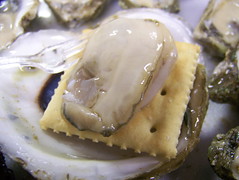
Oyster on SaltineI enjoy their oysters fried, either as a lunch special with hush puppies, beverage, and two sides ($6.75) or in an “oyster burger” sandwich ($4.75, or $6.25 with fries). Their batter recipe produces a fluffy, crispy fried oyster that floats into the mouth (I tried to get their recipe, but they just smiled at me). I have friends who prefer their oysters “nuked” (microwaved), a style I’m not accustomed to; nuked oysters taste a little mealy to me. But I crave their oysters raw and just-shucked ($6.50 a dozen), especially wolfed down Southern-style on saltine crackers so that each bite contrasts the flaky crispness of a cracker and the plump, cold flesh of an oyster.

The Shell also serves grouper, which dipped in their super-secret fry-batter comes out moist and flavorful, its steam rising out of its delicate crispy battered surface, as well as shrimp, scallops, crab claws, and on occasion, crab cakes. (Sorry, I’m a crab snob: only Dungeness for this gal.) I’ve had the shrimp steamed in garlic butter, which was decent enough, and the shrimp is delicious fried — but honestly, I go there for the oysters.

If you’re new to town or just visiting, all of our local fish is wonderful, but I have eaten oysters in a dozen states and several countries, and I can attest we have some of the finest oysters in the world — sweet and crisp, with a mellow flavor note — courtesy of the perfect mix of fresh and salt water that forms our beloved (and beleaguered) Apalachicola Bay.

With one exception, side dishes at the Shell are not memorable. The fries are serviceable. The coleslaw is crunchy and without too much mayonnaise, but lacks spark (I suppose, having said that, it’s contradictory to point out that the portions are very small.) The cheese grits are forgettable. I don’t know why I keep ordering the hush puppies — they’re always soggy with oil, and cold — though here’s my theory for why they’re bad: the cooking oil is kept at just the right temperature for frying fish, which is lower than what’s optimum for frying spoonfuls of cornbread.

But the onion rings — $3.25 for a basket large enough to share with several people — are numinous: crisp, light, melting, almost greaseless. The onions have just a tiny bit of snap, yet are slightly softened and sweetened by their brief time in the fryer. These onion rings are so good, I could be buried with a basket of them in my arms.

Because I’m a little shy in restaurants, I’ve never sat at the Shell’s counter and dined on oysters the way some do, eating them off a tray as fast as the shuckers can shuck them. Not only does that look fun, but it gets around my one concern about the Shell: many meals are served on disposable polystyrene dishes, accompanied by plastic packets of cutlery and napkins. If I had one wish for the Shell, it would be that it reduce the semi-permanent waste it is contributing to our landfill. We don’t need Spode china and linen napkins; trays and lined baskets would work for most meals (and in fact some dishes already use baskets and liners). The Shell is very green already, simply by virtue of serving local fish, and this would take its environmentalism to another level.

Beverages are simple — tea, soda, coffee, and bottled water — but you may BYOB, which for some means Bring Your Own Budweiser and for others means bringing a nice bottle of wine. That’s part of the charm of the Shell: this is a local joint in the best sense of the word, a place where you can rub shoulders with legislators, state wonks, professors, students, folks from local businesses, moms, dads, and their kids, and average Janes like me, all joined together in our common enjoyment of local fish, prepared well and served with real heart. In Tallahassee, where a new chain restaurant pops up every week, serving food trucked in from who-knows-where, we’re lucky to have institutions such as the Shell, and it’s up to us to make sure they survive.

The Shell is cash-only. They accept take-out phone orders and also sell shucked oysters from the pint all the way up to full bags (about 18 dozen oysters). I recently bought a pint to make chowder ($12.00), and the oysters were impeccable (see recipe below). Catering is available.

The Shell Oyster Bar, 114 East Oakland Ave (between Munroe and Adams), 850-224-9919
Monday through Thursday 11-6, Friday 11-7, Saturday 11-6 (closed Sunday)

Type of establishment: down-home oyster bar
Signature dish: raw oysters
Noise level: variable
Dress: just wear something
Cost: $
Notes: cash only; BYOB
Chance I’d eat here again: 100%


Deep Winter Oyster Chowder

Sometimes I like a thin, uncomplicated chowder: not much more than good rich milk and barely-heated oysters. Other times I want something more involved and rib-sticking. Living near the Gulf, the trick is to never outshine the star of the show: the oyster. We’re also lucky to have local dairies and farms. If I worked on it, the wine and the pepper would be the only imports.

3 slices bacon (Niman Ranch is good)
1 tablespoon flour
2 cups chopped leeks, white and pale green part only
1 white or baking potato, approximately 10 ounces
1 8 ounce bottle clam juice, or substitute water
1 to 2 tablespoons chopped fresh thyme (substitute a pinch dry thyme if necessary)
1 pint half-and-half, ½ cup set aside (I like Gustafson’s, available at many local markets)
½ cup good dry white wine, such as a sauvignon blanc or pinot grigio
1 pint Shell Oyster Bar oysters, with oyster liquor
Salt and pepper

Dice the bacon and render in a large saucepan while you peel the potato and chop it into ¼” dice. (You can leave a little peel on.)When the bacon has browned, scoop it out and reserve.

Sautee the chopped leeks in the bacon fat until wilted, 3 to 5 minutes. Stir in the flour and cook for half a minute, then slowly stir in the clam juice and one and a half cups of the half-and-half. Add the diced potato and the thyme.

If no one is looking, take a long drink of the oyster liquor — it’s delicious. Otherwise, pour all of the oyster liquor into the chowder and then stir in the wine.

Simmer the chowder for about ten minutes, or until the potatoes are tender. Stir now and then so the chowder doesn’t burn and so the surface doesn’t develop a skin. If the chowder gets too thick, add a little half and half and water. Stir in the oysters and cook three minutes more, until the oysters have heated through. While the oysters are heating, taste the broth and add salt if necessary.

Grind a little black pepper in the chowder right before or right after serving. Serve in wide bowls with crusty bread, and some hot sauce on the side for those who enjoy a splash of it in their chowder.

Makes two very hearty main-dish portions. (Leave out the potato, and you have four good first-course servings, or with a side or two, a nice lunch for four.)
Two squeeeees and an erp

First, whilst I was in Orlando amusing some of my favorite MMLs (Muckety-Muck Librarians) with my 12-megabyte PowerPoint slideshow, I received news that my essay The Outlaw Bride was accepted for publication! In my typical ultra-superstitious manner I’m not going to tell you where until I at least see a contract, but it’s a well-respected literary publication, and that certainly earns a moue of delight.

To get it published took a good 13 submissions and a decision to rewrite the beginning. Make that 12 submissions, a disciplined revision, and finally and suddenly, a home.

Second, guess what: even if your primary is over, or your state doesn’t have one, you can still vote through February 9… in Florida’s Ask a Librarian YouTube contest! High school students made these videos, and the only downer is that they can’t all win, because I love, love, love every one of these videos, which are surprising in their takes on the value of virtual reference as well as laugh-out-loud funny.

Then my little balloon lost some of its bounce when over on ACRLblog I read this post by Brett Bonfield:

Here’s the second point I’m trying to make: good, thoughtful prose generally takes more than a few minutes a day to write and more than a couple of hundred words to express. I don’t think it’s a bad thing when people dismiss longer pieces with tl;dr (too long, didn’t read). Certainly, when we’re writing for undergraduates or Pierre Bayard, we need to take that wholly defensible sensibility into account. But if you’re writing for me, and for many other academic librarians, please understand that we’re likely to dismiss light, quick, frequent posts with ts;db: “Too short, didn’t bother.”

In theory I should be on the first part of this paragraph like white on rice. My blog could easily be named The Windily Prolix Librarian, or even (to borrow from a favorite joke) On and On, Anon. I do tend to gab, and some of my posts take months or even a year or longer to percolate through my brain and into a shape I want to make public. ’tis what it is.

But I tripped over the comment, “But if you’re writing for me, and for many other academic librarians…”

So the world is divided between the brainy top crust of LibraryLand, able to master long, dense posts at a single bound, and those dim bulbs incapable of what M*ch**l G*rm*n called the “sustained reading of complex texts”?

For that matter, I happen to think some of the best writing on the Web comes in the form of “light, quick, frequent posts.” Stylistically, it’s not my typical approach to writing (I, with my microscope and my tweezers), but I respect it and could frankly learn a lot from it — as could those who have had their wit dulled and their senses muffled by academic librarianship, which can be a castle of intellectual endeavor but can also be a grim, grey dungeon.

In any event, I’m home safe, because “academic librarians” aren’t my audience. You are, gentle reader, whoever you might be.

They tried to make me go to FRBR, I said no, no, no

I just finished a major draft of the first soup-to-nuts literary essay I have written since spring 2006, when I was crankin’ ’em out for MFA workshop homework assignments. (The essay, about local food, was on request, for an anthology.) Yay me! I hope it doesn’t suck, or at least that any sucking can be easily de-sucked. I now know a startling amount of information about Apalachicola oysters — that’s always useful (particularly since I’m going to turn around and take what I know to build a review for this week’s homework assignment in my food writing class).

To celebrate, I’m going to make oyster chowder tonight (I bought a pint of fresh-shucked A-Bay oysters at the Shell Oyster Bar yesterday afternoon) with the very best ingredients I can hunt down, and serve it with the best bread and wine I can find. I plan to have a nice food week, as Shrove Tuesday approacheth, and those jeans I bought four years ago, when we got very serious about South Beach for a few months, are a wee bit snug in the seat. (Cookbook idea: Skinny Bitch Localvore, Southern-Style!)

However, my brain is too numb to write and so I bring you even more link love. Let the love flow!

I had my picture taken at ALA with a cardboard Obama (note: for Sandy, not for me), but I’ll be darned if I can fish it out of this website. They scanned my card, and they know my email, but they can’t point me to my picture? Fun idea, bewildering execution.

David Lynch on watching movies on an iPhone — a priceless 30-second video.

I’m giving a talk on Tuesday about the state of the ILS, updating my presentation from last September with such news as I have gleaned about updates for Evergreen, LibraryFind, Koha, xCatalog, Aquabrowser, WorldCat, and so forth. I’ll be showing some before-and-after slides of sucky OPACs and unsucky OPACs, so suggestions welcome. I have a few but I’m always looking for the nadir of bad design, particularly where the heavy hand of librarians playing interface designer is evident.

(Incidentally, if you look at the presenter evaluations, take note that Michael Norman’s presentation was luminous; he just said some things about the future of cataloging that some folk find a twee unsettling, so you can read his ratings as polarized, versus my usual crowd-pleasing. Bravo Michael.)

In the course of looking for simple ideas to express service-oriented architecture, I found this YouTube video, “SOA this, SOA that.”

I stole my slide design from David Lee King’s talk at Peninsula Panhandle Library Access Network the previous week — white Gills san serif on dark grey, heavy on the visuals, sparing with text. Thanks, David! Great talk, too.

Dan Chudnov goes ballistic on WoGroFuBiCo, and I’m with him. The final report stinketh of typical librarian change-avoidance. We do NOT need to stop RDA; we need to implement FRBR and get it right, not “test” it more; and we do NOT need to do years more of “user testing” to teach us what we already know.

There’s been a Library 2.0 “course correction” which is both healthy and inevitable. Kate Sheehan and John Blyberg are particularly astute on this topic. This doesn’t mean that Library 2.0 is “over”; it means that people are thinking more carefully about what it means (and quite a few people have been doing that all along). My feeling was summed up Friday in a Skype chat with a wise colleague who said the driving question needs to be, “What are we trying to be successful at?” Amen, bro.

OCLC’s governance study, or at least core docs thereof, have been on the Web since mid-November, I learned last Friday. If you skim or read the recommendations, note how without fuss or muss they say meetings will be both f2f and online. No extended hand-writing, no blah blah blah. Also note that they increase the percentage of self-appointed directors on their board (hmmm), eliminate Members Council (a good thing — it has no real power anyway and is too cliquey) and establish regional member groups (fascinating).

Random thought: I like buying books. I like reading online. What I don’t like to do is use my own printer, paper, and toner to print out and staple some unwieldy PDF and try to read it, even if it’s “free.” It’s the clumsiest way to read anything: it won’t fit in my purse, the page-turning gets ridiculous, and then I can’t file it easily if I want to keep it (duh, binding?). Delivery is crucial.

I really wish NPR reporters wouldn’t get cutesy with food reporting and munch over the radio, especially while they’re talking. It’s gross and puts me off my feed. LIANE HANSEN STOP THAT NOW!

The unsuitability of nonfiction writers compared to reel sirius novelists

First be sure to limit your group to six or seven members, so each participant can be assured plenty of opportunities to read. Look for serious writers with lots of material to submit. Make that serious novelists, because short story or nonfiction authors won’t be suited to this type of group, no matter how kind or clever they are.

So says Marie Lamba in “Plotting a Novel Group” in the February issue of Writer’s Digest. Lamba is the author of the young adult novel What I Meant… which as of this post has several respectable blurbs, nearly 200 holdings in WorldCat, 8 glowing reviews on Amazon, and 20 holdings in LibraryThing, where it has an average rating of 3 stars (based on two reviews).

Lamba points out that most writers’ groups “are set up for short submissions” and that “It could take more than two years [for a full-length manuscript] to be critiqued from start to finish.”

We’ve been dealing with that issue in the critique group I formed locally, and this is a valid point. It’s difficult to workshop long manuscripts one chapter at a time. Months down the road I can’t remember characters from the first chapters; I lose all sense of continuity and can’t really grasp the arc of the work. I wouldn’t read a novel that way, and it’s excruciatingly difficult and not terribly helpful to review it that way, as well.

Lamba’s group came up with rules, many of which are sensible and which we already follow. Don’t let the group get too large. Members must critique all submissions. Limit the group to fiction and fictionalized memoir — WAIT! When I read that, my bones all turned to jelly, to paraphrase her protagonist. What the hell’s wrong with workshopping long nonfiction?

So I wrote Lamba to ask her. She quickly sent me a kind reply which I won’t repeat here because it was personal correspondence, but she didn’t clarify her point.

Frankly, if I had a chance to workshop with the likes of Susan Orlean, Fenton Johnson, Mary Karr, Ruth Reichl, Jon Krakauer, Clarence Major or His-Royal-Nonfiction-Highness-Who-Hath-Ascended Truman Capote Himself, I wouldn’t get too fussy about the fact-based nature of their writing, particularly if they helped me through the finer points of understanding the narrative power of lines such as “JASON IS ASKING ME OUT!!!!!” and “ohmygod, does this mean HE MIGHT KISS ME SOON????”

Don’t get me wrong; it’s great that Lamba got her book published and that the workshop helped her reach her goal (and despite my pokes, I’m sure the language in her book is OMG, like, SOOO appropriate for her audience). Perhaps she has experience with workshopping long nonfiction that we should heed. And frankly, if I could form a writers’ group strictly for creative nonfiction, I’d be tempted to go that route.

But after re-reading Lamba’s article, I felt oddly protective of our slightly messy writing group and its struggles and explorations with form and length and genre. I sometimes think I might write fiction (though I breathe deeply and then the feeling goes away), and where would I be if I were in a nonfiction-only group?

As I said to one of our members last week, it’s our workshop and we’re grownups: we can design it any way we want to. What did we ultimately decide last night, over cookies and wine (Lamba overlooked the rule, “Thou shalt always have nibblies”)? We came up with a hybrid form. We’ll workshop 150 pages a month, mostly two 75-word chunks of longer manuscripts, but sometimes a mix of long and short, and as far as genres go, “whatevah.” Will it work? Time will tell — and so shall I.

Orson Scott Card is a Big Fat Homophobe

“‘ “I find the comparison between civil rights based on race and supposed new rights being granted for what amounts to deviant behavior to be really kind of ridiculous. There is no comparison. A black as a person does not by being black harm anyone. Gay rights is a collective delusion that’s being attempted. And the idea of ‘gay marriage’ — it’s hard to find a ridiculous enough comparison.'” — Orson Scott Card

The latest post-conference mishagosh comes to us courtesy of the Young Adult Library Services Association (YALSA), which gave this year’s Margaret A. Edwards Award to Orson Scott Card for his works, Ender’s Game (1985) and Ender’s Shadow.

If you know anything about Card’s views about homosexuality — or about the Edwards award,which “recognizes an author’s work in helping adolescents become aware of themselves and addressing questions about their role and importance in relationships, society, and in the world” — that’s like the Anti-Defamation League giving Bobby Fisher a lifetime achievement award.

In all fairness to the committee, if they had asked the general question “what do we know about Orson Scott Card” (and whether you think the committee should have done that is open for discussion; I say yes, that’s due diligence), it would have taken some effort to uncover Card’s virulent homophobia, and you’d almost have to be looking for it.

A Google search for Orson Scott Card (10 results per page) lists 9 neutral or positive sites about OSC. I had to get to get to the 10th link to read a Salon article (by Donna Minkowitz, a lesbian, no less) in which the author notes on the first page, “But I’d somehow failed to ascertain that Card was a disgustingly outspoken homophobe.”

(Note: the spell-check in WordPress doesn’t even recognize “homophobe” as a word. Then again, it also doesn’t recognize “WordPress.”)

The real damage is in that bastion of impartiality, Wikipedia. Card’s Wikipedia article barely references his opinions about homosexuality, and only in an external link; to get a fuller story, you’d have to go to the Talk page and then look for it. You certainly won’t find Card’s own words on the topic, which include:

Laws against homosexual behavior should remain on the books, not to be indiscriminately enforced against anyone who happens to be caught violating them, but to be used when necessary to send a clear message that those who flagrantly violate society’s regulation of sexual behavior cannot be permitted to remain as acceptable, equal citizens within that society.

Dudes and dudettes, that’s hard-core! Even most “compassionate conservatives” don’t speak that directly, not even when they agree with Card.

But if you read this blog you know I have written that Wikipedia often seems more like a Secret Treehouse Club than everyone’s encyclopedia. Card’s Wikipedia page isn’t a biography, it’s an encomium by true believers who maintain fierce control over Card’s myth.

As for Bobby Fisher, his Wikipedia page references Fisher’s anti-Semitism. Despite all the babble on Card’s Talk page, if there’s a consistent rule about what can be said about an author, I’ll be damned if I can figure out what it is.

Besides, as Tracy Nectoux said on GLBTRT-L, short of saying gays should be trucked to death camps, homophobic comments by famous people don’t warrant sustained attention in the public sphere. This tsuris only occasioned a strong article in School Library Journal and mild back-pedaling from the awards committee, who said that they hadn’t researched Card prior to this award (I cringe when “information professionals” say things like that) and furthermore — ladies and gentlemen, prepare to hoist an eyebrow or two — “personal views aren’t part of the selection criteria.”

In terms of who we as a profession honor as an association — or in terms of any work effort — we need to make clear-eyed choices. We don’t get a lot of choices in our lifetime, really, not for awards, or books to read, or people to love. Card took up time and energy that could have been directed to someone else. It wasn’t intentional, but what’s done is done.

Oh well. Next year in Jerusalem.

If the award did any good, it is this: many more librarians know the truth about Orson Scott Card.

Ok, all the cool, innovative, creative people leave the room….

In this week of Link Love, I leave you with this YouTube video, Hitler Explains Second Life. I include it in my writing feed because the dubbing is brilliantly witty. I guarantee you’ll find a line or two that sticks with you.

Dog Years, Teahouse Fire win Stonewall Book Awards!

Mark Doty’s Dog Years: A Memoir won in the nonfiction category for this year’s Stonewall Book Award, selected by the Gay, Lesbian, Bisexual and Transgendered Roundtable of the American Library Association — passionate readers who spend a year steeped in this particular literature (“exceptional merit relating to the gay/lesbian/bisexual/transgendered experience”).

Dog Years is a gorgeous book, an exploration of grief, loss, love, and empathy told through stories of life and death — of dogs, of lovers, of all the endings life brings us as it moves forward to its inexorable conclusion. Until I read Dog Years I did not understand the criticism that Joan Didion’s The Year of Magical Thinking was too focused on her own grief. I do not fully agree — we live in our heads, after all, and once someone dies, our grief is an important last connection — but I now understand the argument better.

This year’s winner in “Literature” (as the fiction category is labeled) is The Teahouse Fire. Haven’t read it, but I am rarely disappointed by a Stonewall award winner.

The awards will be presented during the Stonewall Book Awards Brunch on Monday, June 30, 2008 during the ALA’s Annual Conference in Anaheim, California.

It would be nice to see ALA trumpet the Stonewall winners the way the Caldecott and Newbery winners in children’s literature get their due.

The main ALA website currently features a press release, “American Library Association announces literary award winners.” But this is a misleading title; these are only the youth awards (Caldecott, Newbery, and so others).

If today you had followed press releases from the “more news” link on the main ALA page, this is what you would have seen (it is of course subject to change):

01/16/2008 – ALA Midwinter Meeting attracts large number of attendees; Youth Media Award selections announced
01/15/2008 – Video Round Table announces 2008 Notable Videos for Adults
01/15/2008 – 2008 American Indian Youth Literature Award
01/14/2008 – American Library Association announces literary award winners
01/14/2008 – Curtis, Bryan win 2008 Coretta Scott King Awards

Again, no mention of the Stonewall awards; no link to the press release. You have to go to the full list of press releases, which in all fairness lists many other unheralded winners.

I’m not suggesting a Vast ALA Conspiracy; I am sure there is none. I also know that the Caldecotts and Newberys receive (and deserve) very high-profile attention worldwide. They are a “money-maker” for ALA and good press for LibraryLand. PLus there are other deserving awards that also drop off the radar scope.

But it would be nice if the Stonewalls had a place at the table. If these awards — two of the few ALA awards targeted at adult readers of good literature — felt welcome and visible.

The Stonewall award also points up the value of “hyphenated” awards. There’s nothing condescending about recognizing books for a particular experience. Dog Years deserves many awards, but the Stonewall Award gives it a nod for a certain slant of light.

The 2008 Stonewall honor books in “literature” are:
“Bow Grip” (Arsenal Pulp Press) by Ivan E. Coyote
“Dark Reflections” (Avalon Publishing Group, Inc.) by Samuel R. Delaney
“The IHOP Papers” (Avalong Publishing Group, Inc.) by Ali Liebegott
“The Indian Clerk, a Novel” (Bloomsbury US) by David Leavitt

The 2008 Stonewall honor books in non-fiction are:
“Grand Surprise: The Journals of Leo Lerman” (Knopf Publishing Group) by Leo Lerman and Stephen Pascal
“Mississippi Sissy” (St. Martins Press) by Kevin Sessums
“Transparent: Love, Family, and Living the T with Transgender Teenagers” (Harcourt) by Cris Beam
“Two Lives: Gertrude and Alice” (Yale University Press) by Janet Malcolm

Help Support the Stonewall Awards

GLBTRT has almost reached its goal of $75,000 to endow the Stonewall two awards. To contribute toward the Endowment, go to https://www.ala.org/cfapps/donations/ and select GLBTRT.

Evergreens are particularly nice in winter

Evergreen (the open source ILS software) gives me hope, and I see more “greening” of LibraryLand. So as I shake and shiver through this nasty brain-sucking cold (it’s hard to get creative when I wake up sounding like a vacuum cleaner), here’s yet more link love today!

This is not to say that Koha doesn’t give me hope — LibLime just signed WALDO, a consortium of small academics in Westchester County — but from the perspective of a state where the catalogs are as big as heffalumps, I’m looking for hope on a larger scale.

LibraryThing’s “I See Dead People[‘s Books]”

I know it’s considered lame to write a hey-gee-look-at-the-pretty-linkies post, but first of all, link posts make a great amusee bouche between those huge ketchup-sauced meatloafs I dole out once or twice a week, and second, I’m tuckered from a whirlwind conference at ALA, backlogged on homework due Thursday, and about to go to an 8 p.m. hair appointment that I would cancel if I wasn’t feeling oh so Phyllis Diller.

Besides, I can’t sit on this discovery: LibraryThing members have been cataloging the libraries of Great People, which is too cool for school. Ernest Hemingway and I have two books in common (both by notorious drunks):

There is one interesting omission… the list of prospective authors is all female male. Do we know the library of Eleanor Roosevelt, or Gertrude Stein?
Incidentally, though earlier I fumed about ungrateful LibraryThing Early Reviewers who don’t review their books, I sat on The Memoirs of a Beautiful Boy. I had a perplexed response to it, and frankly wanted to see what other reviewers had to say. Janet Maslin started to get there (and no, I don’t have any issue with the author rounding off the corners here and there). I’ll try to write my review this week.