Skip to content

Christine Schwartz on WoGroFuBiCo

I realize that in writing about RDA and cataloging on Christmas Eve I’m tagging myself as someone who clearly needs an intervention (if I can use the word “tagging” without making Michael Gorman screw through the ceiling). So let me quibble by saying that I’m really just updating my earlier post by including several links to Christine Schwartz and her good posts about WoGroFuBiCo.

Christine says I am taking on the cataloging establishment. That surprised me; all I did was comment on a report, and as a non-cataloger, I doubt the “cataloging establishment” feels one bit tooken-upon by me, if that is the right verb.

However, I’ll expand on something I said in a comment on her blog: the WoGroFuBiCo draft report seems to be at war with itself. There are at least two authorial voices: the voice of resistance and the voice of change.

The voice of resistance says to suspend work on RDA (though note, work has proceeded so slowly it might be hard to detect its cessation…); it also says to do a lot more testing of FRBR and to conduct research on user behavior. This voice is silent on funding the Dublin Core work I discussed last summer on ALA Techsource.

Voice of Resistance employs a typical librarian strategy: resistance by obfuscation. I’ve seen it in action in libraries, and I saw it on ALA Council. Stall. Postpone. Resist timelines. Do more “studies.” Plan actions around a massive one-time report to be released at some unidentified date in the future.

I’m all for user research, the more the merrier, but the idea that we know nothing about user behavior that can be applied to the theory and practice of information organization is sheer historical revisionism (I refuse to believe it is ignorance). Just this past summer Karen Markey published a two-part series (here’s a citation for part 2) summarizing twenty-five years of user behavior. What we need to do is start acting on what we know.

Voice of Change takes different tactics. Put authorities on the Web. Consider pulling in data from other sources. Rethink cataloging. It’s a different, fresher, more flexible voice. It’s the voice of the future. It suggests experimentation, rapid iteration, responsiveness.

Both voices are still somewhat stuck in the “record” paradigm, and by that I mean thinking in terms of bibliographic records, versus bibliographic data. We are too often still trapped in professional literalisms. A book, ergo a physical record. This gets in the way of rethinking how data is used, reused, remixed, populated into the network cloud, and associated with other rich data.

Both voices also miss the chance to discuss the question of how open we make our data. Which brings up that Christine also has some good comments about OCLC’s response — with which Talis provided its own response (Talis has its own dog in this fight — then again, don’t we all?). My initial take on the WorldCat response to WoGroFuBiCo’s draft report is that I’d be on it like white on rice if only it didn’t come from a vendor-like organization struggling with issues of sharing and trust. I think of OCLC, and I am reminded of the final, heartbreaking scene (at least as I remember it) of the movie version of The Remains of the Day, in which Emma Thompson (representing LibraryLand) crumples her face in grief as she bids farewell to Anthony Hopkins (representing OCLC), who cannot release himself into the trust necessary for love.

Really, I need some gingerbread.

In any event, I appreciate how the library community has conducted a lot of this discussion in the wild. I hope for the final WoGroFuBiCo report that community response and engagement is solicited a) with a longer time frame (they got ten months, we got 16 days) and in a more 2.0-ish, iterative, public-commentish sort of way.

My Christmas Letter

I don’t get Christmas letters any more, and that’s a good thing. How I loathed them. “We had an amazing year! Look how well we did! Life is great!” I was able to stumble through the year, for better or worse, until my life was held up against someone’s improbable standard.

This won’t be that kind of Christmas card.

2007 started out badly for me, and got worse. I was unhappy, and getting more so. I was mourning my old life, where I had the perfect job, in the perfect place to live, and had ever so perfectly spent my free time happily studying writing. Here, in this new place, I was sad, but so stressed and busy that I did not have time to do any of the things that make me happy (like writing).

I felt I was living in a movie I now call Ugly Tallahassee, a listless place with bad food, a weary downtown, and rundown city neighborhoods with crumbling frat houses. Even the YMCA closest to my house was dolorous — a weary, smelly small building, in contrast to the flossy redwood-and-glass affair two blocks from where we lived in Palo Alto.

Not quite mid-year, I changed what I could about my life. I quit my job, and because I quit my job, I suddenly went from having no free time to buckets of it, and spent a lot of it writing for both money and pleasure. It meant a lot of belt-tightening, but we’re used to that — I’ll address that in a minute — and during that period we were blessed with no emergencies. Appliances kept functioning, cars kept running, body parts worked as advertised. I did a lot of revision and I did a lot of submission, and I did some paid writing gigs as well, as well as a couple of talks. I was patient, and when some job possibilities popped and then fizzled, I kept the faith. And kept writing and submitting.

Then I found a great day job at a terrific organization, founded a writing critique group, and restructured my life to ensure that no matter what went on at home or at work, I had some time every week for things that give me pleasure. (It’s not always writing, either: last Saturday I took myself shopping and then played in the kitchen.)

I also wrote a new movie. It’s called Pretty Tallahassee.

In this movie, I work with nice people in a building that feels new and attractive, and has pleasant creature comforts — one of the few places I’ve worked where the staff lounge was really a lounge, with comfortable, attractive furniture and a large TV. When I drive home, I try to take the pretty entrance into Meyer’s Park, so instead of taking the ugly way in — driving past gun and pawn shops, empty commercial buildings, and the world’s worst Thai restaurant — I’m driving through several visually appealing points of access and winding past the real park itself as I go home, where joggers are huffing down the path and the tennis courts are often full. I make sure to keep our birdfeeders stocked so that when I pull up to our house I am often greeted by birds fluttering and chirping near our front door.

In Pretty Tallahassee, when we choose where we go out to eat, it’s someplace delightful, like the Shell (a sweet little dive of an oyster bar) or a luxe place with great food such as Cypress, Sage, or Urbane, the new kid on the block, and a welcome sign of life in downtown Tallahassee (chorizo and fig on a pizza? Oh, mama mia!).

I find I am also tougher in this movie. When the vindaloo was disappointing at Essence of India — which by local standards is usually better than you’d expect for Indian food — I told them so. If someone orders “hot,” she means “hot,” not flaccid. This restaurant can choose to be part of Ugly Tallahassee or Pretty Tallahassee, and some of that rests on not screwing up my vindaloo.

I also stopped going to the ugly YMCA after visiting the new one in Southwood, which made me feel I was in a different city: large, new, loads of equipment, dramatic windows, clean-smelling. Suddenly I realized that the other Y was contributing to my unhappiness; the message was “this is your weary, cramped, odiferous life.” I also started a walk/run routine where I don the iPod, filled with NPR programs and short stories, and run through the pretty park. I’m really enjoying that; I’m getting to know other runners, as well as some delightful doggy neighbors. Sometimes my church offers evening aerobics classes, and these are really fun; I actually learned a dance called The Electric Slide, and in two or three years I might even get up enough nerve to do it in public. (The ratty old Y is undergoing a renovation, and my assessment of it will determine if we keep or drop our Y membership.)

I am measuring good physical progress by my posterior’s jiggle factor: when I started my walk/run (walk to the courts, run down the path, hit the undo button), I felt my bottom had its own life, bouncing behind me, but now it moves in time with the rest of my body. I don’t know if you could bounce a quarter off it (something Condoleeza Rice is reputedly proud of — for her bottom, not mine), but I’m feeling more in shape than I have in years. I generously donate my higher, firmer tush to Pretty Tallahassee, just as I now exercise in matching outfits, not the old sweatpants with the stains and the sagging seat.

The other woman I workshop with (separate from the critique group) commented that we had passed the one-year point, and those monthly sessions at Panera’s, plus many an afternoon on my own, have also been a big part of Pretty Tallahassee. She’s a great writer and an equally great person, and yes, she knows what creative nonfiction is and even how to critically approach it.

As writing spaces go, I’m rather delighted with Panera’s. It’s clean and light but unlike Starbuck’s, it’s not pushing a prefab “lifestyle” on me. The staff leave me alone — actually, they smile at me as I work (I imagine they are thinking, “there goes that sweet lady with the amazingly round, firm posterior”). I even have what I consider My Table, though I try to be flexible about that and do not stare down people who mistakenly take that spot. Well, I don’t consciously stare them down, but the table often does become available sometime during my writing sieges.

Now that my life is prettier, I remember the problems with my Christmas-letter-perfect former life. California was expensive — nosebleed expensive — and every year was its own financial worry. My job, fun as it was, was also a grant-funding roller-coaster in a state with wildly fluctuating financial fortunes in a very highly politicized funding environment. I interviewed for several permanent jobs that never panned out. After five years, Sandy hadn’t found stable employment, either; she had one year of unemployment, and two interim positions.

In the land of milk and honey, we were also spending $2200 a month to rent a dumpy, tiny, one-bathroom house on a noisy street in Palo Alto, next door to a garage band that played loudly, and badly, every weekend. We owned a small condo (which we rented out while we lived in Palo Alto) that was absolutely adorable but was part of a three-member condo association with owners who were so cheap and short-sighted we couldn’t even convince them to upgrade to locked mailboxes. We didn’t resent the wealth around us — we live below our means, and like it that way — but we once felt very ashamed when a veterinarian recommended a dental procedure for our cats that we declined because it was more money than we could spend on our own (deferred) dental work.

My writing life was perfect, but artificially so, propped up by an environment where I had highly specific deadlines and word counts and an enforced writing community. Had we stayed in PerfectLand, I would still have had to confront the post-MFA “what do I do now” hangover.

Life is not perfect here either. I don’t work for a perfect organization, I don’t have a perfect family life, I’ve never had a perfect meal, my body still has plenty of wrinkles, ripples, and sags, my writing life could be better — I still struggle with “what do I do now” — and I myself am oh so not perfect.

But for 2008 I can roll the film on two movies. I know which one is part of my survival.

Writing for the Web Workshop


Writing away

Originally uploaded by freerangelibrarian
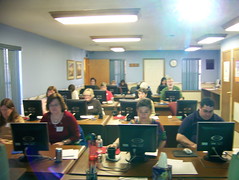
This workshop — my first-ever writing class — was blissfully successful for all concerned. The post-class evaluations were the best I’ve ever had in fifteen years of training and teaching. Teaching a writing class has been a goal of mine for a couple of years, and it was better than I ever thought it would be.

I am going to tweak the syllabus ever so slightly (a little more writing time, a few more examples), but by and large, it worked really well.

I’ll be teaching this workshop at least two more times in 2008. I have workshops lined up for two more library consortia: NEFLIN (March 5) and TBLC (May 22). I’ll combine these training trips with visits to local community college libraries; it was wonderful to visit with the librarians of Chipola and Gulf Coast en route to my class site.

This day-long workshop would also work well as an analog/virtual hybrid, where we would meet in person for a half-day and then conclude the workshop online. I’d say it would work as a fully online class except the face-to-face workshop experience is so heady and valuable, not just for attendees but for me; I rushed home invigorated about my writing and filled with new ideas. Face-to-face instruction is one of the great luxuries of this century.

Last-minute gift ideas for the writers in your life

Trying to buy a gift for a writer?

First, I just heard from W, a delightful friend from a Former Place Of Work Minus Two, and I am reminded of her wise counsel, whenever the subject of gifts arises: large, sparkling gems are always appropriate. Imagine the special writer in your life, hunched over a laptop at a table in a coffee house, scribbling away, while a princess-cut diamond flashes on one hand, and it’s all due to your largess. This Christmas moment is just a web click away.

Major Project

If that’s too dear, Tayari Jones has this list of suggestions, including things not to buy, including a pen. For sure, don’t ever buy me a pen, since I will promptly lose it, or as I did the other day, disassemble it while I am thinking about something and then drop some tiny ineffable part on the multi-colored carpet, never to be found, after which I then noisily rummage in my capacious purse to find yet another defenseless pen to torture. Even my Red Pen Of Death, used for editing everyone’s work, including my own, is a dangerous call, because you may think it’s just any old red pen but it’s actually a Paper Mate Flair Felt Tip Pen with a reinforced 1.1mm nylon tip, and I won’t use anything else (interesting that pens, like illegal drugs, use the metric system).

Meanwhile, Newpages.com recommends buying a subscription to a literary magazine; many lit mags have online forms, and you could send notice of the gift with a free e-card from Amazon scheduled to arrive just as Santa is sledding around the planet.

I hear “nobody reads,” which I do not believe, but it is so not true that nobody writes. I spent last night making a del.icio.us list of good places to submit — and read — creative nonfiction and finally had to put my purse in the other room, as my credit cards kept begging to leap out. I already subscribe to a little more than I can comfortably read, given books and writing and day jobs and whatnot, though I’d rather have too much to read than too little.

A couple more ideas:

Is your writer someone who marches off to Panera’s, Starbucks, Waffle House or any of the other de facto writers’ spaces? Acknowledge their writing lives with a gift card (yes, I have a writing friend who writes at Waffle House — Lord, I love that, it’s so Southern!). Oops… it appears Waffle House doesn’t sell gift cards… but Panera and Starbucks sure do. You could also slip an Amex gift card into an envelope with a note that says something about keeping your writer in tea, coffee, or waffles whilst he or she pursues one’s craft, and Waffle House does accept Amex.

Does your writer live in an area blessed with a writers’ space? Perhaps your writer might appreciate a month’s subscription to a writer-friendly loft with quiet cubicles, high-speed printing, and the shared experience of being among other writers, thoughtfully disassembling pens in their own cubicles. At least one writers’ space offers a ten-visit punch card. There’s even talk in Tallahassee of building such a space — as someone once told me, everything comes to Tallahassee, eventually.

Or try a lifetime LibraryThing account (only $25, until Tim and team wise up!), which is so much safer than buying someone a book, and is a heck of a lot of fun. Plus authors can register to have a big shiny LTAuthor badge. Top off the present with a CueCat barcode scanner — not essential, but even more fun (leave it to a librarian to think wanding barcodes is the pinnacle of amusement) — and get it there by Christmas by sending it priority mail.

Probably the best gift of all is anything that acknowledges you believe in your writer. I feel awkward even calling myself a writer — I’m still waiting for the fraud police to show up — and I often feel guilty about it, as if paying attention to my writing takes away from the other parts of my life, primarily work and family, at the expense of something that at 2 a.m. can feel self-indulgent and ultimately pointless. I am at war with these thoughts all the time (and these thoughts are endemic, even for the best and most famous writers). I know it sounds woo-woo, but a little affirmation or two couldn’t hurt — and can shine more brightly for a writer than the sparklingest gem.

[Anyone observing the many tiny edits I have made to this post: no cracks about buying me grammar books, please!] 

Gulp

“Books won’t help you.”

I had been stammering through a discussion with a contractor about redoing our master bathroom.

My brain started stumbling at the first notes of disapproval in his voice. I could hear him take a breath before he spoke. “How am I supposed to git you a quote  when you don’t even know what you want done?”

My throat dried. What an idiot I am, I thought.  “Um… I haven’t ever had a bathroom redone,” I said. “We want the bathtub replaced with a shower, and we think we need new, what do you call it, sheetwall?”

“You need to tell me the details. Fixtures. Tiles. Cabinets. Then I’ll come take a look. It’s $200 for a visit.”

Oddly, this didn’t deter me, though by now it should be obvious he had written me off as a customer he didn’t need. Furthermore, we had one contractor lined up who we really liked, and without great enthusiasm I was doing the due-diligence get-a-second-quote thing. Yet I badly wanted his approval; I wanted to be the competent, knowledgeable homeowner for whose business he would vie.

I thought fast, or as fast as it gets when I’m feeling five years old. “I could go to Lowe’s and Home Depot and look around, and I could look in books for ideas!”

His voice, already deep, dropped an octave. “Books won’t help you,” he said. “You need to decide what you want.”

Then and there is where I crossed his name off my list of potential contractors.  Maybe it was an innocent comment, but I just can’t work with someone who says out loud that books can’t help me. Maybe they can and maybe they can’t, and maybe I was stupid to call a contractor about redoing a bathroom when we were still so vague about the project.

But I had expected him to say, soothingly, “Sure, that’s a good idea. Go git you some of them Sunset books. You can buy them at Home Depot. Pick out some ideas you like. Then call me back and we can talk about it.”

I’ll stick with the contractor who drives around with the photo album of ideas and emailed me a picture of a recent job. I don’t know what she’d say about books, but I’m guessing it wouldn’t chill my blood.

Free Range Librarian: the year in first lines

A marvelous meme to wrap up the year: list the first sentence of the first post for each month. I include each post’s title because I try to write titles that do a lot of work and often function as the “first sentences” of each post.

If you’d like to play, consider yourself tagged. (Reading, writing, presenting, fussing about ALA, tinkering with my blog, and worrying about librarianship: it does sound like me!) Found on many sites, including Librarians Matter.

January 3, 2007, Management 2.0 and the Trumpeter in the Attic: “Today for the first time I heard the phrase ‘Management 2.0.'”

February 2, 2007, Dorothea on DSpace: “I respect Dorothea’s decision, but I often find myself frustrated by the closed comments at Caveat Lector, primarily when I want to say ‘you go girl’ or ‘me too.'”

March 1, 2007, Oops! Keynote in Klingon: “My PowerPoint from yesterday’s Code4Lib Keynote may look like gibberish to you… I should have realized that if my slides couldn’t display on Roy’s laptop, that pointed to a bigger problem!”

April 1, 2007, Google Buying OCLC: An Early Analysis: ” Some of us had heard rumors flying earlier this week.”

May 1, 2007, New Feed Location for Free Range Librarian: “Another reminder to feed subscribers: the new feeds are here.”

June 1, 2007, Presentation Alley: “I’m deep into the presentation zone today… but heard Bob Stein give a vision talk, had lunch with Greg Schwartz, and in two hours will get to hear Vicky Reich talk about LOCKSS and CLOCKSS, which is the kind of software that can help us reclaim the heartland of our profession.”

July 2, 2007, The ALA Conference Meeting Life Cycle: “For decades (if not longer), the ALA conference meeting schedule has remained unchanged.”

August 1, 2007, So clean, so linear… so YA: “My Librarything ‘Early Reviewers’ copy of Nikita Lalwani’s Gifted showed up yesterday, and when the afternoon storm knocked out the electricity, I used this as my excuse to sit near a window (not TOO near a window) and begin reading by ambient light.”

September 1, 2007, Just Published: “David, Just as he was, White Crane, Summer 2007: “The summer 2007 issue of White Crane arrived Friday afternoon, two days before my 50th birthday, and there could have been no better birthday present.”

October 2, 2007, Death to Jargon: Examples Needed: “On October 11, I’m giving a one-hour talk called ‘Death to Jargon’, and I could use your help.”

November 1, 2007, Road Warrior: “I’m in a friend’s lovely, lovely, lovely home.”

December 2, 2007, The wisdom of each age: “At 7 a.m. in a quiet hotel room — we were in Savannah over Thanksgiving weekend, and I was trying not to wake Sandy — I finished Leaving Atlanta, then rolled back and re-read the last section.”

Creative nonfiction: but still it turns

I am enormously flattered to have my thoughts on the state of the essay featured as a blog post in an interesting ongoing discussion on Brevity’s blog. These thoughts started as a comment on an earlier post in an eminently readable thread.

Perhaps my words showed me in good form because I’ve been thinking about the state of creative nonfiction for a couple of weeks, ever since sitting in a meeting — of writers, no less — with my Nice Librarian smile glued to my face like pasties on a stripper while one writer kept repeating, “I don’t even see that as a genre!”

My reticence, and the fake smile (which make my cheeks hurt for two days), were because I wanted something from this group, and though I have heard this particular spiel before from others in this organization — remember Amadeus, “Too many notes”? — it seemed a tad counterproductive to jump on top of the table to shout “Oh yes it is a genre and I write in it and a lot of people write in it and schools teach it and heck Montaigne started it long before you were writing your poems and westerns and — and — WHATever, haven’t you ever read Joan Didion Philip Lopate Annie Dillard Gretel Ehrlich James Baldwin Emerson E.B. White Virginia Woolf hello hello hello?”

Such an outburst would have been possibly therapeutic, yes, but not an effective Milestone toward the Objective that would help me reach my Goal. Instead, I work slyly from within, a perfect mole, having founded a critique group that must perforce read my essays and other creatively nonfictional forms. I have already made one convert, muah ha ha ha ha! Soon, oh soon, they shall all be in my clutches!
I’m even attending the Mid-South Creative Nonfiction Conference. I was so excited to read about this conference — only a short flight from Tallahassee — that I called as soon as I saw the announcement to ask how I could register and was gently told if I waited three days I could register online. (For my MFA, I showed up two hours early for my first class, out of sheer impatience to get started. I was born early, too. Happy to be here, I am!)

If creative nonfiction doesn’t exist, could they hold a conference on it? In Oxford, no less, which drips with literary history? I think not! Were CNF not a genre, on news of this conference, Faulkner would have risen from his grave, arms straight in front of him like a Hollywood Frankenstein, grunting “Not Genre! Go home! Not Genre!” But that hasn’t happened, so there!

Faulkner notwithstanding, CNF don’t get no respect, and not just locally. I took a swipe at the Wikipedia entry for creative nonfiction when I stumbled across a discussion proposing to subsume it under journalism. The entry is still a big mess, but I’ll keep my eye on it so at least THAT doesn’t happen. (Oh, and you, the anonymous editor who didn’t know Virginia Woolf wrote the first version of “Death of a Moth”? Go to your room.)

It doesn’t help that the Dewey system balkanizes creative nonfiction all over the library. Locally, Cancer Vixen is in 362.196 MAR; Geography of the Heart is 305.38 JOH; The Year of Magical Thinking is B DIDION. This isn’t unusual. In libraries, “nonfiction” is this vast bucket of books ranging from shed-building to recipes to essays, and that which is literary becomes kernels of corn disappeared among the many. I think Maricopa’s Perry Branch, with its bookstore organization, handles this better, the way bookstores in general handle creative nonfiction so much better.

Oh, Galileo!

WoGroFuBiCo 2.0

As noted earlier, individuals and organizations have been scrambling to respond to the Library of Congress Working Group on the Future of Bibliographic Control, which William “FRBR Dude” Denton facetiously but usefully contracted to WoGroFuBiCo (see this group in delicious).

“Scrambling” is a key term here, because the 16-day response period was extremely short, in a 1.0-ish, “We’re giving you a response period but not with enough time to seriously discuss or respond anything of substance” sort of way. Discuss, that is, in the public sphere, leveraging the collective wisdom of LibraryLand. (I try to avoid the phrase “hive mind,” which makes me think of boils and bee-stings.)

I know that the report is in many ways daring; it will certainly ruffle a few feathers, and I don’t mean just Michael Gorman’s. But I’ve heard scattered complaints that the report is top-downish (Hillmann even used the phrase “noblesse oblige”), and I agree. It’s a wee bit top-downish in tone, but it’s also very top-downish in production.

Should there be WoGroFuBiCo or something like it in the future, this is what I suggest (and this also goes for reports from the Big O and various library sages):

  • Build in decent response time — long enough to underscore that you really want thoughtful responses that could in fact influence the document.
  • Plan an iterative approach. Put out a solid draft early and let everyone respond to it, then take it back and work on it some more. (This is also how we need to do future cataloging standards such as RDA, quite frankly. Polishing and polishing the be-all end-all document isn’t going to work.)
  • Make it easy for the community to engage with the document. Publish the document in a section-by-section basis on a wiki or blog (CommentPress is an interesting thought) and encourage paragraph-by-paragraph responses. (Much in the same way that we need to open descriptive enhancement to a broader base of community input.)
  • Open the response silo and build discussion and engagement. This is crucial, whether you stick with the PDF format or not: allow respondents to decide if they want to make their responses public and commentable. This would not only provide organizations the option to share their ideas with the world, but would save the time of organizations and individuals that might simply want to say “me too.” Others might find points to engage with in the comments.

If you are a WoGroFuBiCo veteran and you are reading this, right now your mouth may be pursing to say “But.” Set aside “but” for a moment and replace it with words or phrases such as “maybe,” “how,” or “what if.”

A lot of this has to do with relaxing a bit and leaning into sharing and trust. I remember the first time I saw LibraryThing I was startled that people would want to expose their book collections. But if the Justice Department wants to spy on me they have so many other, far better ways to do it, and I benefit from sharing my collection with others. (For one thing, it means my LibraryThing secret santa has an idea what to get me. 😉 ) As Roy says, it’s all about giving up control — ultimately, for something a lot better.

The future of bibliographic what?

Update (12/16/07): The Big O has weighed in. This delicious set is useful. The bubble-up keyword WoGroFuBiCo (thanks, William Denton!) can be found in the wild.

Update (12/14/07): See comments from Peter Murray (aka Disruptive Library Technology Jester), Rob Styles of Talis, and the Open Knowledge Foundation, which also had a separate list of input on the document.

Note also that the link to Aaron Schwartz is actually a petition about open data which among many others (including Tim O’Reilly, Brewster Kahle, and many librarians) I as an individual have signed.


“We can either wise up or get out of the game. I prefer to wise up.” — Roy TennantDiane Hillmann, Tim Spalding, Roy Tennant, and Aaron Schwartz have provided some cogent commentary on the recent Report of the Library of Congress Working Group on the Future of Bibliographic Control (Diane in the most detail, though the point about data not being open isn’t trivial, and Roy as usual is cogent) .

(For comic relief, Michael Gorman has weighed in as well, railing against that Old Debbil Internet and that sexually transmitted disease known as uncontrolled vocabulary.)

I read LC’s report as comfort food: yes, yes, we should do many things… real soon now… but since there’s no plan or timeline attached to any of this, rest assured you can just keep doing what you’re doing. It’s all part of the task force pyramid scheme, in which one report begets many more.

I like that Roy keyed in on the word, “control.” Every time I hear someone talking about “controlling” bibliographic data, I chuckle, a low throaty laugh intended to convey my disbelief that anyone thinks we will still be controlling anything in fifty years. Thirty. Ten. Five. Now, will the Big O yield some of that control itself?

Many of us in LibraryLand worry that we’re just one black swan away from “game over,” but not the muckety-mucks of cataloging. They remind me of Bush on global warming: needily grounded in beliefs and practices the rest of us see as not only foolish and outdated, but pernicious.

Santathing: irresistable

Once again LibraryThing has done something fresh and marvelous. This time it’s SantaThing.

“You play Santa to a random LibraryThing member, and buy them up $20 worth of books, based on their library or a short description. Someone else does the same to you. LibraryThing orders the books and pays the shipping, so no addresses are exchanged.”

I signed up within minutes of reading about this. How could I not?

(If you want to do this, hurry: sign-up ends Thursday, Dec. 13, 12 Noon Eastern.)

I don’t have many people on my “git list.” My family isn’t close; a few certificates will handle the holiday chores. Sandy and I will buy each other small presents on a special get-away we’re taking after Christmas, but she has this weird fixation that Christmas is about the birth of Jesus and all that stuff, so overall we don’t get carried away with Buying and Shopping. She does allow me to buy a small bottle of Drambuie, and while sharing tots of the golden liquid we tear open many silly stocking stuffers — colorful paper clips and that kind of fun foolery — while the Christmas Eve log burns to embers and another year ticks away.

But SantaThing… that’s too adorable to pass up. How could I not want to find what I hope is the right book for someone else? How could I not want to see how they gift me? The best part is how all these Santas are connected: not through family, or work, or some other exigency, but through the passion of reading. Is there anything more wonderfully subversive?

Merry Christmas, not-so-tiny-Tim. Thank you for all you have done for readers and writers and book addicts everywhere.