-
Outstanding article by Dr. Alison Head on how students conduct research.
-
Interview with Brewster Kahle about the Open Content Alliance.
-
Twenty-minute presentation from David Walker.
Bookmark to:


I’ve been up since 4 a.m. — want to be productive? Try menopause! — so I’ll keep this to one heartfelt recommendation: Garrison Keillor’s short essay, “Bridges aren’t supposed to fall down.” (Though if you’re up for a second recommendation — same broad topic, in a way, but much subtler — read “Exit Wounds,” Pankaj Mishra’s review of Alex von Tunzelmann’s “Indian Summer,” as good an introduction to the partition of India as you can read.)
Today I was feeling grumbly because my clever plan to celebrate my 50th birthday by installing a writing shack in our backyard is running into obstacles — not the least of which is that I can’t fit a eight-foot-wide prefab shed through a six-and-a-half-foot-wide gate (and despite taking woodshop in the 8th grade, I do not see myself building a shed back there). The other obstacle is supposedly a variance we need, but that’s due more to the guy at City Hall who doesn’t return calls. Why do they give them phones if they won’t use them?
Anyway, after church I pulled on my shorts, Crocs, and favorite library teeshirt and went to First Pres to help serve lunch to the homeless, and at that point I was reminded that pouting about a shed is pretty silly when there are people in Tallahassee who sleep on a cot every night and are grateful for meals that are basically packaged hospital food served with leftover bread and iffy fruit. I saw some of them after lunch, slouching around the deserted downtown plaza in the 98-degree heat as I got into my air-conditioned car and drove to the nicely-cooled cafe where I could sit with my cute little iPod and sweet little laptop and drink fancy beverages until my bladder burst or I finished revising my work. (It’s pretty quiet in Panera’s, so I finally folded my tent and got up, and had an even better table when I sat down again.)
Is it 2008 yet? Please can haz election?
Over at ACRLBlog, Steven Bell fressed that “library resources” got the big ignore on a list of “top 100 e-learning tools.”
My first bit of advice (which I also shared on the blog) is that when we see this happening we should skip the hand-wringing and take action. Why not pull together a dozen librarian e-learning types and bullet-vote for one tool, such as SFX? There’s room for more input, and the more folks they hear from the more likely they are to include their voices. Note also that many of the “experts†don’t really work hands-on with e-learning. It’s a very slack rope, and they seem open to input.
But it’s also hard to market something as amorphous as “library resources.” After all, nobody listed “personal computing resources” or “Web resources” — the contributors listed specific tools, such as PowerPoint and FireFox. So rather than say “We librarians are bad at marketing” (true enough as that is), stand back and observe that as a profession we don’t have that many tools we can specifically, clearly market to people.
When it comes to “library resources” (a word that rolls around my mouth as uncomfortably as a half-off cherry), exactly what can we peddle? WorldCat — an incomplete, socially backward, stiff-looking sort-of-universal catalog? SFX, which is really one company’s flavor of link resolvers? (If we called them text-retrievers, maybe they’d be easier to sell..?) “Catalogs?” Don’t think so. Not databases, either; that forces us to leap from the over-broad (databases) to the overly-specific and library-conditional (ProQuest Literature Online) … nope, nope, nope.
People want to solve for X, whether it gives them FireFox, a Mini-Cooper, or a Krispy Kreme donut. What is our X?
One nice part about life is how many do-overs you get, on everything from your love life to your hair color. Tomorrow I get my first Tallahassee Do-Over, where I start a new full-time job that sounds like a great match. But like relationships, good jobs don’t happen on their own; they take work, commitment, and intentionality.
Three years ago I set goals for myself in an MFA program, and two years later was pleasantly surprised to discover that the goals had leafed out and borne fruit. So I won’t memorize the following goals, but I’m going to plant them and see how they flower.
That last goal is a wildcard that stands for that extra something we all have to offer every part of our lives. In my spiritual life, my wildcard is the chocolate pecan pie I bake for special events and bake sales; as a gardener, it’s my knowledge of miniature and other special roses; as a writer, it’s… it’s… my; special; affection; for; semicolons?
I don’t know what my wildcard is for this job… but I look forward to turning it over and seeing what it tells me.
(Note: this review is based on an advance reader’s edition provided by the publisher through the LibraryThing Early Reviewers program. Per the publisher’s request, I do not quote directly from the uncorrected proof.)
Mamas, don’t let your babies grow up to be math geeks. That is at least part of the message from Gifted, an ambitiously-crafted, slightly maddening, yet eminently readable first novel from Nikita Lalwani.
Sentence by sentence, Lalwani’s writing is so good that the book tugged me along through the story of Rumi Vasi, a smart young woman we see at 10, 14, and 15 as she struggles to build her skills as a nascent math whiz. Her small family — a mother snookered into a permanent relocation to England, her strict and miserable father, and her ebullient, oblivious little brother — are, to paraphrase Tolstoy, unhappy in their own way, with enough feuds and dramatic moments to keep the story pitched high. Rumi herself is the weary, grumpy, anxious antithesis to Eliza Naumann in the charming, quirky Bee Season, and as such provides provides a window into any child whose warped family has pushed her beyond balance in any direction — math, piano, soccer, it doesn’t matter: Rumi is so isolated, so exhausted, and — we learn — so angry, that in the end, when she uncoils, everyone pays the price for her misspent hours and her anaerobic life skills.
However, Gifted leaves us with an ambiguity which I found unwelcome: Lalwani doesn’t reveal enough of Rumi’s gift to allow us to gage her true skills. Is Mahesh, her father, coaching her to reveal truly unusual abilities, or simply torturing a smart, obedient child? There aren’t enough cues; perhaps Lalwani didn’t want to make the book too geeky, but even I, an English major, wanted to see Rumi fuss with equations a bit more openly and often, and surely there were other devices to help us assess Rumi’s real abilities. This opacity ultimately weakens the part of the ending that would benefit from this answer (no spoiler here!), while Rumi’s relationship with Shreene, her mother, isn’t developed enough to claim their role in how the book concludes… or rather, fizzles out. Call me an Aristotelian fetishist, but once I’ve been through the beginning and the middle, I kind of like to get to the end.
Lalwani’s need to underscore the arid inner life of Mahesh comes at the expense of other opportunities. A strange, weak chapter about Mahesh visiting DisneyLand — bias alert: the chapter featured a dream sequence, and I almost never find these well done — marred the narrative arc at exactly the wrong moment, though not perniciously. Otherwise, Lalwani’s storytelling skills and eye for arresting visuals — no doubt honed from her work as a producer of documentaries — pull us through grim familial battles and across continents, with several scenes set in India adding nice visual texture, and a moment on a transcontinental flight that made me tear up in recognition.
Despite the ups and downs, I could not stop reading this book. Rumi is Every Adolescent, from her extreme terror of the social elite at her school to her conviction (occasionally well-placed) that her every pimple and sartorial error is noted with glee by other classmates. Adolescence is, after all, about hyper-awareness, imbalance, separation from one’s parents — and sexual awakening. That last topic is particularly well-done, at once discreet, believable, heartbreaking, and funny, without any of the tediously explicit extremes found in some novels marketed to teens. It is possible, Lalwani reminds us, for a kiss to be at once sublimely erotic and fundamentally disastrous.
A well-drawn adolescent character, such as Rumi, can also stand in for adult experience, and can even represent the writer’s lot in life. To push too hard at something few people understand, often to the point of imbalance; to repeatedly expose your skills to public scrutiny (something Lalwani, with her masters in creative writing, has no doubt repeatedly experienced through writing workshops); to endure the mockery of people who do not understand why you do what you do; to withdraw from normal human behavior for months at a time for a goal that after the fact can seem specious… however conscious or not the parallels, at some point I realized I was feeling sorry for Rumi in part because (having just endured another spate of rejections) I was feeling sorry for my poor awkward pimply writing self.
But never mind. Gifted has other joys. Setting this book in the 1980s was a sharp move that adroitly sidesteps some obvious complications — otherwise, surely Rumi would be messaging her friends or moping on her MySpace page (incidentally, this book has a MySpace page, though I refuse to visit it) and not sitting fully isolated in her room consuming unholy amounts of cumin seed, a strange but interesting obsession. It’s possible the technologically antediluvian setting might disconnect Rumi and her plight from some of the publisher’s target audience. On the other hand, I had a great time revisiting that decade through Lalwani’s writing, and would think that for the right teen, it would be a retro kick.
There is one more problem (very hard to discuss without a spoiler, but I will try). Stepping back from a second reading of Gifted, I felt a smidgen uneasy with a book where a lone girl math geek cannot triumph (and arguably suffers for her gifts). In only one scene late in the book does Lalwani even faintly hint that Rumi’s gender plays any role in the events that follow, nor does Rumi waste time in asking if her gender matters. I remember the 1980s quite well: my women civilian friends were marching forth in their little faux-man-suits to try to crack glass ceilings, while I was a speck of a minority in a formerly all-male military specialty, dressed quite literally in men’s clothing. Setting aside Lalwani’s unintended message, I can’t quite believe that even Rumi and her family, in their miserable self-absorption, would not have stopped to ponder not only her extreme youth but her gender.
My quibbles large and small with Gifted did not stop me from greedily devouring it end-to-end and placing it high on my “recommend” list for adolescents of any age. Whether this is a roman a clef that will pave the way to novels targeted at those of us who are outwardly adult or the first in a series of books intended for teens, I’m glad Lalwani is writing, and I look forward to what comes next.
Free Range Librarian is taking a short break. I’ll be back in several days. I had thought I’d do one last now-I’m-going-off-the-grid-and-here’s-my-last-gasp post, but then I flew into an office-cleaning frenzy, complete with flying rags and huge bags stuffed with old paper… I’m so enchanted with my efforts; I’m just five bookends away from perfection.
But (you knew there had to be a “but”) before I stand down for a few days, I must point out the obvious: the millionaires who keep working because they feel poor are not mistaken. They are hungry in their souls.
This morning we said goodbye to a wonderful couple in our church who are moving to another state, and they cried and we cried and we stood in a circle and sang songs, and then many of us (though not I) feasted on saturated fats and carbohydrates, in the manner of our People. Then we all got into our unpretentious cars and drove home with our families (chosen or otherwise). I felt quite rich, driving home in my beloved 13-year-old Honda, knowing that I was one small part of a community that mattered to a young family.
I would like it if I never had to worry about having enough money, but I wouldn’t wish financial wealth on myself if it made me think that my life revolved around reaching for the next brass ring. As the article points out, there’s no end to that. (The article eerily recalls the literature of anorexia… it’s as if, when you get that rich, you lose the ability to see yourself as rich.)
I hope you all understand your wealth and enjoy it. It goes fast, this small bag of coins.
If you comment on a post in the next several days, it may not show up quickly unless you have posted here before.
See you soon!
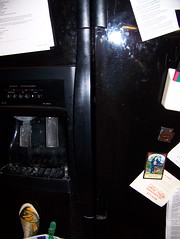
Originally uploaded by freerangelibrarian
I came home from the 9 a.m. service scheming to whip up a special surprise brunch for Sandy. The surprise was on me when a fridge handle snapped off in my hand. I’ve been much better about getting to aerobics classes at the YMCA… yet I still don’t think it was my fault.
Sir Elton John would like to shut down the Web for five years, he tells us. Yet within fifteen minutes I had identified that a door handle is not an uncommon point of failure for Kenmore Elite appliances; located a spare part and a parts diagram; and received solid advice about replacing the handle (since I am trying hard to avoid paying Sears to replace a handle on a six-year-old fridge). Ten more minutes, and I had recorded my gripe on a bulletin board, uploaded a picture to Flickr… and written this entry.
It’s really ok with me if Sir Elton stays offline for the next five years. Me? I’m all about teh Interwebs.
That’s the number of references to same-sex couples in the Census Bureau’s “Facts for Features” for Unmarried and Single Americans Week 2007 — or for 2006 or 2005, although this information was cited in the Facts for Features for 2004.
(The Facts for Features series is intended for media consumption, and “consist[s] of collections of statistics from the Census Bureau’s demographic and economic subject areas intended to commemorate anniversaries or observances or to provide background information for topics in the news.”)
It’s not terribly hard to find Census data sets that cite such same-sex information as gets reported (and of course, it’s surely underreported; I’m not convinced there are fewer gay people in Alabama and Utah, as the data suggest, but I guarantee you there are parts of the country where Sandy and I are Just Sisters when when passing through — not uncommon practice, either — and the residents may lie low, as well).
If you’d rather read a nicely-crunched assessment of this data, see this Census Bureau PowerPoint based on “American Community Survey Data,” which concludes:
Same-sex unmarried-partner households looked very similar to married-couple households except they had slightly more education and were less likely to have children in the household.
No wonder the gummint wants same-sex households edited out of the Official Story. It’s hard to get excited about the “defense of marriage” when the net impact of the Homosexual Agenda is to raise your property value.
Greetings to those of you following a link from Critical Mass, the blog of the National Book Critics’ Circle. I’m honored to have been able to share my thoughts with you about the future of literary journals.
For those FRL readers who haven’t read that post, I think you’ll find it’s not easily definable. In one breath I argue that we shouldn’t help kill off small print-based literary journals (you can find many of them listed at the wonderful site, newpages.com). But I also point out that we librarians can play a role in moving print journals online, and I make a pitch for open access.
I think exception-handling distinguishes librarianship as a profession (versus simply a trade); our ability to understand when one size does not fit all — and why that is, and whether or not that square peg should be “fixed” or left alone, or the hole shaved to make it fit — sets us apart as information professionals. We wield a lot more power than we realize, and I’d like to see us use that power wisely.